Saturn V
About the Saturn V
Saturn V
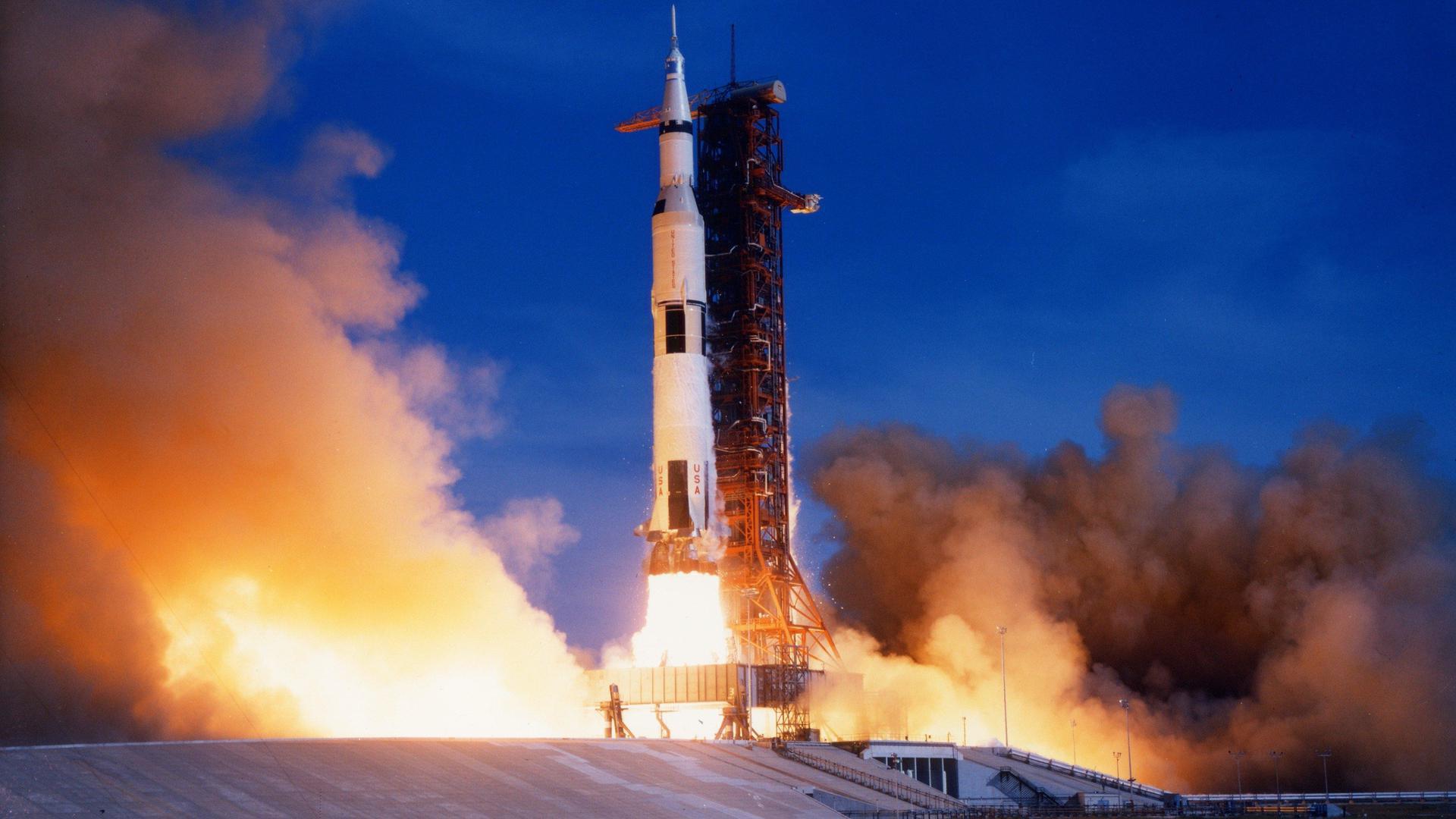
The Saturn V is an American super-heavy orbital launch vehicle developed and operated by the National Aeronautics and Space Administration (NASA). Designed and built in the 1960s under NASA's Apollo program with major contributions from Boeing, North American Aviation, and Douglas Aircraft, it remains one of the most powerful and consequential rockets ever flown. The vehicle launched exclusively from Kennedy Space Center in Florida, carrying crews and cargo to the Moon and later supporting the construction of America's first space station.
Design and Capability
Standing 110.6 meters tall with a diameter of 10.1 meters, the Saturn V is a towering three-stage rocket whose sheer scale set it apart from every other launch vehicle of its era. Its ability to deliver 140,000 kilograms to low Earth orbit placed it in a class of its own, enabling mission profiles that smaller vehicles could not attempt. The first stage burned refined kerosene and liquid oxygen, while the upper stages used liquid hydrogen and liquid oxygen, a high-performance propellant combination that maximized efficiency for translunar injection burns.
Flight History
Our flight record spans 13 missions between 1967 and 1973, of which 12 were fully successful and one was a partial failure. All flights were conducted on behalf of NASA, making it one of history's few launch vehicles operated entirely by a single government customer.
The vehicle's career began with uncrewed qualification flights before rapidly transitioning to crewed lunar missions. Among the most notable launches in our record are Apollo 14, Apollo 15, Apollo 16, and Apollo 17, the latter representing the final crewed lunar landing mission. Apollo 13, also in our record, is widely known for the in-flight emergency that forced the crew to abort the lunar landing and return safely to Earth using the spacecraft's lunar module as a lifeboat — a mission that underscores the partial-failure entry in the flight record.
The final Saturn V mission tracked in our data is Skylab 1, flown in 1973, which used a modified configuration to launch the Skylab orbital workshop into low Earth orbit. This mission demonstrated the vehicle's versatility beyond lunar operations and closed out its active service life.
Legacy
The Saturn V retired after 1973 without a direct successor capable of matching its payload class, leaving a capability gap that persisted for decades. Its unmatched lift performance, combined with a strong overall reliability record across 13 tracked flights, cemented its reputation as a landmark achievement in aerospace engineering. The rocket made possible six successful crewed lunar landings and the establishment of America's first long-duration space station, milestones that continue to define the boundaries of human spaceflight achievement.
Several Saturn V vehicles are preserved as museum artifacts at locations including Kennedy Space Center and the Johnson Space Center in Houston, where they serve as enduring physical testaments to the engineering ambitions of the Apollo era.
- May 14, 1973Saturn V | Skylab 1Success
- Dec 07, 1972Saturn V | Apollo 17Success
- Apr 16, 1972Saturn V | Apollo 16Success
- Jul 26, 1971Saturn V | Apollo 15Success
- Jan 31, 1971Saturn V | Apollo 14Success
- Apr 11, 1970Saturn V | Apollo 13Success
- Nov 14, 1969Saturn V | Apollo 12Success
- Jul 16, 1969Saturn V | Apollo 11Success
- May 18, 1969Saturn V | Apollo 10Success
- Mar 03, 1969Saturn V | Apollo 9Success
- Dec 21, 1968Saturn V | Apollo 8Success
- Apr 04, 1968Saturn V | Apollo 6Partial Failure
- Nov 09, 1967Saturn V | Apollo 4Success