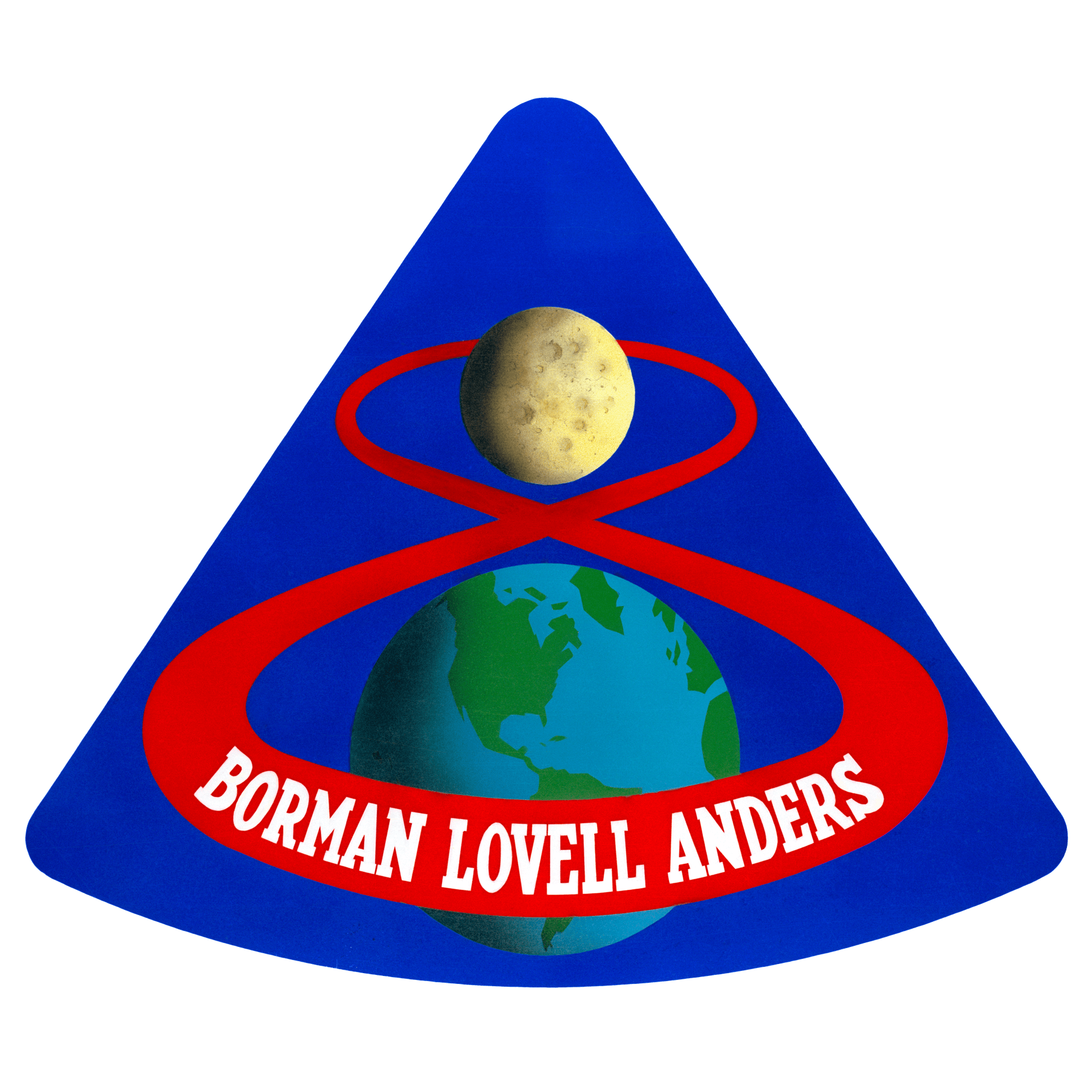
Saturn V | Apollo 8
First crewed flight to orbit the Moon; "Earthrise."
About this launch
Background
By the closing months of 1968, the United States space program was operating under enormous pressure. The decade was nearly spent, and President John F. Kennedy's challenge to land Americans on the Moon before it ended remained unfulfilled. NASA had suffered a devastating setback with the Apollo 1 fire in January 1967, which claimed the lives of three astronauts and grounded the crewed spaceflight program for nearly two years. When flights finally resumed, engineers and mission planners faced a compressed schedule with precious little margin for delay or failure. Against this backdrop, Apollo 8 took shape as a mission of remarkable boldness — one that would not merely test hardware in low Earth orbit, but push human beings all the way to the Moon itself.
The crew selected for the mission reflected the caliber of experience NASA was drawing upon at the height of the Space Race. Commander Frank Borman was a disciplined, mission-focused Air Force officer who had previously flown on Gemini 7. Command Module Pilot James Lovell, also a Gemini veteran, brought exceptional navigational skill and composure under pressure. Lunar Module Pilot William Anders, though on his first spaceflight, was a trained engineer whose observations and photography during the mission would produce some of the most enduring images in the history of exploration. Together, the three men formed a crew well suited to the unprecedented nature of what they were being asked to do.
The Saturn V rocket that would carry them was itself a marvel of engineering ambition. Standing taller than a thirty-story building and generating thrust that staggered the imagination, the Saturn V had been developed by NASA as the sole launch vehicle powerful enough to place the mass required for a lunar mission on a translunar trajectory. Apollo 8 marked the first time this rocket would carry human beings — an extraordinary vote of confidence in the vehicle's engineering, given the limited number of test flights that had preceded it.
The Launch
On Saturday, 21 December 1968, at 12:51:00 GMT, Saturn V lifted off from Launch Complex 39A on the eastern coast of the United States. The launch site, situated at what is now Kennedy Space Center in Florida, had been purpose-built for the giant rocket, its scale matched to the ambitions of the Apollo program. NASA, the mission operator, had prepared meticulously for this moment, and the launch proceeded without significant incident — a smooth, powerful ascent that sent the rocket climbing through Florida's winter sky and into orbit.
The initial phase of the mission placed Apollo 8 into low Earth orbit, where the crew and ground controllers took time to verify the spacecraft's systems before committing to the next and most consequential step. This practice of parking in low Earth orbit before a major propulsive maneuver was standard Apollo procedure, offering a final opportunity to confirm that everything was functioning as intended. When the checks were complete and the decision made to proceed, the rocket's upper stage ignited again and Apollo 8 left Earth orbit behind. Three human beings were on their way to the Moon for the first time in history.
The transit across the vast distance between Earth and Moon unfolded over the better part of three days. During this period, the crew conducted navigation checks, communicated regularly with mission controllers, and took in a view of their home planet that was utterly unlike anything seen before. As they traveled deeper into cislunar space, Earth shrank from a world filling their windows to a brilliant, fragile sphere suspended against absolute darkness — a sight that profoundly affected all three men.
The Mission
Apollo 8's arrival at the Moon and its successful insertion into lunar orbit represented a watershed moment in human history. The spacecraft became the first crewed vehicle to orbit another world, circling the Moon multiple times and giving Borman, Lovell, and Anders an intimate view of its ancient, cratered surface. They observed the far side of the Moon, which no human eye had ever seen directly, and they reported back on the terrain that future landing missions would need to navigate.
Among the most significant moments of the orbital phase came when the crew witnessed the Earth rising above the lunar horizon — a phenomenon that Anders captured in a photograph that would become one of the most recognized and consequential images ever made. The image showed Earth as a small, luminous orb of blue and white, delicate and isolated against the stark grey of the Moon and the infinite black of space. It communicated something that words had struggled to convey: the smallness and singularity of the planet, the improbability and preciousness of life upon it. That photograph — known simply as "Earthrise" — went on to influence environmental consciousness and the way humanity understood its relationship to the planet.
The crew also conducted a live television broadcast from lunar orbit on Christmas Eve, speaking to an audience of hundreds of millions of people around the world. Rather than fabricate the specific words exchanged, it is enough to note that the broadcast was judged by many observers to be one of the most watched and emotionally resonant television events of the era, arriving at a moment when much of the world was in need of something transcendent.
After completing their orbits of the Moon, the crew performed the engine burn required to break free of lunar gravity and begin the journey home. The return transit and the subsequent reentry into Earth's atmosphere proceeded successfully, and Apollo 8 splashed down safely, its mission accomplished in full.
Legacy
The success of Apollo 8 reshaped what was thought possible in human spaceflight. By demonstrating that astronauts could travel to the Moon, enter orbit, and return safely, the mission cleared away fundamental uncertainties that had surrounded the entire lunar program. Engineers and mission planners now had confirmation that the navigation techniques, communication systems, life support, and re-entry procedures developed for lunar distance could work in practice, not just in theory. The path to a landing was more clearly visible than it had ever been.
The mission also changed the cultural meaning of space exploration in ways that extended far beyond the competition between superpowers. "Earthrise" became a symbol invoked across disciplines — by scientists, philosophers, artists, and activists — as a representation of Earth's vulnerability and the shared responsibility of its inhabitants. The image is widely credited with helping to catalyze the modern environmental movement, appearing as it did at the very moment that awareness of ecological fragility was beginning to crystallize into organized action.
For NASA and the National Aeronautics and Space Administration as an institution, Apollo 8 represented a demonstration of organizational courage and engineering confidence. The decision to send the first crewed Saturn V directly to lunar orbit, rather than conduct more cautious intermediate missions, was a calculated risk that paid off. It bought time, restored momentum, and ultimately made possible the landing missions that followed.
Apollo 8 remains, decades later, one of the defining human achievements of the twentieth century — a mission that was simultaneously a feat of engineering, an act of exploration, and an unexpected gift of perspective to the entire world.