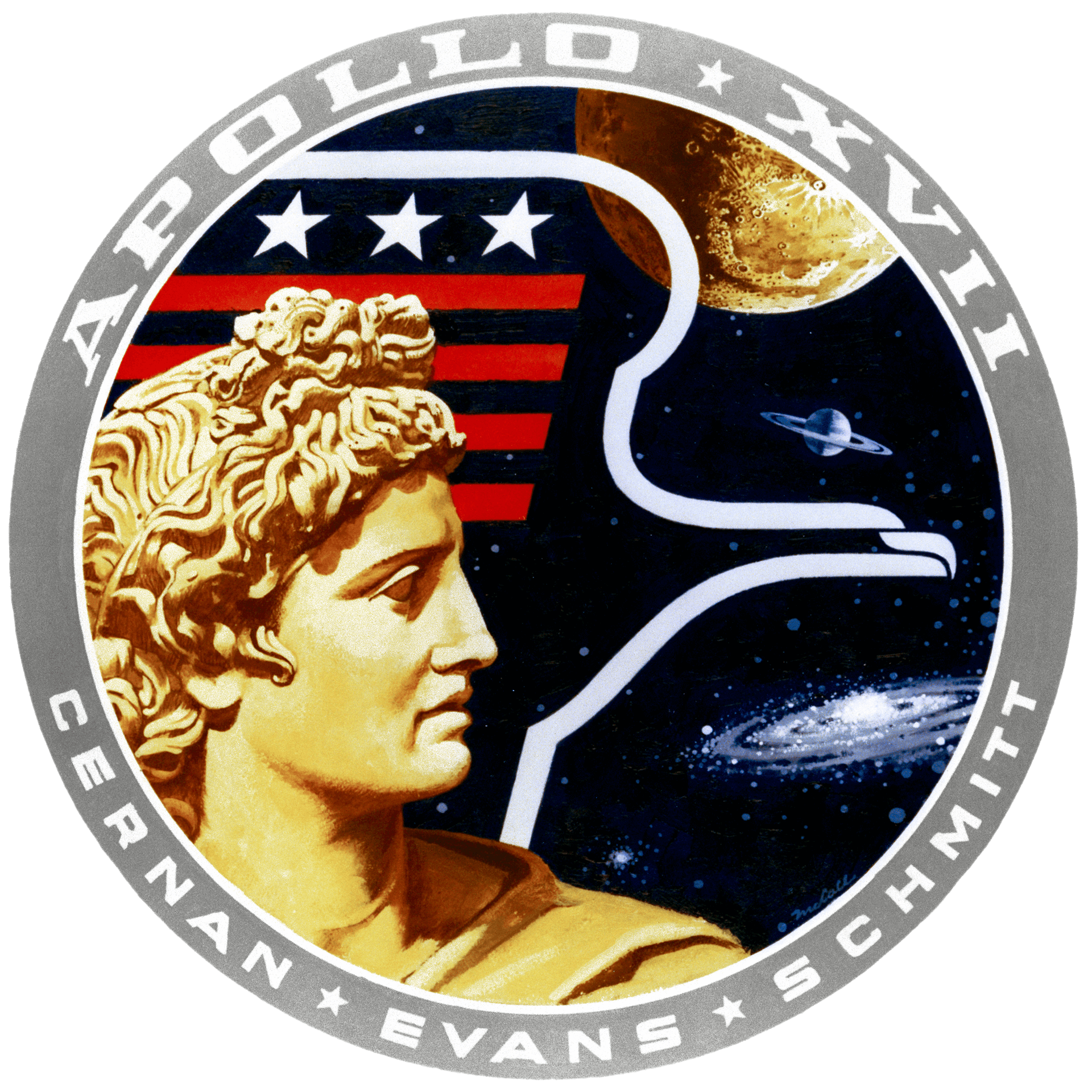
Saturn V | Apollo 17
The last crewed mission to the Moon, December 1972.
About this launch
Background
By the closing months of 1972, the Space Race that had defined a generation of American ambition was drawing toward its conclusion. The Apollo program, conceived in the aftermath of President Kennedy's challenge to land a human being on the Moon before the end of the 1960s, had already achieved that goal with Apollo 11 and had endured the near-catastrophe of Apollo 13. With budgetary pressures mounting and public attention drifting toward other concerns, NASA faced the reality that its era of crewed lunar exploration was coming to an end. Apollo 17 would be the capstone—the final opportunity to conduct science on the lunar surface and to place human footprints in a region of the Moon not yet visited.
The crew selected for this closing chapter were among the most capable assembled for any lunar mission. Commander Eugene Cernan was a veteran astronaut making his third spaceflight, having previously flown on Gemini 9A and served as Lunar Module Pilot on Apollo 10, during which he had descended to within miles of the lunar surface without landing. Command Module Pilot Ronald Evans, though on his first spaceflight, was a highly trained naval aviator who would hold a vigil in lunar orbit while his crewmates descended to the surface. Most notably, Lunar Module Pilot Harrison Schmitt was a professional geologist—the first and, as history would have it, only research scientist to walk on the Moon. His inclusion on the crew reflected NASA's evolving understanding that the later Apollo missions should extract maximum scientific value from what little time remained in the program.
The chosen landing site was the Taurus-Littrow valley, a geologically promising location on the southeastern rim of Mare Serenitatis. Scientists believed the area might yield both ancient highland material and evidence of more recent volcanic activity, offering a broad window into the Moon's geological history. It was an ambitious target, and reaching it required a trajectory that necessitated a nighttime launch—a first for the Apollo program.
The Launch
At 05:33:00 GMT on Thursday, 7 December 1972, the Saturn V rocket carrying Apollo 17 ignited at Launch Complex 39A in Florida, United States of America, and lifted away from the Earth. The Saturn V, the most powerful rocket NASA had ever flown operationally, had by this point established itself as a supremely reliable vehicle. Its performance on this final crewed lunar mission was no exception.
Because the launch window required a nighttime departure, the ascent of Apollo 17 illuminated the Florida coastline with a brilliance that observers described as transforming night momentarily into day. It was a spectacular send-off for the program's concluding flight, the immense columns of flame from the Saturn V's five F-1 engines reflecting off the water and drawing hundreds of thousands of spectators who had gathered, many of them aware they were witnessing something that might not be seen again in their lifetimes.
The Saturn V performed its role with characteristic precision, lifting the Apollo spacecraft out of the atmosphere and setting the crew on a trajectory toward the Moon. The operator of the mission was the National Aeronautics and Space Administration, and the destination was lunar orbit—the gateway to the surface that Cernan and Schmitt would soon walk upon.
The Mission
Apollo 17 lasted 12 days, 13 hours, 51 minutes, and 59 seconds in total—a mission of considerable duration that reflected both the complexity of the undertaking and NASA's determination to extract every possible scientific return from this final lunar voyage. After the transit from Earth to Moon and the separation of the spacecraft components, Cernan and Schmitt descended to the lunar surface in the Lunar Module while Evans remained in orbit aboard the Command Module, conducting his own program of observations and experiments from above.
On the surface, Cernan and Schmitt spent three days conducting scientific work in the Taurus-Littrow valley. They completed three separate moonwalks during that period, ranging across the valley floor and its surrounding terrain to collect lunar samples and to install a suite of scientific instruments that would continue transmitting data back to Earth long after the crew had departed. The geological diversity of the site rewarded their efforts: Schmitt's trained eye proved invaluable in characterizing rock types and selecting samples of the highest scientific value. Among the most celebrated discoveries of the surface stay was the identification of orange soil—tiny glass beads of volcanic origin that provided important clues about the Moon's thermal history.
Throughout the surface operations, Cernan and Schmitt communicated with mission controllers and conducted their traverses with a methodical thoroughness befitting what everyone understood to be the last human expedition to the lunar surface for the foreseeable future. When the time came to leave, Cernan was the last to climb the ladder of the Lunar Module, making him, by circumstance of mission design, the most recent human being to stand on the Moon. He and Schmitt then lifted off to rendezvous with Evans in orbit, and the three astronauts began the long journey home.
Apollo 17 was confirmed as a success. Every major objective of the mission was accomplished, and the crew returned safely to Earth along with a substantial collection of lunar samples and a wealth of scientific data gathered both from the surface and from Evans's orbital observations.
Legacy
The significance of Apollo 17 extends well beyond its considerable scientific achievements. It represents a boundary in human history: the last time, as of this writing, that any human being has traveled beyond low Earth orbit. The mission closed not just a program but an era—one defined by the belief that the distance between the Earth and the Moon could be bridged by human courage, engineering ingenuity, and sustained national commitment.
The scientific returns from Apollo 17 have proved enduring. The lunar samples collected by Cernan and Schmitt continue to be studied by researchers decades after the mission, yielding new insights as analytical technologies improve. The instruments left on the surface contributed to a body of geophysical data that reshaped understanding of the Moon's interior and its volcanic past.
For NASA, the conclusion of the Apollo program marked a pivot toward new priorities—space stations, the Space Shuttle, and eventually robotic exploration of the broader solar system. Yet Apollo 17 retained a particular symbolic weight that subsequent programs have rarely matched. The image of a geologist kneeling in the lunar dust to examine an ancient rock, or of a commander pausing at the foot of a ladder knowing he was about to leave the Moon for the last time, captured something that transcends the technical accomplishments of the flight.
The Saturn V rocket that powered this final lunar mission had performed flawlessly across the program it helped define. Its role in launching Apollo 17 from Launch Complex 39A on 7 December 1972 was the last time the vehicle would carry human beings, and it remains the most powerful rocket to have ever completed operational crewed flights. The mission it dispatched stands today as both a summit and a threshold—the farthest shore humanity reached in the twentieth century, and the marker against which all future ambitions for human deep-space exploration are measured.