Falcon Heavy
About the Falcon Heavy
Falcon Heavy
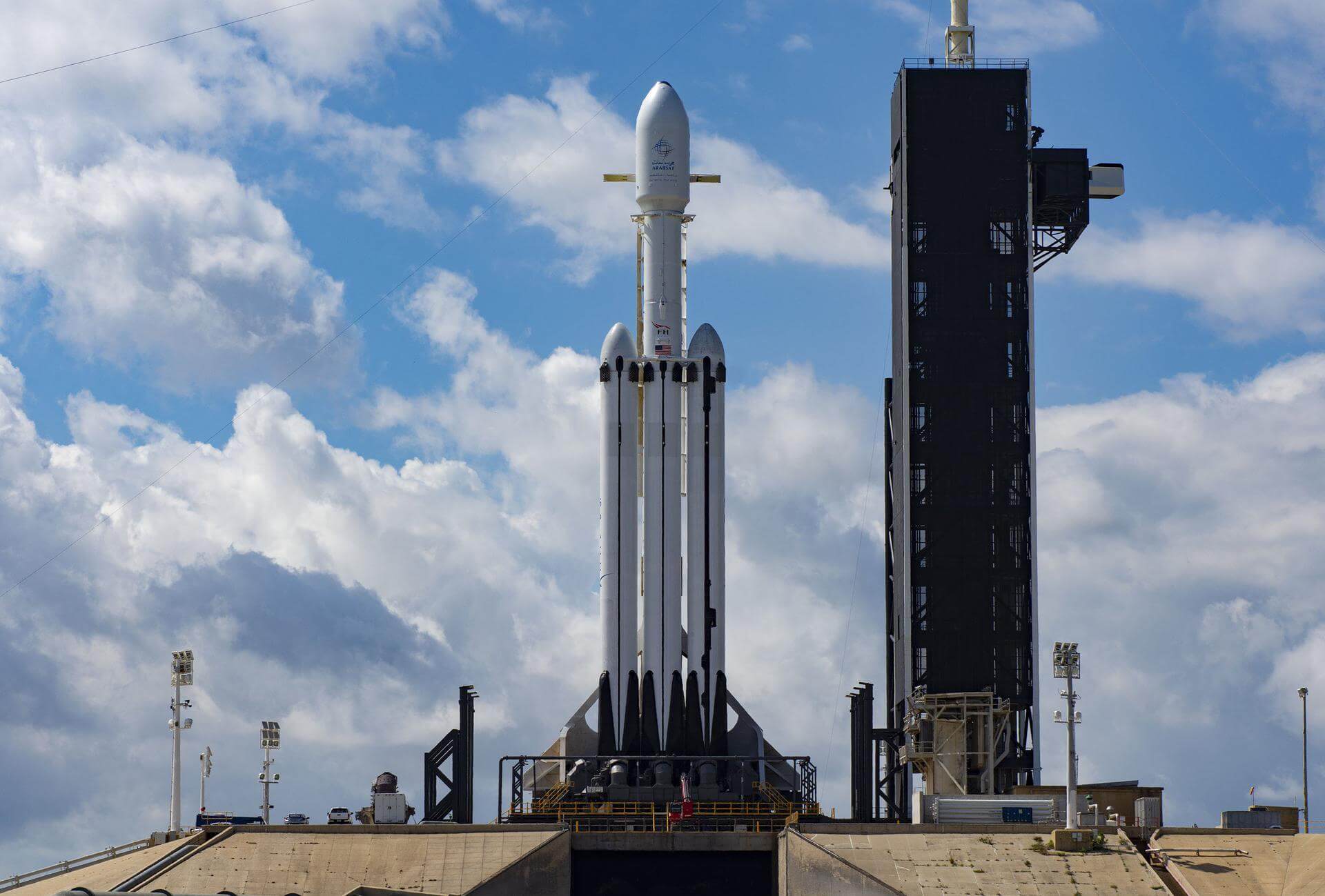
The Falcon Heavy is a heavy-lift orbital launch vehicle designed and operated by SpaceX, the American aerospace company founded by Elon Musk. Built around a core of three Falcon 9 first-stage boosters strapped together, it is the most powerful operational rocket in the world and represents a significant milestone in the commercial spaceflight era. It launches primarily from Launch Complex 39A at NASA's Kennedy Space Center in Florida.
Design and Capability
The Falcon Heavy stands 70 meters tall with a span of 12.2 meters across its three side-by-side booster cores. It is capable of delivering 63,800 kg to low Earth orbit and 26,700 kg to geostationary transfer orbit, making it competitive with — and in many cases exceeding — the largest government-developed rockets of previous generations. A defining feature of the vehicle is its reusability: all three booster cores are designed to return to Earth and land propulsively, dramatically reducing the cost of access to heavy-lift orbits. The two side boosters routinely perform simultaneous landings at Cape Canaveral, a spectacle that has become one of the most recognizable images in modern spaceflight.
History and Service Record
The Falcon Heavy made its debut in 2018 with a now-famous demonstration mission that sent Elon Musk's personal Tesla Roadster into a heliocentric orbit. Since then it has become an indispensable workhorse for demanding national security and science missions. Our flight record covers 26 tracked flights spanning 2018 through 2029, all concluded successfully — a remarkable reliability record for a vehicle in its class.
Customers and Missions
The top customer in our dataset is SpaceX itself, reflecting missions where the company operated both the launch vehicle and the payload. Beyond internal missions, the Falcon Heavy has carried an increasingly prominent manifest of U.S. government payloads, with recent missions including NROL-97 for the National Reconnaissance Office and USSF-186 and USSF-174 for the United States Space Force — underscoring the vehicle's central role in American national security space launch. The manifest has also grown to include high-profile science and exploration payloads: the ExoMars 2028 Rosalind Franklin rover mission, a collaboration with the European Space Agency, and NASA's Dragonfly rotorcraft lander destined for Saturn's moon Titan, both represent some of the most ambitious planetary science missions of the 2020s. Astrobotic-3 further reflects growing demand from the commercial lunar sector.
Significance
The Falcon Heavy occupies a unique position in the current launch market. It bridges the gap between medium-heavy lift vehicles and the super-heavy class represented by SpaceX's own Starship, offering proven reliability and reusability for payloads too large or too demanding for a single Falcon 9. Its combination of high payload capacity, demonstrated flight heritage, and reusable architecture has made it the preferred vehicle for missions where performance and reliability cannot be compromised. The breadth of its mission manifest — spanning commercial satellites, classified government spacecraft, and deep-space science — reflects how thoroughly it has become embedded in the infrastructure of 21st-century space access.
- Dec 31, 2029Falcon Heavy | USSF-186TBD
- Dec 31, 2029Falcon Heavy | USSF-174TBD
- Oct 31, 2028Falcon Heavy | ExoMars 2028 Rosalind Franklin roverTBD
- Jul 05, 2028Falcon Heavy | DragonflyTBD
- Dec 31, 2027Falcon Heavy | Gateway PPE & HALOTBD
- Dec 31, 2027Falcon Heavy | Astrobotic-3TBD
- Jun 30, 2027Falcon Heavy | USSF-155TBD
- Jun 30, 2027Falcon Heavy | WGS-12 (USSF-206)TBD
- Jun 30, 2027Falcon Heavy | USSF-63TBD
- Jun 30, 2027Falcon Heavy | NROL-86TBD
- Dec 31, 2026Falcon Heavy | Griffin Mission OneTBD
- Dec 31, 2026Falcon Heavy | USSF-75TBD
- Oct 02, 2026Falcon Heavy | NROL-97Success
- Aug 30, 2026Falcon Heavy | Nancy Grace Roman Space TelescopeSuccess
- Apr 29, 2026Falcon Heavy | ViaSat-3 F3 (ViaSat-3 Asia-Pacific)Success
- Oct 14, 2024Falcon Heavy | Europa ClipperSuccess
- Jun 25, 2024Falcon Heavy | GOES-USuccess
- Dec 29, 2023Falcon Heavy | OTV-7 (X-37B) (USSF-52)Success
- Oct 13, 2023Falcon Heavy | PsycheSuccess
- Jul 29, 2023Falcon Heavy | EchoStar 24/Jupiter-3Success
- May 01, 2023Falcon Heavy | ViaSat-3 F1 (ViaSat-3 Americas) & othersSuccess
- Jan 15, 2023Falcon Heavy | USSF-67Success
- Nov 01, 2022Falcon Heavy | USSF-44Success
- Jun 25, 2019Falcon Heavy | STP-2Success
- Apr 11, 2019Falcon Heavy | Arabsat-6ASuccess
- Feb 06, 2018Falcon Heavy | Demo (Test Flight)Success