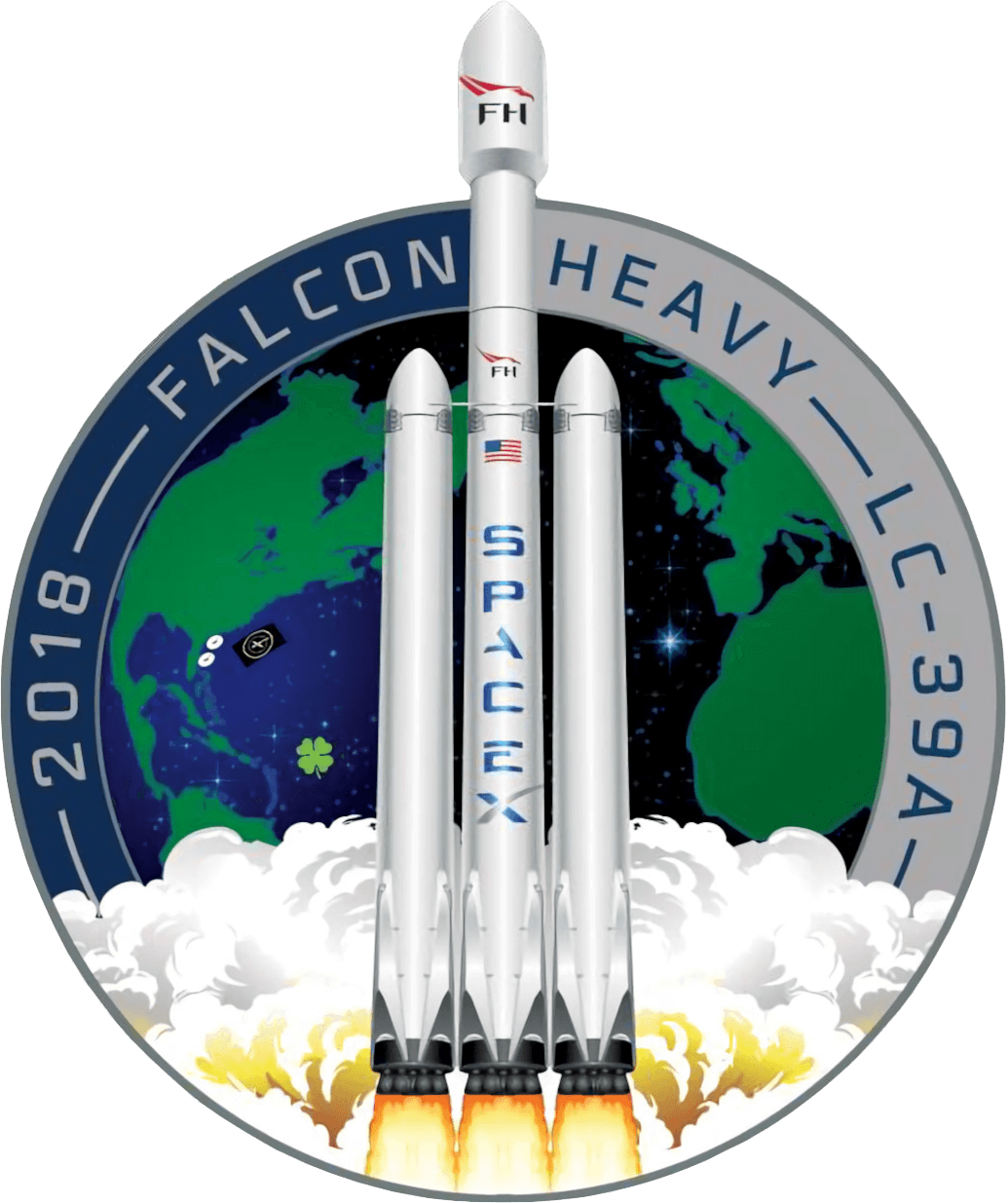
Falcon Heavy | Demo (Test Flight)
Maiden Falcon Heavy flight — the Tesla Roadster.
About this launch
Background
By the mid-2010s, SpaceX had established itself as a disruptive force in the launch industry, reshaping expectations around cost, reusability, and cadence with its Falcon 9 rocket. Yet the company had long harboured ambitions that stretched well beyond medium-lift orbital delivery. The Falcon Heavy represented the fullest expression of those ambitions in a single vehicle — a rocket designed to place massive payloads into orbit, send cargo toward the Moon or Mars, and do so with the same philosophy of reuse that had already transformed how the world thought about expendable boosters.
Development of the Falcon Heavy was neither quick nor straightforward. First announced in the early 2010s, the programme experienced repeated delays as engineers confronted one of the most demanding engineering challenges in the vehicle's design: making three Falcon 9 cores work together as a single coherent system. The aerodynamic and structural interactions between the cores, particularly during max-q, required extensive analysis and redesign. SpaceX chief executive Elon Musk was candid in the years leading up to the launch about how difficult the project had proven, acknowledging that the complexity of the vehicle had surprised even his own team. By early 2018, however, the rocket was at last ready to fly.
To maximise the symbolic weight of the occasion while minimising the risk to any paying customer's property — given that a maiden flight carries inherent uncertainty — SpaceX chose an unconventional test payload. Rather than a mass simulator or a block of concrete, Musk offered up his own midnight cherry Tesla Roadster, complete with a spacesuit-clad mannequin dubbed "Starman" in the driver's seat. The vehicle's sound system was loaded with David Bowie's "Space Oddity," a choice that seemed almost too fitting: a sports car named for the stars, drifting through the void to the accompaniment of an astronaut lost in space. It was a piece of theatre, certainly, but it also served a genuine engineering purpose — demonstrating that the Falcon Heavy could deliver a real, if whimsical, object to a demanding destination.
The Launch
On Tuesday, 6 February 2018, at 20:45 GMT, the Falcon Heavy lifted off from Launch Complex 39A at Kennedy Space Center in Florida — the same historic pad from which Apollo 11 had departed for the Moon nearly five decades earlier. The choice of 39A was itself laden with meaning, a deliberate signal from SpaceX that it was operating in a tradition of audacious American spaceflight.
Ignition of the Falcon Heavy's twenty-seven Merlin engines produced a spectacle that reverberated across the Florida coastline. The combined thrust at liftoff made it the most powerful operational rocket in the world at the time of its debut, a distinction that underscored just how large a gap existed between Falcon Heavy and the next most capable vehicles then flying. Crowds who had gathered along the Banana River and on rooftops and beaches across Brevard County watched as the rocket climbed through a clear late-afternoon sky, the exhaust plume catching the low winter sun.
The early phases of the flight proceeded with striking smoothness. The two side boosters separated cleanly and, in one of the most visually arresting sequences in recent spaceflight history, descended in near-perfect synchrony back toward Landing Zones 1 and 2 at Cape Canaveral Air Force Station, their engines reigniting for landing burns and touching down simultaneously just minutes after liftoff. The image of two boosters landing side by side, plumes settling as the sonic booms rolled across the cape, became one of the defining photographs of the era. The centre core, tasked with a more demanding downrange drone ship landing, was lost — its attempt to return to the autonomous spaceport drone ship did not succeed — but in the context of a test flight, this was an entirely acceptable outcome. Two out of three cores recovered on a vehicle's maiden voyage was, by any reasonable measure, an extraordinary result.
The upper stage, carrying the Roadster and Starman, continued on its trajectory and ultimately performed its burns to send the payload on a path away from Earth entirely.
The Mission
SpaceX designated the intended destination as a heliocentric orbit — an elliptical path around the Sun rather than around any planet. The target was an orbit with an apoapsis, the farthest point from the Sun, reaching out to approximately the orbital distance of Mars. This made the Falcon Heavy demo flight something genuinely unusual in the history of uncrewed spaceflight: a privately owned automobile on a solar orbit, placed there not for any scientific purpose but as an emblem of what a private launch company was now capable of delivering to interplanetary space.
With "Space Oddity" playing on loop — at least until the batteries expired in the vacuum — and Starman seated behind the wheel of the cherry-red roadster, the payload became an instant cultural landmark. Cameras mounted on the vehicle returned footage of the car drifting silently against the curved limb of the Earth and then against the pure black of deep space, images that circulated globally within hours and acquired a kind of permanence in public memory. The mannequin's gloved hand rested casually on the door frame; a copy of Douglas Adams' *The Hitchhiker's Guide to the Galaxy* was reportedly stowed in the glovebox, along with a small plaque bearing the message "Don't Panic" — details that reinforced the sense that the entire enterprise was a love letter to science fiction as much as an engineering demonstration.
The mission was declared a success. The Falcon Heavy had performed its primary objective: reaching the intended orbit class, validating the vehicle's integrated systems, and demonstrating the booster recovery architecture at scale.
Legacy
The first Falcon Heavy flight was significant on several levels simultaneously, and its legacy has only grown more legible with the passage of time. Most immediately, it validated a new class of heavy-lift capability in the commercial sector, demonstrating that a privately developed rocket could compete on raw performance with vehicles that had historically required national programmes and government budgets to produce.
The successful synchronised landing of the two side boosters changed the visual vocabulary of the space age. Reusability had already been demonstrated by SpaceX with the Falcon 9, but the Falcon Heavy landing sequence — with its almost choreographic symmetry — made the case more viscerally than any single booster recovery had managed. It accelerated a shift in public and industry expectations: rocket stages coming back to land began to seem normal rather than remarkable.
For SpaceX itself, the flight unlocked a new tier of commercial and government missions. The Falcon Heavy subsequently became a vehicle of serious strategic interest for heavy national security payloads and deep space missions, filling a capability gap that had existed in the American launch manifest since the retirement of earlier heavy-lift platforms.
The Roadster, for its part, continued on its heliocentric journey long after the cameras went dark. Tracking by amateur and professional astronomers confirmed it had achieved an orbit broadly consistent with the intended parameters, crossing Mars' orbital distance and settling into a long elliptical path that will carry it around the Sun for the foreseeable future. As an artefact, it occupies a singular category: the first privately owned passenger vehicle in interplanetary space, launched on 6 February 2018, from one of history's most storied launch pads, on a rocket that redefined what commercial spaceflight could accomplish.