Atlas LV-3B
About the Atlas LV-3B
Atlas LV-3B
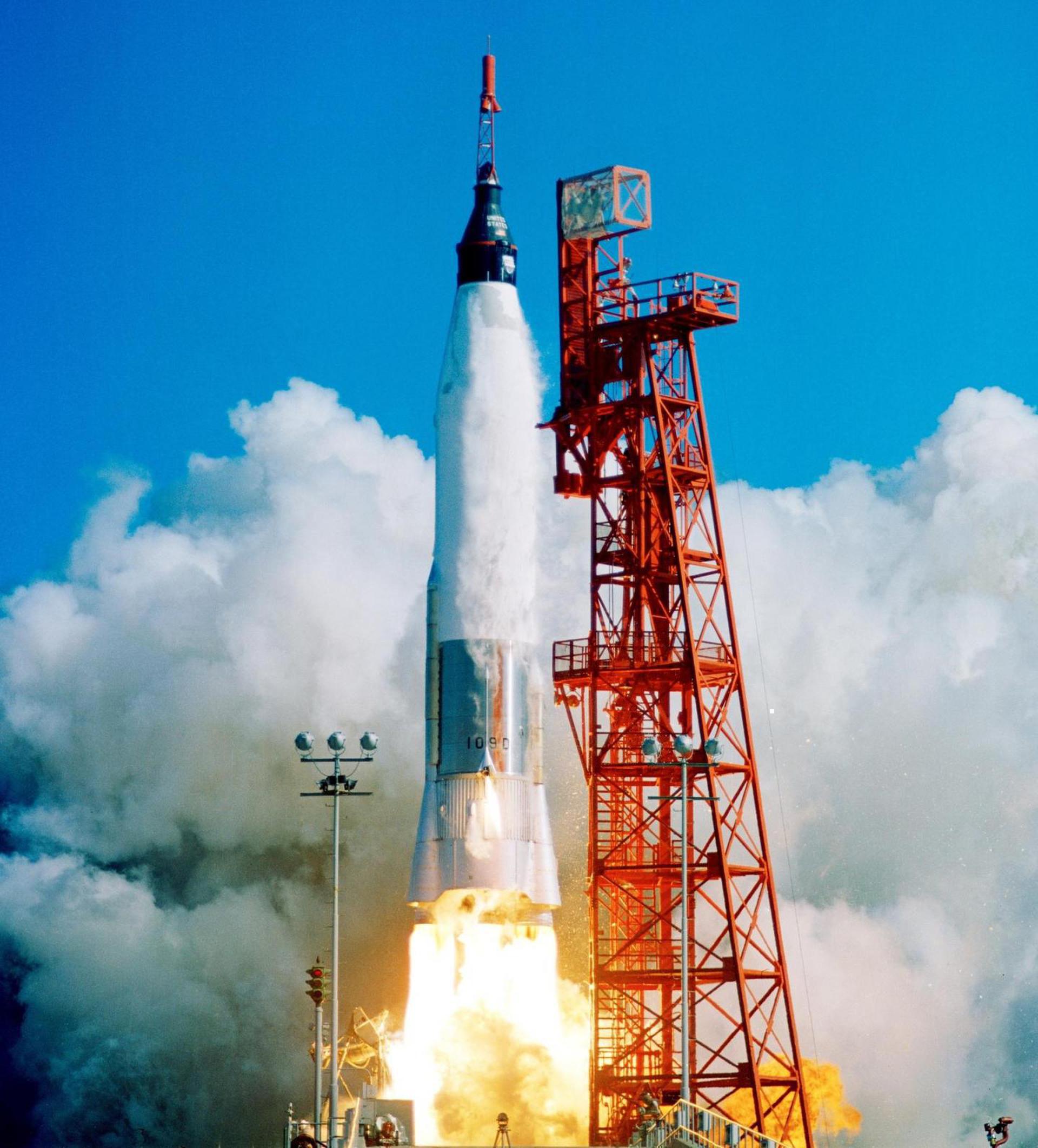
The Atlas LV-3B was an American orbital launch vehicle developed by Convair and operated primarily by the National Aeronautics and Space Administration (NASA). A member of the storied Atlas rocket family, it served as the dedicated launch vehicle for NASA's Project Mercury, the United States' first human spaceflight program. Active from 1959 to 1963, the Atlas LV-3B occupies a defining place in the history of crewed spaceflight.
Design and Configuration
Standing 28.7 meters tall with a diameter of 3 meters, the Atlas LV-3B was derived from the Atlas intercontinental ballistic missile, adapted and man-rated for crewed orbital missions. Like other Atlas vehicles of its era, it employed a distinctive "stage-and-a-half" propulsion architecture, in which the booster engines were jettisoned during ascent while the sustainer engine continued burning using the same propellant tanks. This approach kept the vehicle's structure exceptionally light. The LV-3B variant was specifically modified with additional safety systems and reliability upgrades required to carry astronauts, and was capable of delivering approximately 1,360 kg to low Earth orbit.
Operational History
Our flight record documents 10 flights of the Atlas LV-3B between 1959 and 1963, of which 7 were successful and 3 resulted in failure or partial failure. This success rate reflects the genuine engineering challenges of the era, as the Atlas family itself had evolved rapidly from a military missile program into a reliable space launch system. Early uncrewed test flights helped qualify the vehicle and the Mercury spacecraft before astronauts were placed aboard.
The most prominent missions in the record are the Mercury-Atlas flights, which represent milestones in American spaceflight history. Mercury-Atlas 6, launched in February 1962, carried John Glenn on the first American orbital spaceflight. Subsequent missions — Mercury-Atlas 7, Mercury-Atlas 8, and Mercury-Atlas 9 — extended American presence in orbit, with Mercury-Atlas 9 representing the final and longest Mercury mission, carrying Gordon Cooper on a 22-orbit flight in May 1963. Earlier uncrewed and chimpanzee-carrying missions, including Mercury-Atlas 4 and Mercury-Atlas 5, were essential in validating the system ahead of crewed flights.
Legacy
The Atlas LV-3B's role in Project Mercury established the United States as a serious competitor in the Space Race and demonstrated that American rockets could safely carry humans into orbit. NASA was far and away the vehicle's top customer, with virtually all tracked flights supporting the agency's crewed and developmental spaceflight objectives.
Although the Atlas LV-3B's operational window was brief — spanning just four years — its contributions were outsized relative to its flight count. The missions it supported not only proved human orbital spaceflight feasible but also generated critical experience in mission operations, crew recovery, and spacecraft design that directly informed the Gemini and Apollo programs that followed. The Atlas rocket family itself continued to evolve for decades, but the LV-3B variant remains among its most historically significant configurations.
- May 15, 1963Atlas LV-3B | Mercury-Atlas 9Success
- Oct 03, 1962Atlas LV-3B | Mercury-Atlas 8Success
- May 24, 1962Atlas LV-3B | Mercury-Atlas 7Success
- Feb 20, 1962Atlas LV-3B | Mercury-Atlas 6Success
- Nov 29, 1961Atlas LV-3B | Mercury-Atlas 5Success
- Sep 13, 1961Atlas LV-3B | Mercury-Atlas 4Success
- Apr 25, 1961Atlas LV-3B | Mercury-Atlas 3Failure
- Feb 21, 1961Atlas LV-3B | Mercury-Atlas 2Success
- Jul 29, 1960Atlas LV-3B | Mercury-Atlas 1Failure
- Sep 09, 1959Atlas LV-3B | Big Joe 1Partial Failure