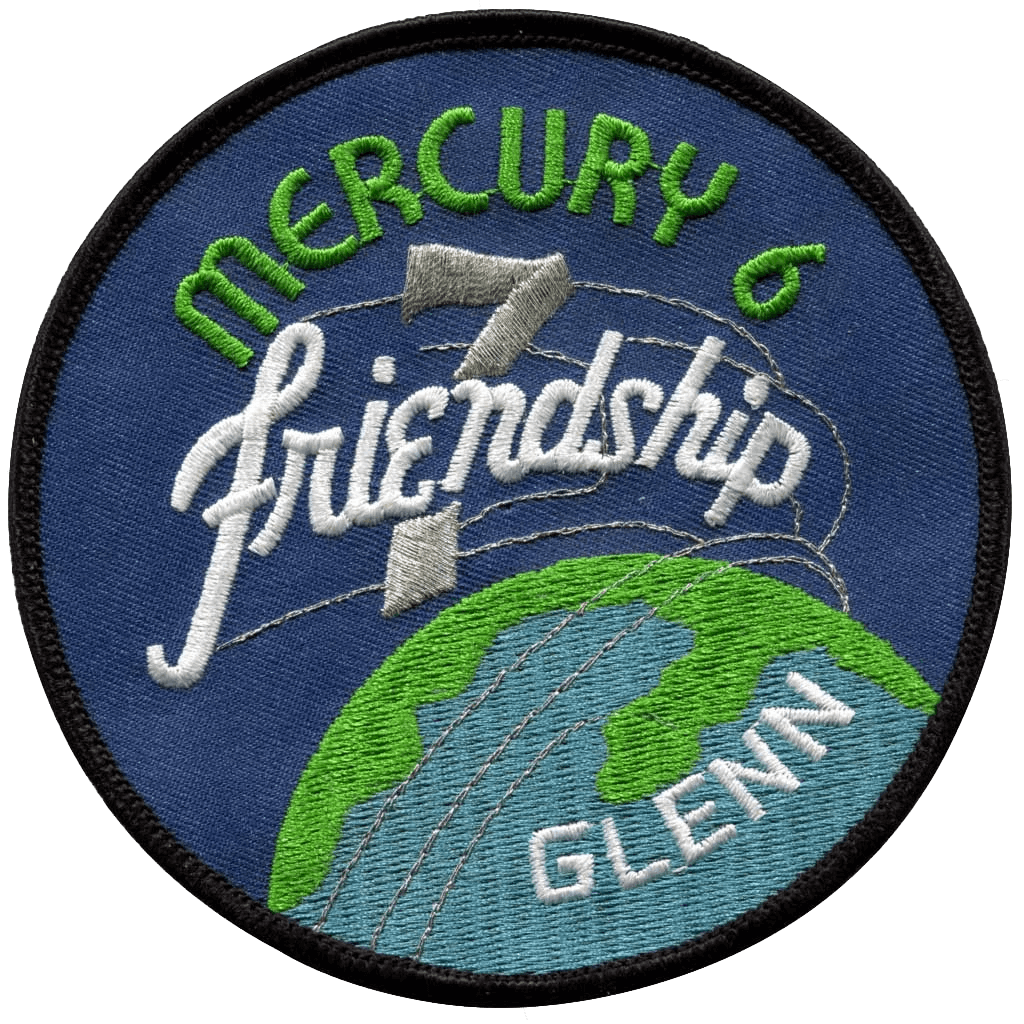
Atlas LV-3B | Mercury-Atlas 6
John Glenn — first American to orbit Earth (Friendship 7 / Mercury-Atlas 6).
About this launch
Background
By the early 1960s, the Space Race between the United States and the Soviet Union had become one of the defining contests of the Cold War era. The Soviet Union had already demonstrated a series of stunning firsts — launching the first artificial satellite, sending the first human into space, and achieving the first orbital spaceflight — and American prestige was under sustained pressure. NASA's Mercury program had been designed as the United States' immediate answer to that challenge: a single-astronaut capsule program intended first to reach space and then, critically, to achieve orbital flight.
The two preceding crewed Mercury missions had been suborbital flights, brief arcing journeys that demonstrated the ability to place a human being into space and return him safely, but they did not involve sustained flight around the Earth. Orbital flight represented a fundamentally different and more demanding undertaking. It required a more powerful launch vehicle capable of achieving the velocity necessary to sustain an orbit, a more complex mission profile, and a spacecraft and crew capable of enduring conditions across multiple circuits of the globe. For that purpose, NASA paired the Mercury capsule with the Atlas rocket, an intercontinental ballistic missile adapted for crewed spaceflight, in a configuration designated the Atlas LV-3B. The mission designated Mercury-Atlas 6 would be the first attempt to carry an American astronaut into orbit.
Selected to fly that mission was Marine Corps Lieutenant Colonel John H. Glenn Jr., one of the original seven Mercury astronauts and among the most experienced test pilots in the program. Glenn had served as a fighter pilot and had set a transcontinental speed record before joining the astronaut corps, and he brought a reputation for composure and technical precision to one of the most scrutinized missions in American history. The spacecraft Glenn would ride was named Friendship 7 — a name that reflected the era's hope that space exploration might transcend geopolitical rivalry, even as the mission itself was deeply bound up in the competition between superpowers.
The Launch
On Tuesday, 20 February 1962, at 14:47:39 GMT, an Atlas LV-3B rocket lifted off from Space Launch Complex 14 on the coast of Florida in the United States. The launch came after a series of delays on prior attempts had stretched the wait across weeks, building anticipation in the public and the press to an extraordinary degree. When the rocket finally rose from the pad, it did so under the eyes of a nation that had invested enormous symbolic weight in the outcome.
Space Launch Complex 14 had been developed specifically to support the Mercury-Atlas program, and it would become one of the most historically resonant launch sites of the American space program. The Atlas LV-3B, while derived from a weapons system, had been extensively modified and tested to meet the demands of carrying a human crew. The combination of rocket and spacecraft had itself experienced a difficult development path, with early unmanned tests producing both successes and failures. By the time Glenn strapped into Friendship 7, however, NASA engineers had accumulated enough confidence in the vehicle to commit to a crewed orbital attempt.
The ascent proceeded successfully, and Friendship 7 was placed into low Earth orbit — precisely the intended destination. For the United States, the achievement of orbit marked a pivotal moment, completing the basic threshold that the Soviet Union had crossed months earlier and positioning NASA for the more ambitious missions that would follow.
The Mission
Mercury-Atlas 6 was the third crewed spaceflight conducted by the United States, following the two earlier suborbital Mercury missions. With Friendship 7 now in orbit, John Glenn became the first American astronaut to orbit the Earth — a milestone with immediate historical and strategic significance.
The mission completed three orbits of the Earth. Over the course of those circuits, Glenn performed observations, conducted basic scientific tasks, and reported on his experience of the orbital environment. The total duration of the flight was 4 hours, 55 minutes, and 23 seconds from launch to recovery — a relatively compact mission by later standards, but one that demonstrated the essential viability of American orbital human spaceflight.
The mission was not without tension. During the flight, telemetry data received on the ground suggested a potential problem with the heat shield securing the base of the capsule — the critical barrier that protected the spacecraft and its occupant during the intense heating of atmospheric reentry. Mission controllers faced a difficult decision about how to manage the reentry procedure in light of that uncertainty, opting to retain the retrorocket package attached to the heat shield rather than jettisoning it as planned, in hopes that it would help keep the heat shield in place if it had indeed come loose. Glenn was informed of the concern and conducted his reentry accordingly. The heat shield ultimately proved to be intact — the earlier telemetry reading was later attributed to a faulty sensor — but the episode illustrated both the genuine hazards of early spaceflight and the capacity of astronaut and ground team to manage unexpected contingencies under pressure.
Friendship 7 reentered the atmosphere and came down over the Atlantic Ocean, where Glenn and the capsule were recovered by the United States Navy. The mission was declared a success.
Legacy
The significance of Mercury-Atlas 6 extended far beyond the technical accomplishment of placing one person into orbit for just under five hours. John Glenn's flight transformed the public perception of American spaceflight capability and provided a powerful counterpoint to the sense of Soviet dominance that had characterized much of the Space Race up to that point. The United States had now demonstrated that it could send an astronaut into orbit and return him safely, and it had done so with a level of public transparency — live broadcasts, press coverage, direct communication with the astronaut in flight — that contrasted sharply with the secrecy surrounding Soviet missions.
Glenn himself became one of the most celebrated figures in American public life. His return was marked by national celebrations and a joint address to Congress — a reception that reflected how thoroughly his mission had captured the imagination of a country watching history unfold. He would later return to space decades afterward aboard the Space Shuttle, becoming at that time the oldest person to fly in space, but it is the Friendship 7 mission for which he is most enduringly remembered.
The Atlas LV-3B and Space Launch Complex 14 continued to support the Mercury program through its remaining crewed missions, and the complex has since been preserved as a historic site. The Mercury-Atlas program as a whole served as a foundational chapter in the story of American human spaceflight — demonstrating the capabilities, confronting the risks, and building the operational experience that would underpin the Gemini and Apollo programs to follow.
Mercury-Atlas 6 stands in the record as a mission of unambiguous historical consequence: the flight on which the United States first placed an astronaut in orbit, completing one of the essential steps in humanity's extension of its presence beyond the surface of the Earth.