Redstone MRLV | Mercury-Redstone 3
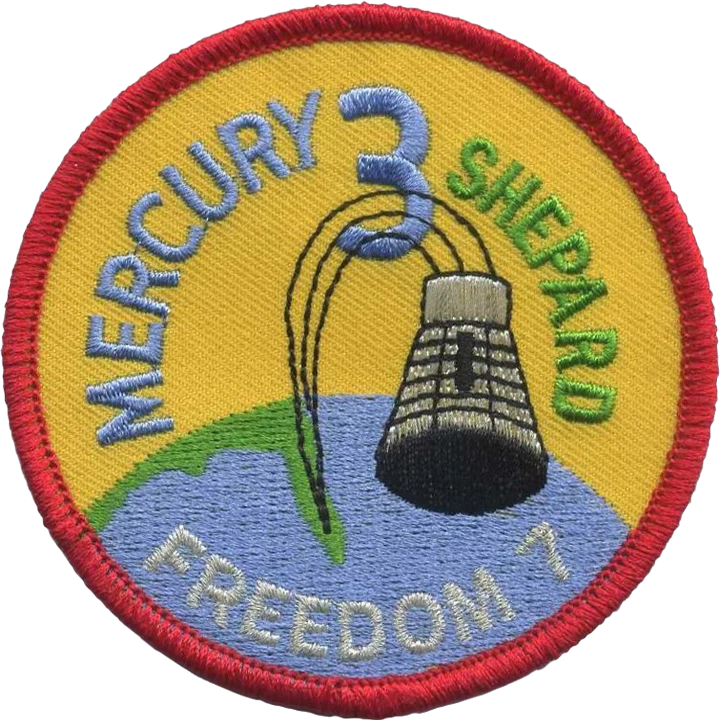
Alan Shepard — first American in space (Freedom 7 / Mercury-Redstone 3).
About this launch
Background
The flight of Mercury-Redstone 3 did not emerge from a vacuum. It was the product of years of accelerating ambition, political pressure, and methodical engineering conducted under the banner of Project Mercury, NASA's first human spaceflight program. Established in the late 1950s in the immediate wake of the Soviet Union's Sputnik shock, Project Mercury carried a mandate that was both scientific and deeply symbolic: to place an American astronaut in orbit around the Earth and return him safely to the ground. The program's early years were consumed by uncrewed test flights, hardware failures, and the sobering recognition that sending a human being beyond the atmosphere demanded a level of reliability that rocketry had not yet consistently achieved.
The vehicle chosen for the earliest crewed flights was the Redstone, a medium-range ballistic missile developed by the Army and later transferred to NASA's operational portfolio. Reliable and well-understood by its engineers, the Redstone was not powerful enough to achieve orbital velocity, but it was capable of lofting a Mercury capsule on a high arcing suborbital trajectory — sufficient for an initial demonstration of human endurance in the space environment. The Mercury spacecraft itself was a compact, conical capsule designed around the astronaut rather than built to accommodate one as an afterthought. Every gram of mass and every cubic centimeter of interior volume had been contested and negotiated across hundreds of engineering meetings.
Seven military test pilots had been selected as NASA's first astronaut group in 1959. Among them was Alan Bartlett Shepard Jr., a Navy aviator with a reputation for exceptional precision and a competitive intensity that distinguished him even within a cohort of high achievers. When NASA announced that Shepard would be the pilot for the first crewed Mercury-Redstone flight, he became the face of American ambitions in a race that, by the spring of 1961, was not going especially well. The Soviet Union had already achieved a series of firsts, and pressure on NASA to proceed was immense.
The Road to Launch
The path to the launch pad at Cape Canaveral's Launch Complex 5 was neither smooth nor swift. A succession of uncrewed Mercury-Redstone test flights had been conducted to qualify both the rocket and the capsule, and while the program had made steady progress, each anomaly discovered demanded resolution before a human life could be committed to the vehicle. Engineers, flight controllers, and program managers worked through technical reviews with a rigor that reflected the stakes involved. NASA's leadership was acutely aware that a catastrophic failure on a crewed flight would not merely cost a life — it would reshape the political and public landscape of American space exploration for years.
The flight had originally been targeted for earlier in the spring of 1961, but a combination of technical refinements and weather delays pushed the schedule forward. Then, on April 12, 1961, Soviet cosmonaut Yuri Gagarin completed a full orbital circuit of the Earth aboard Vostok 1, becoming the first human being in space. The achievement landed in America like a thunderclap. Shepard's upcoming suborbital hop — always modest in scope compared to what the Soviets had accomplished — was now framed by an even starker contrast. NASA pressed on, unwilling to rush to the point of recklessness but equally unwilling to wait indefinitely.
Shepard named his capsule *Freedom 7*, a choice that carried both patriotic resonance and a quiet nod to the group of seven Mercury astronauts. The name would be carried on the side of the spacecraft and would enter the historical record alongside the mission's official designation, Mercury-Redstone 3.
The Launch and Flight
On Friday, May 5, 1961, at 14:34:13 GMT, the Redstone MRLV rocket ignited at Launch Complex 5 on the eastern coast of Florida, and *Freedom 7* lifted away from American soil. The vehicle performed as its engineers had designed it to, accelerating Shepard upward and downrange on a carefully calculated arc. The mission was operated by the National Aeronautics and Space Administration, and the flight was classified as a suborbital trajectory — not the sustained orbit that Project Mercury ultimately aimed for, but a precisely shaped parabola that carried the capsule beyond the atmosphere before gravity pulled it back toward Earth.
The primary objective of the flight was straightforward in concept, if not in execution: to demonstrate that a human pilot could function during the high g-forces of powered ascent and the equally demanding deceleration of atmospheric re-entry. Both phases of spaceflight subjected the human body to stresses far exceeding anything encountered in conventional aviation, and while centrifuge training had offered some preparation, only an actual flight could confirm that the combination of spacecraft life support, pilot physiology, and mission profile worked as intended.
Shepard remained conscious and alert throughout the flight, demonstrating that a trained pilot could not only survive but actively monitor and respond to his spacecraft's systems under these conditions. The capsule reached its apex beyond the atmosphere and then descended, its heat shield absorbing the thermal energy of re-entry before parachutes deployed to slow its final descent. *Freedom 7* splashed down in the Atlantic Ocean, and Shepard was recovered by naval forces. The entire flight lasted approximately fifteen minutes from liftoff to splashdown — brief by any subsequent measure of human spaceflight, but historic in every dimension that mattered.
The mission outcome was recorded as a success.
Legacy
The significance of Mercury-Redstone 3 extends far beyond its fifteen-minute duration. Alan Shepard became the first American in space, a distinction that carried enormous weight in the context of the Cold War competition that framed the entire space age. The flight did not erase the Soviet lead — Gagarin's orbital mission remained a more technically impressive achievement by any objective measure — but it demonstrated that the United States had the capability, the will, and the human talent to compete.
President John F. Kennedy, already contemplating a more dramatic declaration of national intent, would use the momentum of *Freedom 7* as part of the context for his address to Congress later that same month, in which he committed the United States to landing a human being on the Moon before the end of the decade. Without the credibility established by Shepard's flight, that commitment might have seemed even more audacious than it already did.
For Project Mercury itself, the success of the mission validated years of engineering work and opened the path to subsequent flights of increasing ambition. The program continued through orbital missions and ultimately delivered the foundational experience — in vehicle design, mission operations, astronaut training, and flight control — that made Gemini and Apollo possible.
Shepard himself went on to command the Apollo 14 mission, becoming one of only twelve human beings to walk on the Moon, a trajectory that began with that fifteen-minute arc over the Atlantic in May 1961. Launch Complex 5, the site from which he departed, still stands at what is now Cape Canaveral Space Force Station, preserved as a monument to the moment when the United States first sent one of its citizens into space.
The Redstone MRLV and the *Freedom 7* capsule represent the opening line of a very long story — one that began on a Friday morning with a rocket igniting at the edge of the ocean and a nation watching to see whether the future was something it could reach.