Zenit-2
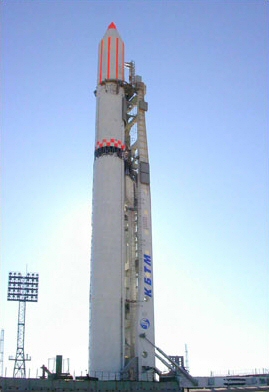
About the Zenit-2
Zenit-2
The Zenit-2 is a Soviet and Ukrainian medium-to-heavy orbital launch vehicle developed by the Yuzhnoye Design Bureau and manufactured by Yuzhmash, both based in Dnipro (formerly Dnipropetrovsk), Ukraine. Operated under the Soviet space program and later the Russian Federal Space Agency (Roscosmos), the Zenit-2 was designed as a modern, highly automated rocket intended to reduce launch crew workload and improve reliability compared to older Soviet boosters.
Design and Capabilities
Standing 57 meters tall with a diameter of 3.9 meters, the Zenit-2 is a two-stage vehicle capable of delivering up to 13,740 kg to low Earth orbit (LEO), placing it firmly in the medium-to-heavy lift category. Its first stage is powered by the RD-171 engine, one of the most powerful single-chamber liquid-propellant rocket engines ever developed, burning a kerosene and liquid oxygen (RP-1/LOX) propellant combination. This high-energy propellant choice contributed to the vehicle's competitive payload performance relative to its size.
The rocket was designed for launch from Site 45 at Baikonur Cosmodrome in Kazakhstan, and its architecture emphasized a high degree of automation during pre-launch and launch operations — a notable engineering priority at the time of its development.
Operational History
The Zenit-2 entered service in 1985 and remained in operation through 2004, spanning the final years of the Soviet era and the subsequent transition to Russian and Ukrainian national space programs. Over its operational life, the vehicle conducted 35 tracked flights, of which 29 were successful and 6 resulted in failure or partial failure — a reliability record broadly consistent with the challenges of operating a relatively new rocket design that saw only moderate flight frequency.
The vehicle served almost exclusively governmental missions, with its primary customers being the Soviet Space Program and Roscosmos. Its manifest was dominated by classified and government remote-sensing payloads. Notable missions in the later portion of its career included the Okean-O ocean observation satellite, the Meteor-3M No. 1 meteorological spacecraft, and multiple flights of the Tselina-2 signals intelligence satellite series and the Orlets-2 reconnaissance constellation — all reflecting the rocket's sustained role in supporting state intelligence, military, and Earth observation programs.
Legacy and Family
The Zenit-2's design served as the foundation for a broader family of vehicles. Its architecture was adapted for the Zenit-3SL used in the international Sea Launch program, which operated from a modified ocean platform and extended the rocket's commercial reach. The Zenit lineage represented one of the most technically ambitious Soviet rocket projects of the 1980s, and its core design principles — particularly the RD-171 engine and automated launch systems — influenced later international launch vehicle development.
Although the Zenit-2 itself was retired by 2004, its engineering heritage remained relevant well into the following decades, cementing its place as a significant chapter in both Soviet and post-Soviet spaceflight history.
- Jun 10, 2004Zenit-2 | Tselina-2 22Success
- Dec 10, 2001Zenit-2 | Meteor-3M No. 1Success
- Sep 25, 2000Zenit-2 | Orlets-2 2Success
- Feb 03, 2000Zenit-2 | Tselina-2 21Success
- Jul 17, 1999Zenit-2 | Okean-OSuccess
- Jul 28, 1998Zenit-2 | Tselina-2 20Success
- Jul 10, 1998Zenit-2 | Resurs-O1Success
- May 20, 1997Zenit-2 | Tselina-2 19Failure
- Sep 04, 1996Zenit-2 | Tselina-2 18Success
- Oct 31, 1995Zenit-2 | Tselina-2 17Success
- Nov 24, 1994Zenit-2 | Tselina-2 16Success
- Nov 04, 1994Zenit-2 | Resurs-O1Success
- Aug 26, 1994Zenit-2 | Orlets-2 1Success
- Apr 23, 1994Zenit-2 | Tselina-2 15Success
- Sep 16, 1993Zenit-2 | Tselina-2 14Success
- Mar 26, 1993Zenit-2 | Tselina-2 13Success
- Dec 25, 1992Zenit-2 | Tselina-2 12Success
- Nov 17, 1992Zenit-2 | Tselina-2 11Success
- Feb 05, 1992Zenit-2 | Tselina-2 10Failure
- Aug 30, 1991Zenit-2 | Tselina-2 9Failure
- Oct 04, 1990Zenit-2 | Tselina-2 8Failure
- May 22, 1990Zenit-2 | Tselina-2 7Success
- Nov 23, 1988Zenit-2 | Tselina-2 6Success
- May 15, 1988Zenit-2 | Tselina-2 5Success
- Aug 28, 1987Zenit-2 | GVM Tselina-2Success
- Aug 01, 1987Zenit-2 | GVM Tselina-2Success
- May 13, 1987Zenit-2 | Tselina-2 4Success
- Mar 18, 1987Zenit-2 | GVM Tselina-2Success
- Feb 14, 1987Zenit-2 | GVM Tselina-2Success
- Oct 22, 1986Zenit-2 | Taifun-1B 9Success
- Jul 30, 1986Zenit-2 | GVM Tselina-2Success
- Dec 28, 1985Zenit-2 | Tselina-2 3Success
- Oct 22, 1985Zenit-2 | GVM Tselina-2Success
- Jun 21, 1985Zenit-2 | GVM Tselina-2Failure
- Apr 13, 1985Zenit-2 | GVM Tselina-2Failure