Vulcan VC2S
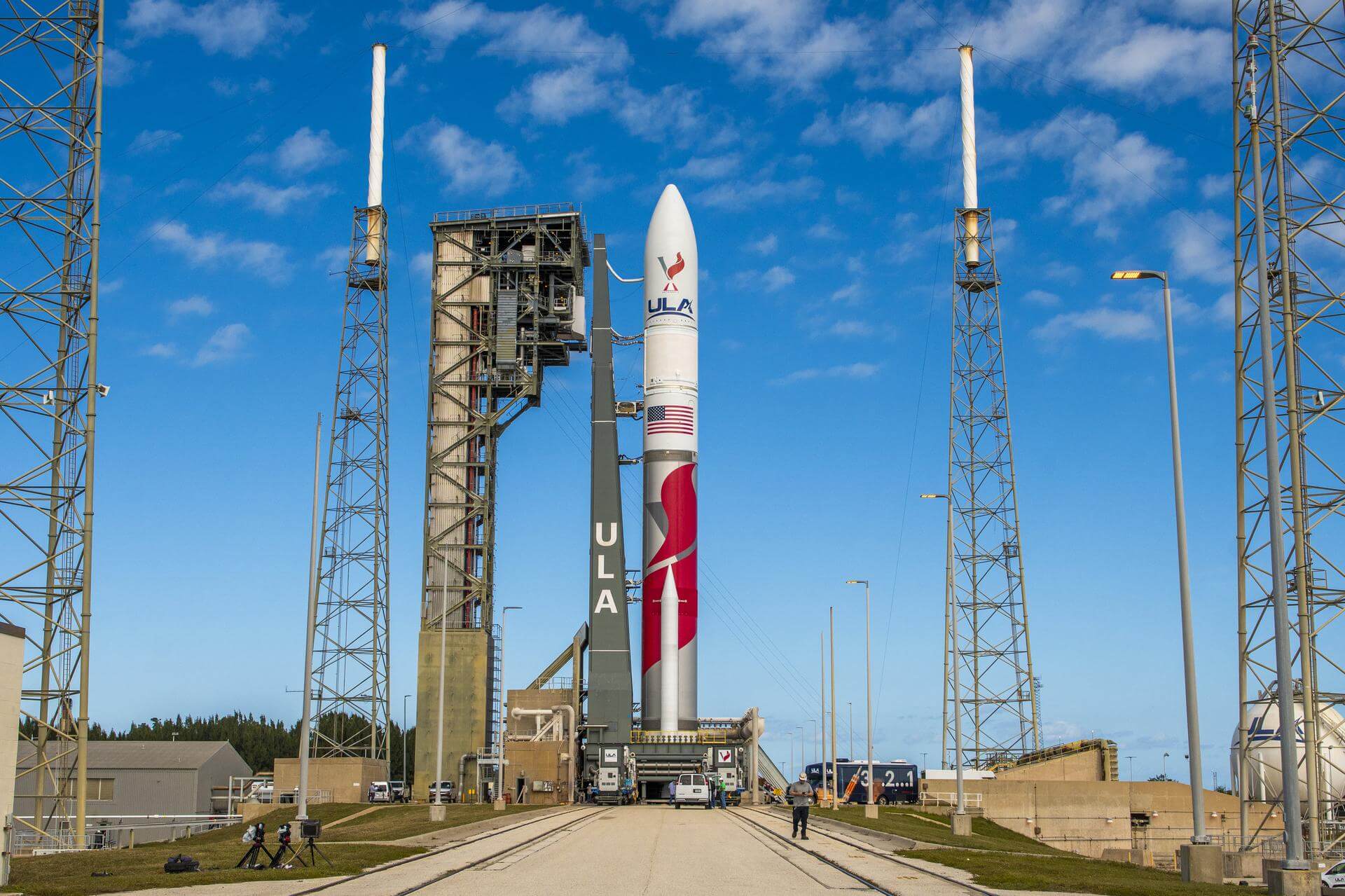
About the Vulcan VC2S
Overview
The Vulcan VC2S is an American orbital launch vehicle developed and operated by United Launch Alliance (ULA), the joint venture between Boeing and Lockheed Martin. It serves as the primary configuration of ULA's Vulcan Centaur rocket family, which was developed as the successor to both the Atlas V and Delta IV launch systems. Vulcan represents ULA's first entirely new rocket design in decades, intended to offer improved performance and reduced operational costs while maintaining the reliability standards the company built its reputation on.
Design and Configuration
Standing 61.6 meters tall with a core diameter of 5.4 meters, the Vulcan VC2S is a substantial vehicle capable of delivering up to 19,000 kg to low Earth orbit and 8,400 kg to geostationary transfer orbit. The "VC2S" designation refers to the vehicle's configuration: a Vulcan core stage paired with two solid rocket boosters and a dual-engine Centaur V upper stage. The Centaur V is a modernized evolution of the long-running Centaur upper stage heritage, featuring enlarged propellant tanks and running on liquid hydrogen and liquid oxygen. The main engines for the core stage are the BE-4, developed by Blue Origin — a significant departure from the Russian-built RD-180 engines previously used on Atlas V.
Launch History
Vulcan VC2S made its maiden flight in January 2024, carrying the Peregrine lunar lander for Astrobotic Technology as part of NASA's Commercial Lunar Payload Services program. While the rocket itself performed nominally, the Peregrine spacecraft suffered a critical propellant anomaly after separation, preventing a successful lunar landing. Nevertheless, the flight demonstrated the launch vehicle's capability and marked ULA's entry into a new generation of American rocketry.
The program's Certification Flight 2 followed, continuing the formal qualification process required for Vulcan to fly national security payloads for the United States Space Force. This step was essential for ULA to maintain its standing as a certified provider under the National Security Space Launch (NSSL) program.
By 2027, Vulcan VC2S had accumulated three tracked flights in our database, with two confirmed successes and no failures or partial failures on record — a strong early performance consistent with ULA's historically conservative and methodical approach to launch operations. Among its recent missions, the vehicle flew the GPS IIIF SV04 satellite under the USSF-88 mission, delivering a next-generation navigation satellite to orbit for the U.S. military.
Role and Significance
Vulcan VC2S occupies a critical place in the contemporary American launch market. It bridges ULA's legacy of high-reliability government launches with a modernized architecture designed to compete in an era increasingly shaped by reusable commercial vehicles. By retiring dependence on foreign propulsion and introducing the high-performance Centaur V upper stage, the platform positions ULA to serve both civil and national security customers well into the coming decade.
Launches take place from Space Launch Complex 41 at Cape Canaveral Space Force Station in Florida, the same pad long associated with the Atlas V program.