Vostok-L 8K72
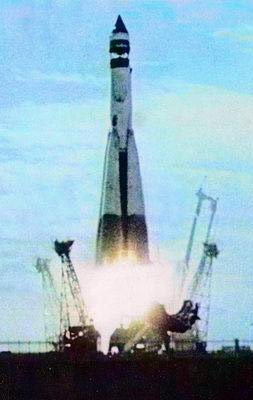
About the Vostok-L 8K72
Vostok-L 8K72
The Vostok-L 8K72 is an early Soviet orbital launch vehicle developed and operated by the Soviet Space Program during the late 1950s. A member of the broad R-7 rocket family — the lineage that traces back to Sergei Korolev's intercontinental ballistic missile design — the 8K72 represented one of the first dedicated attempts to configure the R-7 airframe for deep-space and lunar missions rather than simple Earth orbital flights.
Standing 30.84 meters tall with a core diameter of 2.6 meters, the vehicle followed the classic R-7 configuration: a central sustainer core surrounded by four strap-on booster modules that jettisoned shortly after liftoff. This clustered arrangement, distinctive in profile, became the visual signature of the entire Soviet launcher family for decades. The 8K72 variant added an upper stage — designated Block E — intended to provide the additional velocity needed to reach the Moon, distinguishing it from the baseline Sputnik-era configurations. Its rated payload capacity to low Earth orbit stands at 4,000 kg.
Operational History
Our flight records show the Vostok-L 8K72 conducted nine tracked flights between 1958 and 1960, a period that places it at the very heart of the early Space Race. Of those nine attempts, three were fully successful, while six ended in failure or only partial success — a reflection of the extraordinary technical ambitions being pursued with hardware that was still maturing rapidly.
The vehicle's most significant missions were directed at the Moon. Luna-1, launched in January 1959, became the first spacecraft to escape Earth's gravity and enter heliocentric orbit — a landmark achievement in human spaceflight, even though it missed its intended lunar impact. Luna-2 followed later that year and successfully impacted the lunar surface, making it the first human-made object to reach another world. Luna-3, also in 1959, performed the first flyby of the lunar far side and returned the first photographs of terrain never before seen by human eyes — an iconic scientific and propaganda triumph.
The record also shows two additional attempts associated with Luna-2 and Luna-3 program objectives — designated Luna-2a and Luna-4a/4b — that ended in failure, underscoring how demanding these missions were given the state of rocket technology at the time.
Significance
Despite its modest operational lifespan of roughly two years and a success rate that reflects the trial-and-error nature of early spaceflight, the Vostok-L 8K72 achieved milestones of permanent historical importance. Its lunar missions redefined what was technically possible and set the pace of competition between the Soviet Union and the United States. All launches were conducted from Baikonur Cosmodrome in what is now Kazakhstan, the facility that would anchor Soviet and later Russian launch operations for generations.
The 8K72 fed directly into the development of the Vostok-K variant that would carry Yuri Gagarin into orbit in 1961, cementing the R-7 family's role as the foundation of human spaceflight.
- Apr 16, 1960Vostok-L 8K72 | Luna-4bFailure
- Apr 15, 1960Vostok-L 8K72 | Luna-4aFailure
- Oct 04, 1959Vostok-L 8K72 | Luna-3Success
- Sep 12, 1959Vostok-L 8K72 | Luna-2Success
- Jun 18, 1959Vostok-L 8K72 | Luna-2aFailure
- Jan 02, 1959Vostok-L 8K72 | Luna-1Success
- Dec 04, 1958Vostok-L 8K72 | Luna-1cFailure
- Oct 11, 1958Vostok-L 8K72 | Luna-1bFailure
- Sep 23, 1958Vostok-L 8K72 | Luna-1aFailure