Vostok 8A92
About the Vostok 8A92
Vostok 8A92
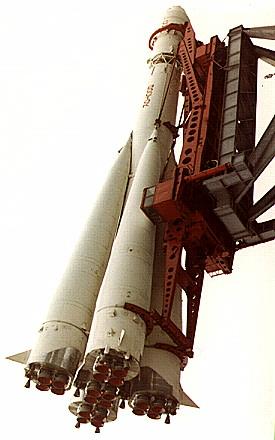
The Vostok 8A92 is a Soviet expendable orbital launch vehicle derived from the R-7 intercontinental ballistic missile family, operated exclusively by the Soviet Space Program. It represents one of the core variants of the broadly successful Vostok rocket lineage, which itself descends from Sergei Korolev's foundational R-7 design — the same lineage responsible for launching the first artificial satellite and the first human into orbit. The 8A92 designation identifies a specific configuration refined for the regular delivery of reconnaissance and Earth-observation payloads.
Design and Configuration
Standing 30.84 metres tall with a core diameter of 2.99 metres, the Vostok 8A92 follows the characteristic R-7 layout: a central core stage surrounded by four strap-on boosters, all igniting at liftoff. This arrangement gives the vehicle its distinctive tapered silhouette. The rocket is capable of delivering up to 4,730 kg to low Earth orbit, a meaningful payload capacity that made it well-suited to the Soviet Union's growing need for operational satellites in the early 1960s. Specific thrust and propellant figures are not detailed here beyond the stat panel, but like its R-7 relatives it burned liquid oxygen and kerosene (RG-1).
Operational History
Our flight record covers 44 tracked launches conducted between 1962 and 1967, of which 40 were fully successful and 4 resulted in failure or partial failure. This translates to a success rate of roughly 91 percent across a relatively concentrated five-year operational window, reflecting a vehicle that was dependable but not without the occasional anomaly typical of early spaceflight-era hardware.
The overwhelming majority of missions in the record were flown on behalf of the Soviet Space Program, with no commercial or foreign customers identified in the data. The vehicle's operational period coincides precisely with the rapid buildup of the Soviet military reconnaissance satellite effort, and the mission manifest reflects this clearly.
Payload and Missions
The most prominent payloads carried by the Vostok 8A92 were Zenit-2 spacecraft — second-generation Soviet photographic reconnaissance satellites that returned film capsules to Earth. The most recent missions in our record, running from Zenit-2 44 through Zenit-2 49, illustrate the routine, production-line character of these launches. Zenit-2 satellites were among the Soviet Union's earliest operational spy satellites, and the Vostok 8A92 served as their primary delivery vehicle throughout the mid-1960s.
Legacy
The Vostok 8A92 occupies an important place in the broader R-7 family tree. While earlier Vostok variants carried cosmonauts and scientific probes, the 8A92 variant was purpose-adapted for the systematic deployment of military Earth-observation assets — a mission that would eventually be inherited by more capable successors such as the Soyuz rocket family. Its concentrated service life from 1962 to 1967 marks it as a transitional vehicle, bridging the pioneering era of Soviet spaceflight and the industrialized, operationally focused satellite programs that followed. The 44 flights recorded here represent a substantial contribution to the Soviet Union's early space infrastructure.
- May 12, 1967Vostok 8A92 | Zenit-2 49Success
- Apr 04, 1967Vostok 8A92 | Zenit-2 48Success
- Mar 13, 1967Vostok 8A92 | Zenit-2 47Success
- Feb 27, 1967Vostok 8A92 | Zenit-2 46Success
- Jan 19, 1967Vostok 8A92 | Zenit-2 45Success
- Dec 19, 1966Vostok 8A92 | Zenit-2 44Success
- Nov 19, 1966Vostok 8A92 | Zenit-2 43Success
- Oct 14, 1966Vostok 8A92 | Zenit-2 42Success
- Sep 16, 1966Vostok 8A92 | Zenit-2 41Failure
- May 06, 1966Vostok 8A92 | Zenit-2 38Success
- Apr 20, 1966Vostok 8A92 | Zenit-2 37Success
- Mar 17, 1966Vostok 8A92 | Zenit-2 36Success
- Feb 10, 1966Vostok 8A92 | Zenit-2 35Success
- Jan 22, 1966Vostok 8A92 | Zenit-2 34Success
- Jan 07, 1966Vostok 8A92 | Zenit-2 33Success
- Dec 10, 1965Vostok 8A92 | Zenit-2 32Success
- Nov 27, 1965Vostok 8A92 | Zenit-2 31Success
- Aug 14, 1965Vostok 8A92 | Zenit-2 30Success
- Jul 13, 1965Vostok 8A92 | Zenit-2 29Failure
- Jun 15, 1965Vostok 8A92 | Zenit-2 28Success
- May 07, 1965Vostok 8A92 | Zenit-2 27Success
- Mar 25, 1965Vostok 8A92 | Zenit-2 26Success
- Jan 11, 1965Vostok 8A92 | Zenit-2 25Success
- Oct 28, 1964Vostok 8A92 | Zenit-2 24Success
- Oct 14, 1964Vostok 8A92 | Zenit-2 23Success
- Sep 24, 1964Vostok 8A92 | Zenit-2 22Success
- Aug 14, 1964Vostok 8A92 | Zenit-2 21Success
- Jul 15, 1964Vostok 8A92 | Zenit-2 20Success
- Jun 23, 1964Vostok 8A92 | Zenit-2 19Success
- Jun 10, 1964Vostok 8A92 | Zenit-2 18Success
- Apr 25, 1964Vostok 8A92 | Zenit-2 17Success
- Apr 04, 1964Vostok 8A92 | Zenit-2 16Success
- Dec 19, 1963Vostok 8A92 | Zenit-2 15Success
- Nov 28, 1963Vostok 8A92 | Zenit-2 14Failure
- Oct 18, 1963Vostok 8A92 | Zenit-2 13Success
- May 24, 1963Vostok 8A92 | Zenit-2 11Success
- Apr 28, 1963Vostok 8A92 | Zenit-2 10Success
- Apr 22, 1963Vostok 8A92 | Zenit-2 9Success
- Mar 21, 1963Vostok 8A92 | Zenit-2 8Success
- Dec 22, 1962Vostok 8A92 | Zenit-2 7Success
- Oct 17, 1962Vostok 8A92 | Zenit-2 6Success
- Sep 27, 1962Vostok 8A92 | Zenit-2 5Success
- Jul 28, 1962Vostok 8A92 | Zenit-2 4Success
- Jun 01, 1962Vostok 8A92 | Zenit-2 3Failure