Vostok-K
About the Vostok-K
Vostok-K
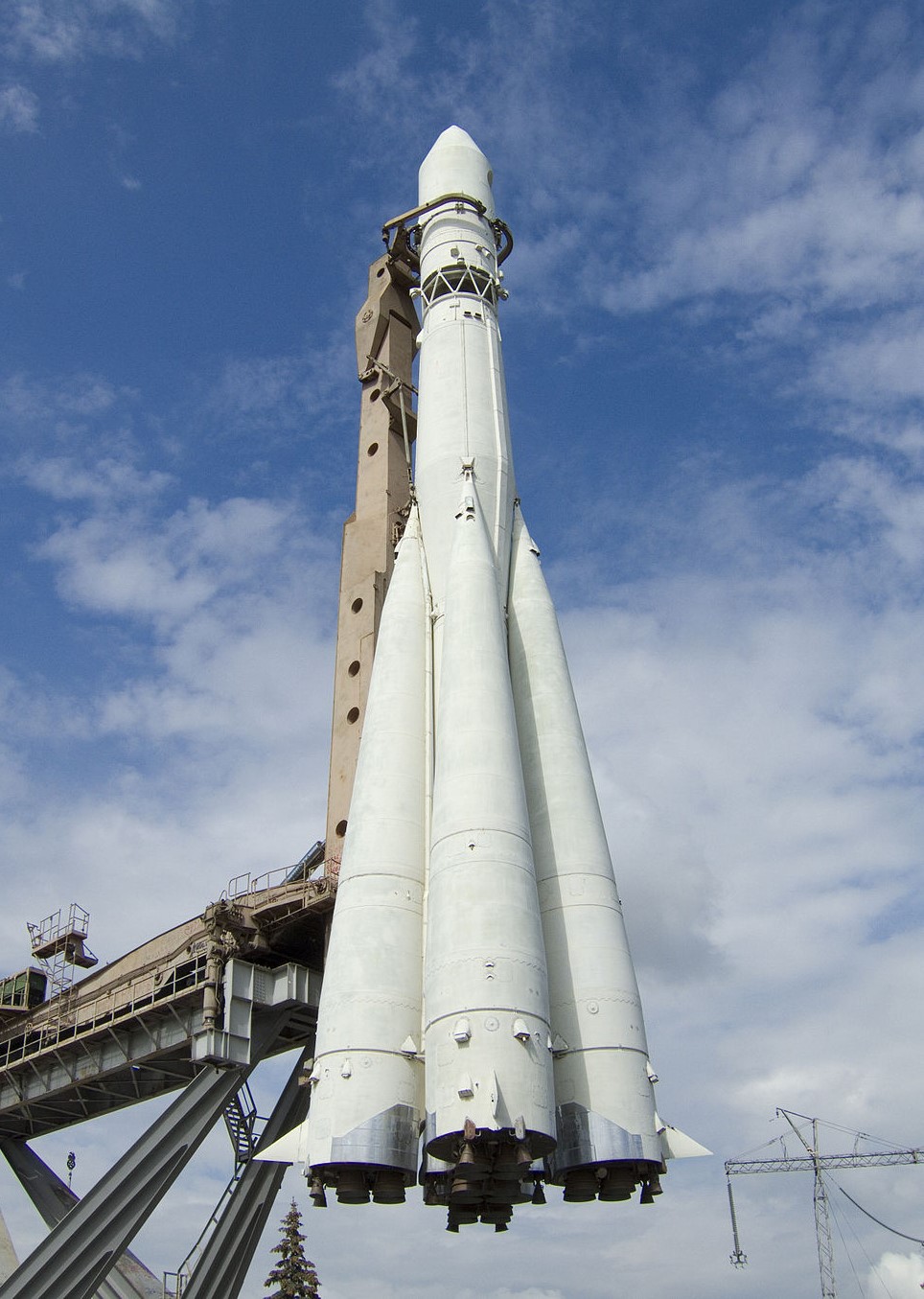
The Vostok-K was a Soviet orbital launch vehicle developed and operated by the Soviet space program during the early 1960s. A member of the broader R-7 rocket family — the lineage originally derived from the world's first intercontinental ballistic missile — Vostok-K served as the dedicated launcher for the Soviet Union's pioneering human spaceflight efforts, as well as selected scientific satellite missions. Launches were conducted from the Baikonur Cosmodrome in Kazakhstan.
Design and Capability
Standing 30.84 meters tall with a core diameter of 2.99 meters, Vostok-K followed the characteristic staged-core architecture of the R-7 family, with four strap-on boosters clustered around a central sustainer stage. This configuration gave the vehicle a recognizable tapered profile that became iconic in the history of spaceflight. The rocket was capable of delivering up to 4,725 kilograms to low Earth orbit, a substantial capacity for its era and one well-suited to the mass requirements of crewed Vostok spacecraft.
Operational History
Our flight record documents 13 launches of the Vostok-K between 1960 and 1964, of which 11 were fully successful and 2 resulted in failure or partial failure. This represented a strong reliability record for an early orbital launch vehicle, reflecting the maturity that the R-7 platform had accumulated since its debut in the late 1950s.
The vehicle's most historically significant missions were the crewed flights of the Vostok program, which placed the first humans in Earth orbit. These missions included Vostok 3, Vostok 4, Vostok 5, and Vostok 6 — the last of which carried Valentina Tereshkova, the first woman to fly in space, in June 1963. The dual flights of Vostok 3 and 4, and later Vostok 5 and 6, demonstrated the Soviet program's ability to conduct simultaneous multi-spacecraft operations.
Beyond human spaceflight, Vostok-K also launched scientific payloads, most notably the Elektron radiation-belt research satellites. The missions Elektron-1 & 2 and Elektron-3 & 4 each deployed two satellites on a single launch, placing spacecraft into different orbital altitudes to study Earth's Van Allen belts — an innovative dual-payload approach that maximized scientific return per flight.
Legacy
The Soviet Space Program was the sole customer for the Vostok-K, and the vehicle's contributions to that program were foundational. It carried human beings into orbit for the first time in history when Yuri Gagarin flew aboard Vostok 1 in April 1961 — a mission that preceded the window captured in our flight record but established the vehicle's enduring historical importance. By the time Vostok-K flew its final tracked missions in 1964, it had helped define the opening chapter of human spaceflight and laid the groundwork for the more capable Voskhod and Soyuz launch vehicles that followed within the same rocket family.
- Jul 10, 1964Vostok | Elektron-3 &4Success
- Jan 30, 1964Vostok | Elektron-1 & 2Success
- Jun 16, 1963Vostok-K | Vostok 6Success
- Jun 14, 1963Vostok-K | Vostok 5Success
- Aug 12, 1962Vostok-K | Vostok 4Success
- Aug 11, 1962Vostok-K | Vostok 3Success
- Apr 26, 1962Vostok | Zenit-2 2Success
- Dec 11, 1961Vostok-K | Zenit-2 1Failure
- Aug 06, 1961Vostok-K | Vostok 2Success
- Apr 12, 1961Vostok-K | Vostok 1Success
- Mar 25, 1961Vostok-K | Sputnik 10Success
- Mar 09, 1961Vostok-K | Sputnik 9Success
- Dec 22, 1960Vostok | Korabl-Sputnik (4)Failure