Vega
About the Vega
Vega
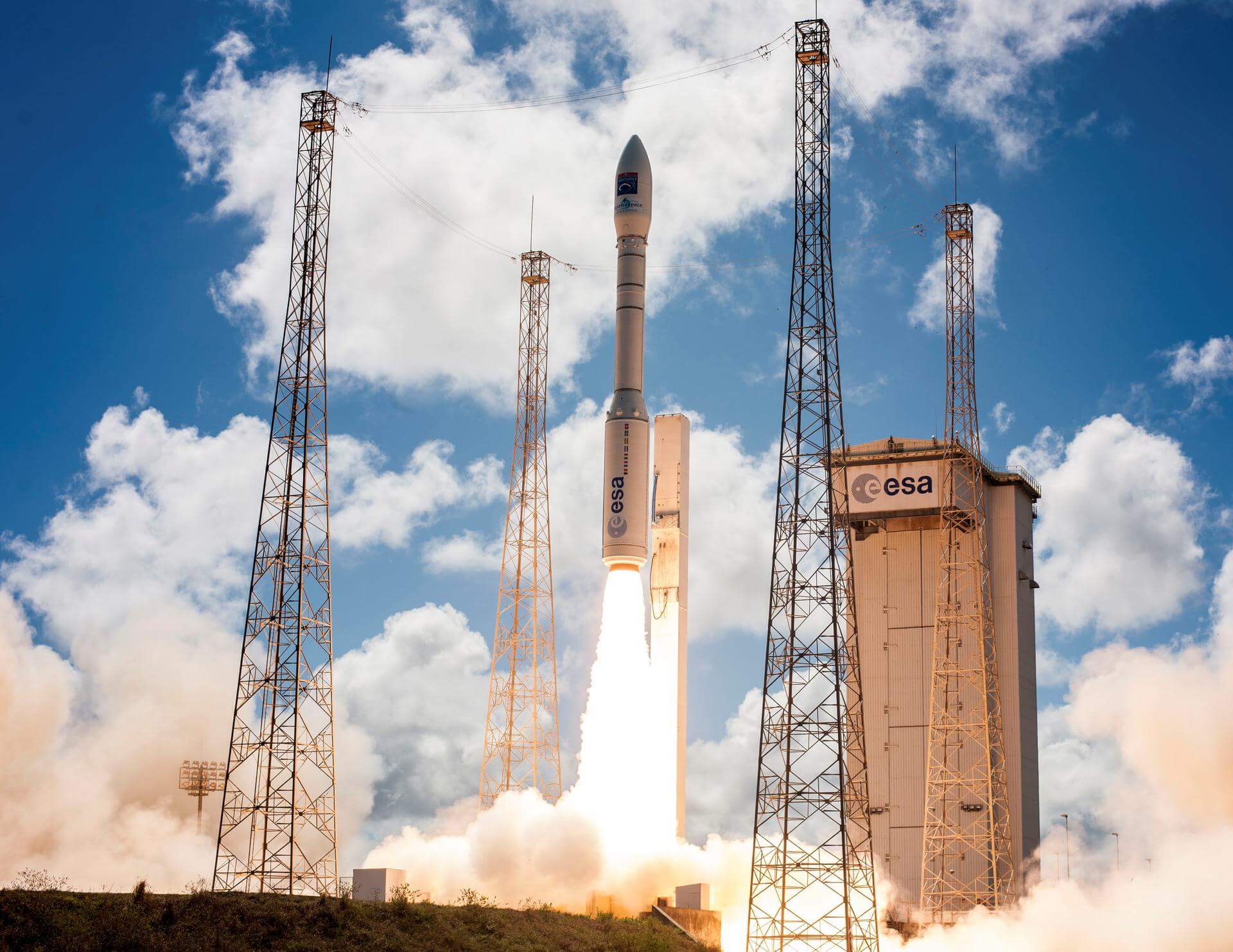
Vega is a small-to-medium European orbital launch vehicle developed by the Italian Space Agency (ASI) and manufactured by Avio, operating under commercial launch services provider Arianespace. Designed to serve the lightweight satellite market, Vega fills a dedicated niche in Europe's launch portfolio alongside the larger Ariane family, offering dedicated access to low Earth orbit and sun-synchronous orbits for scientific, Earth observation, and institutional payloads.
Design and Capabilities
Standing 29.9 metres tall with a diameter of 3.025 metres, Vega is a compact, four-stage vehicle. Its first three stages are solid-fuelled, providing simplicity and reliability, while a liquid-fuelled upper stage — the AVUM (Attitude and Vernier Upper Module) — delivers precise orbital insertion and the flexibility to target multiple orbital inclinations in a single mission. The vehicle is capable of delivering up to 1,500 kg to low Earth orbit, making it well suited to small and medium Earth observation and scientific satellites.
Vega launches from the Guiana Space Centre at Kourou, French Guiana, taking advantage of the site's equatorial location to maximise performance across a range of orbital destinations.
Operational History
Vega conducted its maiden flight in 2012 and has remained active through 2024, accumulating 22 tracked flights with a strong reliability record of 20 successes against 2 failures or partial failures. This track record has established the vehicle as a dependable workhorse for European institutional spaceflight, with the European Space Agency (ESA) and Arianespace representing its primary customers.
The manifest has been heavily weighted toward Earth observation missions of strategic importance to Europe. Recent flights include the Sentinel-2C mission, part of the European Union's Copernicus environmental monitoring constellation, and the SEOSAT-Ingenio & Taranis mission, which carried Spain's first domestically developed Earth observation satellite. Commercial high-resolution imaging has also featured prominently, with Pléiades Neo 3 and Pléiades Neo 4 — satellites forming Airbus's next-generation optical constellation — both launched aboard Vega. Other notable recent missions include CERES, a French signals-intelligence satellite cluster, and a multi-manifest flight carrying THEOS-2, TRITON, and additional secondary payloads, reflecting the vehicle's flexibility for rideshare arrangements.
Role and Legacy
Vega represents a significant achievement for European industrial autonomy in space access, providing the continent with an independent, dedicated capability for smaller payloads that do not require the lift of Ariane 5 or Ariane 6. Its development helped grow a mature Italian and broader European commercial space industry around solid rocket propulsion and upper-stage technology.
The Vega-C variant, an evolved version offering improved performance, entered development to succeed the baseline Vega, though the original configuration continued to serve operational needs well into the 2020s. Across more than a decade of service, Vega has launched a diverse range of scientific and Earth observation assets that collectively represent some of Europe's most important space infrastructure, cementing its place as a reliable and strategically valuable vehicle in the global launch market.
- Sep 05, 2024Vega | Sentinel-2CSuccess
- Oct 09, 2023Vega | THEOS-2, TRITON & othersSuccess
- Nov 16, 2021Vega | CERESSuccess
- Aug 17, 2021Vega | Pléiades Neo 4Success
- Apr 29, 2021Vega | Pléiades Neo 3Success
- Nov 17, 2020Vega | SEOSAT-Ingenio & TaranisFailure
- Sep 03, 2020Vega | SSMS PoCSuccess
- Jul 11, 2019Vega | Falcon Eye 1Failure
- Mar 22, 2019Vega | PRISMASuccess
- Nov 21, 2018Vega | Mohammed VI-BSuccess
- Aug 22, 2018Vega | ADM-AeolusSuccess
- Nov 08, 2017Vega | Mohammed VI-ASuccess
- Aug 02, 2017Vega | OptSat 3000 & VENµS (VENUS)Success
- Mar 07, 2017Vega | Sentinel-2BSuccess
- Dec 05, 2016Vega | Göktürk-1ASuccess
- Sep 16, 2016Vega | PerúSAT-1 / SkySat 4-7Success
- Dec 03, 2015Vega | LISA PathfinderSuccess
- Jun 23, 2015Vega | Sentinel-2ASuccess
- Feb 11, 2015Vega | IXVSuccess
- Apr 30, 2014Vega | KazEOSat 1Success
- May 07, 2013Vega | Proba-V, VNREDSat 1A, ESTCube-1Success
- Feb 13, 2012Vega | Multipayload mission, 9 satellitesSuccess