Vanguard
About the Vanguard
Vanguard
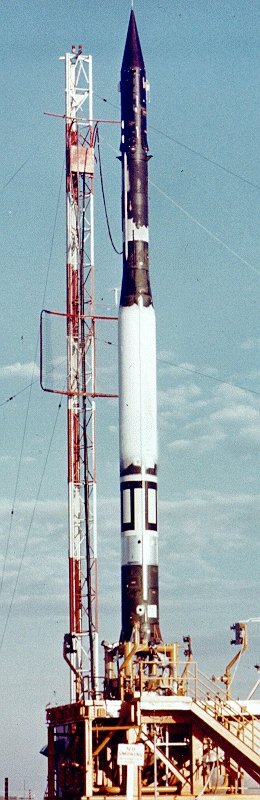
The Vanguard was an American orbital launch vehicle developed and operated by the U.S. Navy in cooperation with the Naval Research Laboratory. Designed during the mid-1950s as part of the United States' contribution to the International Geophysical Year, Vanguard holds a significant place in spaceflight history as one of the earliest American rockets purpose-built for the task of placing a satellite into Earth orbit.
Background and Development
Vanguard emerged from a civilian scientific program at a moment of intense geopolitical pressure. When the Soviet Union launched Sputnik 1 in October 1957, the Vanguard program suddenly found itself at the center of the Space Race. Development drew heavily on heritage from the Viking sounding rocket and the Aerobee research rocket, producing a slender, three-stage vehicle standing 23 meters tall with a diameter of 1.14 meters. Its design reflected the state of the art for American rocketry of the era, though the compressed development timeline and ambitious objectives left little margin for error.
Launch Profile and Payload Capability
Vanguard was configured to deliver very small payloads to low Earth orbit, with a rated capacity of approximately 9 kilograms — sufficient only for compact scientific satellites of the era. Launches took place from Cape Canaveral, Florida. The vehicle's three stages combined liquid- and solid-propellant technology, with the upper stages providing the precision needed to achieve a stable orbital trajectory.
Flight History
Our flight record documents 11 total launches conducted between 1957 and 1959, of which 3 were fully successful and 8 resulted in failure or only partial success. This reflects the brutal difficulty of early orbital rocketry, where even experienced teams struggled with reliability across every stage of flight.
The program's most public setback came on December 6, 1957, when a launch attempt ended in a catastrophic pad explosion just seconds after liftoff — a failure broadcast live on television and deeply felt by the American public. Despite this and subsequent losses, the program persisted.
Among the notable missions recorded in our data are Vanguard II, which successfully reached orbit and carried instruments designed to image cloud cover from space, and Vanguard III, which completed a successful mission studying Earth's magnetic field, radiation environment, and micrometeorite flux. The first complete success, Vanguard 1, launched in March 1958 and became the fourth artificial satellite placed in Earth orbit. Remarkably, Vanguard 1 remains in orbit today, making it the oldest human-made object still circling the Earth.
Legacy
Despite its troubled flight record, the Vanguard program made lasting contributions to space science and launch vehicle engineering. The satellites it successfully orbited returned valuable data that refined humanity's understanding of Earth's shape, radiation belts, and near-space environment. The program demonstrated both the extraordinary difficulty of early spaceflight and the determination of the teams who pushed through repeated failure. Vanguard's brief operational life of roughly two years, from 1957 to 1959, represents a foundational chapter in the history of American rocketry.
- Sep 18, 1959Vanguard | Vanguard IIISuccess
- Jun 22, 1959Vanguard | VanguardFailure
- Apr 14, 1959Vanguard | VanguardFailure
- Feb 17, 1959Vanguard | Vanguard IISuccess
- Sep 26, 1958Vanguard | VanguardFailure
- Jun 26, 1958Vanguard | VanguardFailure
- May 28, 1958Vanguard | VanguardFailure
- Apr 29, 1958Vanguard | VanguardFailure
- Mar 17, 1958Vanguard | VanguardSuccess
- Feb 05, 1958Vanguard | VanguardFailure
- Dec 06, 1957Vanguard | VanguardFailure