UR-500
About the UR-500
UR-500
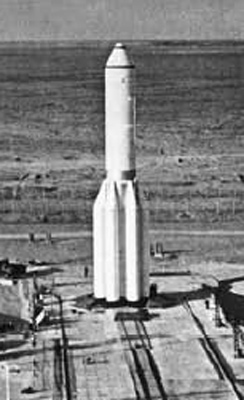
The UR-500 is a Soviet two-stage orbital launch vehicle developed by the Chelomei design bureau (OKB-52) and operated by the Soviet Space Program. Known in the West as the Proton, the UR-500 represents the foundational configuration of what would become one of the most enduring and prolific heavy-lift rocket families in spaceflight history. It launched exclusively from the Baikonur Cosmodrome in Kazakhstan.
Origins and Design
Conceived in the early 1960s, the UR-500 was originally proposed as an intercontinental ballistic missile capable of delivering a large thermonuclear warhead, but the design transitioned into a purely orbital launch vehicle before entering service. Standing 46.28 meters tall with a core diameter of 4.15 meters, the vehicle was notable for its distinctive clustered first stage, in which six fuel tanks are arranged around a central oxidizer tank — a configuration driven partly by the need to fit within Soviet rail transport constraints. The rocket's propellant combination of nitrogen tetroxide and unsymmetrical dimethylhydrazine (UDMH) gave it high performance but also introduced handling challenges due to the highly toxic nature of those propellants.
With a payload capacity of 8,400 kg to low Earth orbit, the UR-500 was among the most capable launch vehicles of its era, significantly exceeding the lift capacity of earlier Soviet boosters.
Operational History
The UR-500 flew during a brief but consequential window, with four tracked flights between 1965 and 1966. Of those, three were successful and one resulted in failure or partial success. All known missions were conducted on behalf of the Soviet Space Program, reflecting the vehicle's role as a government scientific launcher during the height of the Space Race.
The tracked missions — Proton 1, Proton 2, Proton 3, and Proton 3a — were dedicated to high-energy physics research, carrying large scientific payloads designed to study cosmic rays and other phenomena in Earth orbit. These spacecraft gave the rocket its enduring Western nickname, Proton, which would later be applied to the more capable multi-stage variants that followed. The Proton satellites were among the heaviest scientific payloads placed into orbit anywhere in the world at that time, a demonstration of the UR-500's considerable lifting power.
Legacy
The UR-500 flew in its original two-stage form only during this short period before being succeeded by the UR-500K, a three-stage variant that dramatically expanded the rocket's capability and versatility. The UR-500K — and later iterations marketed internationally as the Proton-K and Proton-M — would go on to launch interplanetary probes, space station modules, and commercial geostationary satellites over the following decades, making the Proton family one of the longest-serving rocket lineages in history.
The UR-500's operational career was short, but its significance lies in what it established: a powerful, reliable heavy-lift platform that gave Soviet planners confidence in the design's fundamental architecture and propulsion approach. Its four flights between 1965 and 1966 laid the groundwork for a rocket family that would remain in active service well into the twenty-first century.