Titan IVB/Centaur
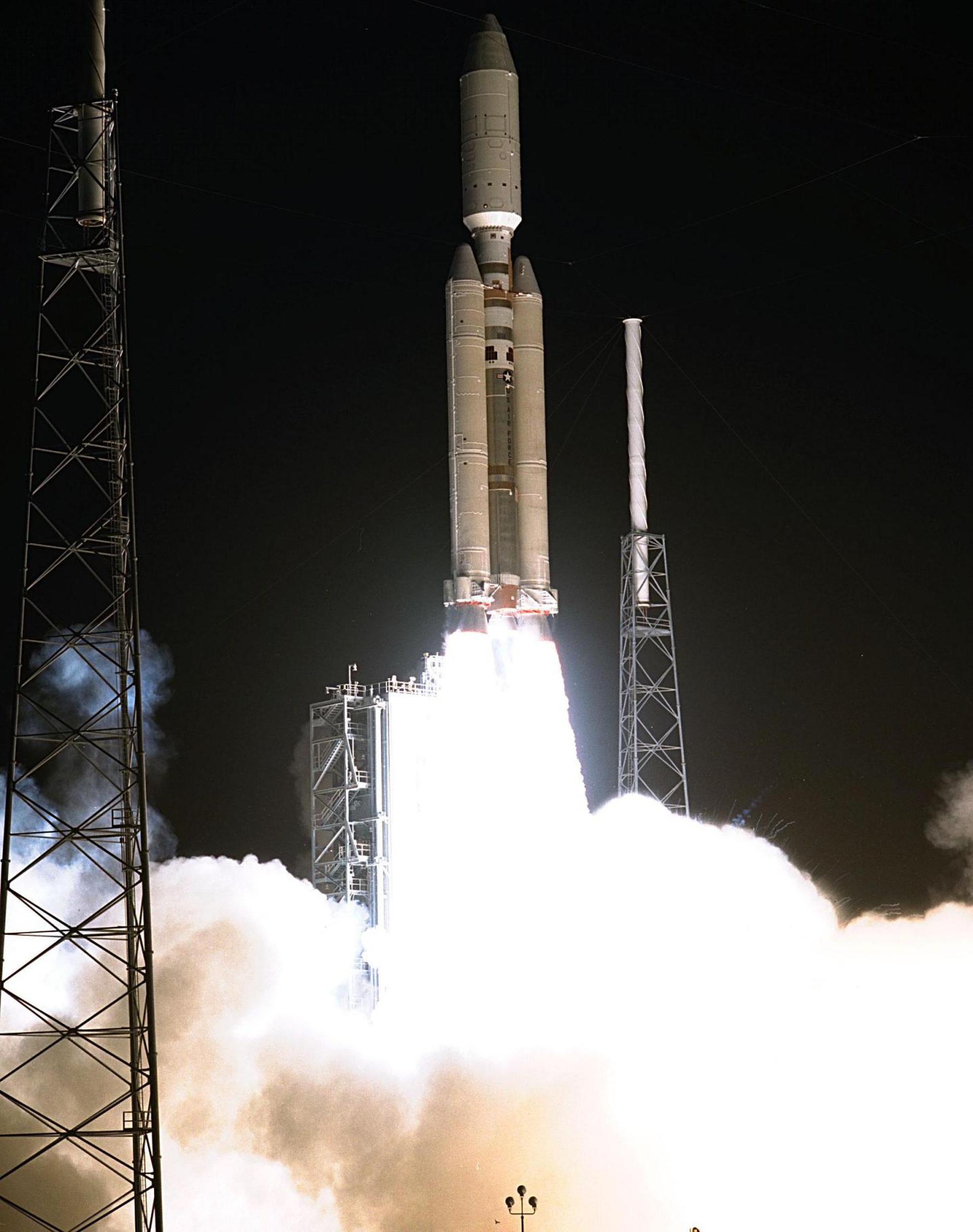
About the Titan IVB/Centaur
Titan IVB/Centaur
The Titan IVB/Centaur is an American expendable heavy-lift launch vehicle configuration combining the Titan IVB core rocket with the cryogenic Centaur upper stage. Operated by the United States Air Force and manufactured principally by Lockheed Martin, this configuration represented one of the most capable launch systems available to the U.S. government during the late 1990s and early 2000s, delivering high-priority national security payloads to demanding orbits including geostationary transfer and beyond.
Background and Configuration
The Titan IVB served as the final and most capable evolution of the long-running Titan rocket family, which traces its lineage to an intercontinental ballistic missile developed in the 1950s. The addition of the Centaur upper stage — itself a mature, high-energy stage powered by liquid hydrogen and liquid oxygen — gave the combination exceptional performance for reaching geosynchronous orbit. This made the Titan IVB/Centaur the configuration of choice when the Air Force needed to place its heaviest and most sophisticated spacecraft into high-energy trajectories that a solid-fueled upper stage could not efficiently achieve.
Launches were conducted from Cape Canaveral Space Force Station in Florida, taking advantage of its location for easterly trajectories suited to geostationary missions.
Flight Record
Our tracking data records seven flights of the Titan IVB/Centaur, spanning the years 1997 through 2003. Of those seven missions, six were fully successful, with one resulting in a failure or partial failure, giving the configuration a strong but imperfect operational record consistent with the complexity of its missions and the demands placed on its high-energy upper stage.
The vehicle's primary customers were the United States Air Force and Lockheed Martin, reflecting the vehicle's exclusive focus on government and national security spaceflight during this period.
Notable Missions
The Titan IVB/Centaur is closely associated with the Milstar satellite constellation, an advanced military communications network designed to provide survivable, jam-resistant communications for U.S. strategic and tactical forces. Multiple Milstar spacecraft — including Milstar 3, Milstar 4, Milstar 5, and Milstar 6 — were delivered to orbit by this vehicle configuration, representing the backbone of its operational manifest. These were among the most capable and expensive military satellites of their era, making the reliable delivery of each one a matter of significant national importance.
The vehicle also carried classified payloads under the NROL (National Reconnaissance Office Launch) designation, including NROL-6 and NROL-19, underscoring the degree of trust the intelligence community placed in this configuration for its most sensitive reconnaissance missions.
Legacy
The Titan IVB/Centaur retired alongside the broader Titan IV program in the early 2000s, as the Air Force transitioned toward the Evolved Expendable Launch Vehicle (EELV) program — namely the Atlas V and Delta IV — to replace the aging Titan family. Despite its relatively small number of flights in this specific configuration, the Titan IVB/Centaur left a substantial legacy through the critical national security infrastructure it placed in orbit, much of which remained operational for years after the rocket itself was retired.