Titan IIID
About the Titan IIID
Titan IIID
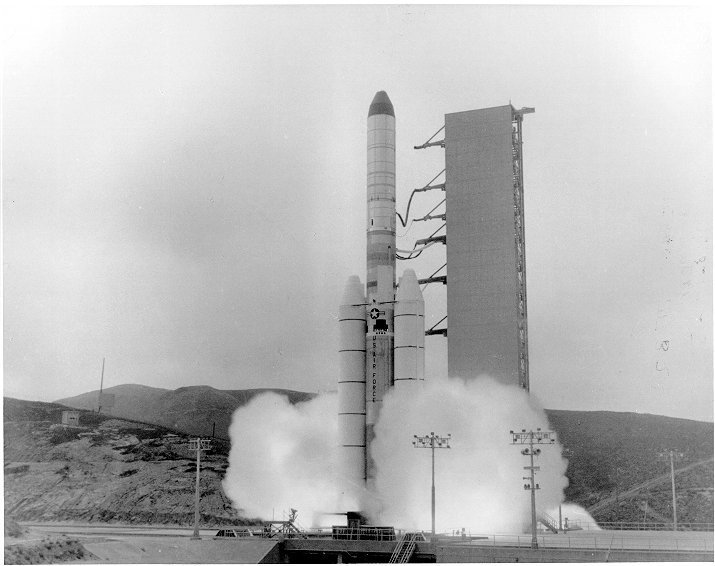
The Titan IIID was an American expendable orbital launch vehicle operated by the United States Air Force and manufactured by Martin Marietta. A member of the broader Titan III family, it was developed specifically to serve the demanding requirements of the U.S. national reconnaissance program, making it one of the most consequential — if least publicly discussed — rockets of the Cold War era.
Design and Configuration
Standing 36 meters tall with a core diameter of 3.05 meters, the Titan IIID shared its basic architecture with other Titan III variants, combining a liquid-fueled core stage with a pair of large solid rocket boosters strapped to its sides. Unlike the Titan IIIC, it did not carry an upper stage for geosynchronous missions; instead, its design was optimized for delivering very heavy payloads into low Earth orbit, where it could lift up to 12,300 kilograms. This substantial capacity made it exceptionally well suited to the large, complex reconnaissance satellites it was tasked with carrying.
Operational History
The Titan IIID flew exclusively from Space Launch Complex 4 at Vandenberg Air Force Base in California, a site chosen for its favorable geometry for polar and sun-synchronous orbits — the preferred trajectories for imaging reconnaissance satellites passing over denied territory. The vehicle entered service in 1971 and remained in operation through 1982, a run of over a decade.
Our flight record documents 22 launches, all of which were successful — a remarkable reliability record for any launch vehicle, and a testament to the maturity of the Titan airframe and the rigor of Air Force launch operations. The Titan IIID achieved a perfect 22-for-22 success rate across its entire career.
Payloads and Legacy
The Titan IIID's manifest was dominated by two of the most significant satellite programs in U.S. intelligence history. It carried multiple KH-9 HEXAGON satellites — large film-return vehicles capable of imaging vast swaths of the Earth's surface with high resolution — and was also the launch vehicle of choice for the KH-11 KENNAN, the first American reconnaissance satellite to transmit digital electro-optical imagery in near-real time back to ground stations. The KH-11 represented a generational leap in intelligence-gathering capability, and the Titan IIID was its sole launch vehicle throughout this period.
Recent missions in our record include the final KH-11 and KH-9 flights of the era: KH-11 5, KH-9 17, KH-11 4, KH-9 16, KH-11 3, and KH-9 15, underscoring how central the Titan IIID was to sustaining continuous American reconnaissance satellite coverage through the final years of its operational life.
Though it operated largely in secrecy, the Titan IIID's unblemished record and the strategic importance of its payloads firmly secure its place as one of the most operationally significant launch vehicles of the Cold War. It was eventually succeeded by the Titan 34D, which carried forward much of the same design philosophy with improved performance.
- Nov 17, 1982Titan IIID | KH-11 5Success
- May 11, 1982Titan IIID | KH-9 17Success
- Sep 03, 1981Titan IIID | KH-11 4Success
- Jun 18, 1980Titan IIID | KH-9 16Success
- Feb 07, 1980Titan IIID | KH-11 3Success
- Mar 16, 1979Titan IIID | KH-9 15Success
- Jun 14, 1978Titan IIID | KH-11 2Success
- Mar 16, 1978Titan IIID | KH-9 14Success
- Jun 27, 1977Titan IIID | KH-9 13Success
- Dec 19, 1976Titan IIID | KH-11 1Success
- Jul 08, 1976Titan IIID | KH-9 12Success
- Dec 04, 1975Titan IIID | KH-9 11Success
- Jun 08, 1975Titan IIID | KH-9 10Success
- Oct 29, 1974Titan IIID | KH-9 9Success
- Apr 10, 1974Titan IIID | KH-9 8Success
- Nov 10, 1973Titan IIID | KH-9 7Success
- Jul 13, 1973Titan IIID | KH-9 6Success
- Mar 09, 1973Titan IIID | KH-9 5Success
- Oct 10, 1972Titan IIID | KH-9 4Success
- Jul 07, 1972Titan IIID | KH-9 3Success
- Jan 20, 1972Titan IIID | KH-9 2Success
- Jun 15, 1971Titan IIID | KH-9 1Success