Titan IIIC
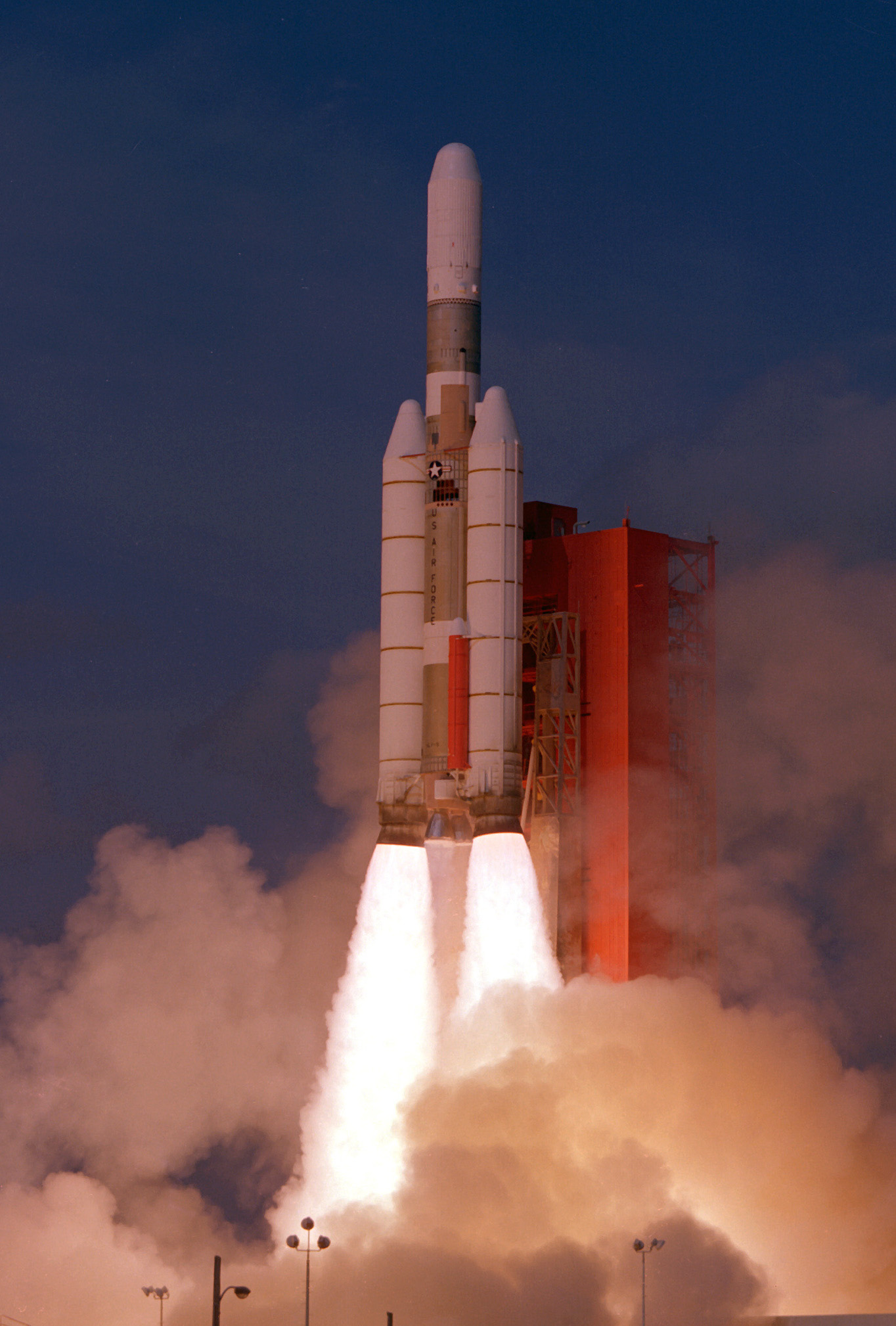
About the Titan IIIC
Titan IIIC
The Titan IIIC was an American expendable orbital launch vehicle operated by the United States Air Force and manufactured by Martin Marietta. A member of the broader Titan rocket family — itself descended from the Titan II intercontinental ballistic missile — the Titan IIIC was developed specifically to meet the Air Force's need for a heavy-lift launcher capable of placing large military payloads into a wide range of orbits, including geosynchronous transfer orbit.
Design and Capability
Standing 42 meters tall with a core diameter of 3 meters, the Titan IIIC paired a liquid-fueled Titan III core with two large solid rocket motors strapped to its sides, giving it substantially more thrust at liftoff than its predecessors. An upper stage — the Transtage — provided the in-space propulsion necessary to deliver payloads to high or geosynchronous orbits. This combination gave the vehicle a payload capacity of approximately 13,100 kg to low Earth orbit and 3,000 kg to geosynchronous transfer orbit, making it one of the most capable American launch vehicles of its era.
Operational History
The Titan IIIC conducted its first flight in 1965 and remained in service through 1982, a span of nearly two decades that reflected both its reliability and its central importance to American military space operations. Our flight record covers 36 tracked launches, of which 34 were successful and 2 resulted in failure or partial failure — a strong overall reliability record for a vehicle of its generation.
All Titan IIIC missions were launched from Cape Canaveral, Florida, with the vehicle serving almost exclusively as a workhorse for classified and strategic military satellite programs. The United States Air Force was by far its dominant customer throughout its operational life.
Notable Payloads
The Titan IIIC was the primary launch vehicle for several of the Air Force's most critical satellite programs. It lofted multiple spacecraft in the Defense Support Program (DSP) series, a constellation of missile-warning satellites in geosynchronous orbit. It also launched payloads in the Defense Satellite Communications System (DSCS) program, often carrying two DSCS satellites simultaneously, and supported the Vortex signals intelligence satellite series.
Among the most recent missions in our record are launches carrying DSP 10, Vortex 10, DSP 9, DSCS-2 13 & 14, Vortex 9, and DSP 8 — a sequence that illustrates the vehicle's sustained role in maintaining and replenishing the Air Force's geosynchronous satellite infrastructure during the late 1970s and early 1980s.
Legacy
The Titan IIIC represented a significant step forward in American heavy-lift capability and helped establish the geosynchronous belt as a permanent feature of U.S. military space architecture. Its combination of solid strap-on boosters and a versatile upper stage influenced the design philosophy of later Titan variants, including the Titan 34D and ultimately the Titan IV. By the time it was retired in 1982, the Titan IIIC had demonstrated that large, operationally dependable launch vehicles could sustain long-term military satellite constellations — a concept that remains central to space operations today.
- Mar 06, 1982Titan IIIC | DSP 10Success
- Oct 31, 1981Titan IIIC | Vortex 10Success
- Mar 16, 1981Titan IIIC | DSP 9Success
- Nov 21, 1979Titan IIIC | DSCS-2 13 & 14Success
- Oct 01, 1979Titan IIIC | Vortex 9Success
- Jun 10, 1979Titan IIIC | DSP 8Success
- Dec 14, 1978Titan IIIC | DSCS-2 11 & 12Success
- Jun 10, 1978Titan IIIC | Chalet 8Success
- Mar 25, 1978Titan IIIC | DSCS-2 9 & 10Failure
- May 12, 1977Titan IIIC | DSCS-2 7 & 8Success
- Feb 06, 1977Titan IIIC | DSP 7Success
- Jun 26, 1976Titan IIIC | DSP 6Success
- Mar 15, 1976Titan IIIC | LES 8, 9 & Solrad 11A, 11BSuccess
- Dec 14, 1975Titan IIIC | DSP 5Success
- May 20, 1975Titan IIIC | DSCS-2 5 & 6Success
- May 30, 1974Titan IIIC | ATS 6Success
- Dec 13, 1973Titan IIIC | DSCS-2 3 & 4Success
- Jun 12, 1973Titan IIIC | DSP 4Success
- Mar 01, 1972Titan IIIC | DSP 3Success
- Nov 03, 1971Titan IIIC | DSCS-2 1 & 2Success
- May 05, 1971Titan IIIC | DSP 2Success
- Nov 06, 1970Titan IIIC | DSP 1Success
- Apr 08, 1970Titan IIIC | Vela 6A & 6BSuccess
- May 23, 1969Titan IIIC | Vela 5A & 5BSuccess
- Feb 09, 1969Titan IIIC | TACSAT 1Success
- Sep 26, 1968Titan IIIC | OV2-5Success
- Jun 13, 1968Titan IIIC | IDCSP 20 to 27Success
- Jul 01, 1967Titan IIIC | IDCSP 16 to 19Success
- Apr 28, 1967Titan IIIC | Vela 4A & 4BSuccess
- Jan 18, 1967Titan IIIC | IDCSP 8 to 15Success
- Nov 03, 1966Titan IIIC | Gemini BSuccess
- Aug 26, 1966Titan IIIC | IDCSP 8 to 14Failure
- Jun 16, 1966Titan IIIC | IDCSP 1 to 7Success
- Dec 21, 1965Titan IIIC | OV2-3Success
- Oct 15, 1965Titan IIIC | OV2-1Success
- Jun 18, 1965Titan IIIC | Transtage 5Success