Titan IIIE
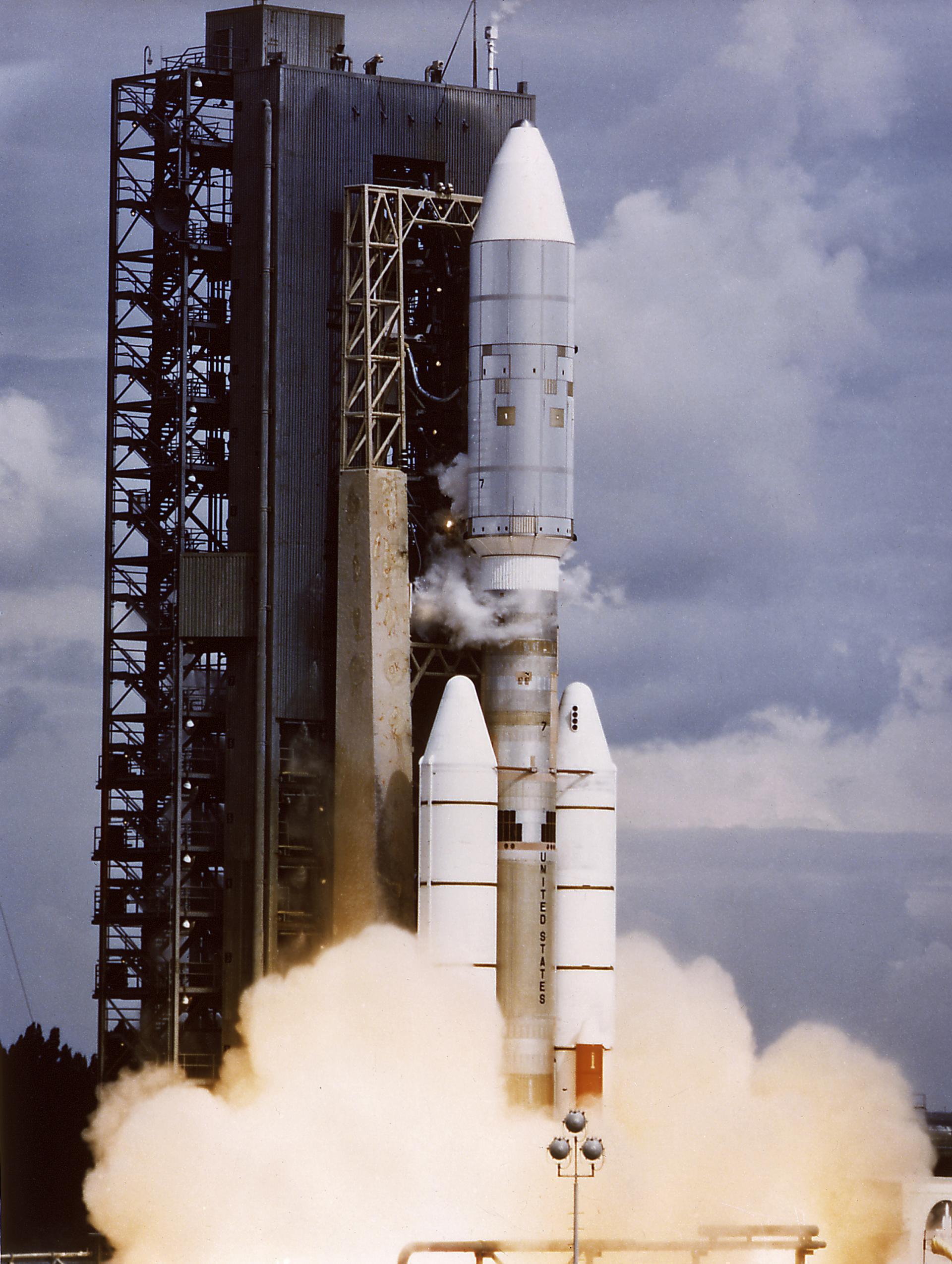
About the Titan IIIE
Titan IIIE
The Titan IIIE (also written Titan III-E) was an American expendable launch vehicle developed and operated by the United States Air Force in partnership with NASA, manufactured by Martin Marietta. A member of the long-running Titan rocket family, it represented one of the most capable heavy-lift vehicles available to American science and exploration programs during the 1970s, standing 48.8 meters tall with a core diameter of 3.05 meters and a rated payload capacity to low Earth orbit of 15,400 kilograms.
Design and Configuration
The Titan IIIE combined a two-stage liquid-fueled Titan III core with a pair of large solid rocket boosters strapped to its sides, giving it the considerable thrust needed to dispatch heavy payloads. Its upper stage of choice was the Centaur, a cryogenic hydrogen-fueled stage that provided the high energy necessary for demanding interplanetary trajectories. This Titan-Centaur combination made the vehicle uniquely suited to missions that needed not just raw lift, but the velocity to escape Earth's gravity well entirely — a quality that defined nearly every mission it flew.
Flight History
Our records show the Titan IIIE conducted 7 tracked flights between 1974 and 1977, achieving 6 successes alongside 1 failure or partial failure. Despite its relatively brief operational window, its mission manifest reads as a remarkable chapter in the history of robotic space exploration.
The vehicle launched both Viking 1 and Viking 2, NASA's landmark Mars landers that became the first spacecraft to successfully operate on the Martian surface. It also lofted the Helios-A and Helios-B solar probes, a joint NASA–West German project that set records for the closest approach to the Sun achieved by a man-made object at the time. Most famously, the Titan IIIE was the rocket that sent both Voyager 1 and Voyager 2 on their way — the twin interplanetary probes that conducted the first detailed reconnaissance of the outer solar system and ultimately became the first human-made objects to enter interstellar space.
The primary customer represented in the flight record is Lockheed Martin, reflecting the vehicle's close association with major government and scientific procurement of the era.
Legacy
In just four years of operation, the Titan IIIE was entrusted with some of the most scientifically consequential missions in NASA history. The combination of heavy-lift capacity, the high-energy Centaur upper stage, and a reliable (though not perfect) flight record made it the instrument of choice when the agency needed to send large, sophisticated spacecraft on ambitious deep-space journeys.
The vehicle's contributions to planetary science are difficult to overstate. The Voyager missions alone — still operating decades later — transformed humanity's understanding of Jupiter, Saturn, Uranus, and Neptune. The Viking landers redefined what was known about Mars. The Helios probes expanded knowledge of the inner solar system. That this handful of flights produced such enduring scientific returns makes the Titan IIIE one of the most consequential launch vehicles, flight-for-flight, in the history of spaceflight.
- Sep 05, 1977Titan IIIE | Voyager 1Success
- Aug 20, 1977Titan IIIE | Voyager 2Success
- Jan 15, 1976Titan IIIE | Helios-BSuccess
- Sep 09, 1975Titan IIIE | Viking 2Success
- Aug 20, 1975Titan IIIE | Viking 1Success
- Dec 10, 1974Titan IIIE | Helios-ASuccess
- Feb 11, 1974Titan IIIE | Sphinx (Titan IIIE Maiden Flight)Failure