Titan II SLV
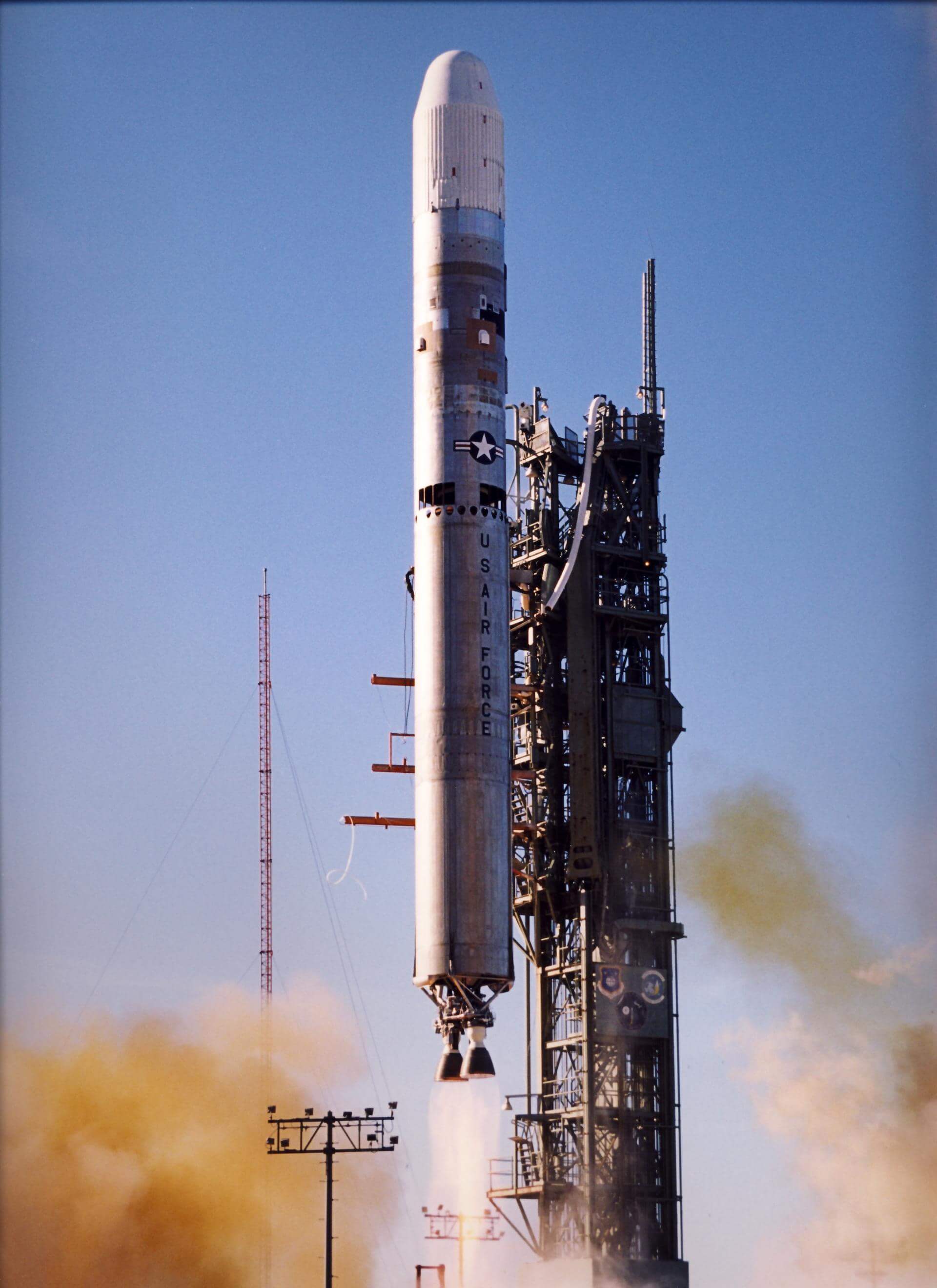
About the Titan II SLV
Titan II SLV
The Titan II SLV (Space Launch Vehicle) is an American orbital launch vehicle derived from the Titan II intercontinental ballistic missile, converted for civil and military satellite deployment. Operated by the United States Air Force, it represents one of the most successful examples of a repurposed Cold War-era ICBM being transitioned into a reliable small-satellite workhorse.
Origins and Development
The Titan II began its life as a second-generation ICBM deployed by the U.S. Air Force during the 1960s. Following the retirement of the missile from nuclear service in the 1980s, surplus airframes were refurbished and modified by Martin Marietta (later Lockheed Martin) for use as space launch vehicles. The conversion program stripped the warhead-carrying hardware and replaced it with a payload fairing suitable for orbital missions, giving the vehicle a second operational life as an affordable government launch asset.
Standing 31.4 meters tall with a diameter of 3.05 meters, the Titan II SLV is a two-stage liquid-propellant rocket. Its propellants — nitrogen tetroxide as oxidizer and Aerozine 50 as fuel — were inherited directly from its ICBM heritage, a combination notable for being hypergolic, meaning the propellants ignite on contact without a separate ignition system. This characteristic contributed to operational simplicity and reliability.
Operational History
According to tracked flight records, the Titan II SLV conducted 13 orbital launch attempts between 1988 and 2003, achieving 12 successes alongside one failure or partial failure. This represents a strong reliability record for a vehicle built on reconditioned missile hardware. The rocket was capable of lifting approximately 3,600 kilograms to low Earth orbit, placing it firmly in the medium-small launch category and making it well-suited for government Earth observation and weather satellites.
Launches took place from Vandenberg Air Force Base in California, a facility historically favored for missions requiring polar or sun-synchronous orbits — precisely the orbital regimes needed by the remote-sensing and meteorological payloads the Titan II SLV most frequently carried.
Notable Missions
The vehicle's customer manifest was dominated by the United States Air Force and associated government agencies. Among its most prominent missions were multiple flights supporting the Defense Meteorological Satellite Program (DMSP), including the DMSP F-15 and DMSP F-16 spacecraft, which provide critical weather data for military operations. The rocket also lofted several NOAA weather satellites — including NOAA 16 and NOAA 17 — serving civilian meteorological needs. Other notable payloads included QuikScat, a NASA scatterometer satellite designed to measure ocean surface wind speeds, and Coriolis, a joint military and scientific mission.
Legacy
The Titan II SLV occupies a distinctive place in spaceflight history as a cost-effective bridge between the ICBM age and the modern era of dedicated small satellite launchers. By extracting further utility from decommissioned strategic missiles, the program delivered genuine scientific and operational value at a reduced cost compared to developing an entirely new vehicle. Its final flights in the early 2000s closed the chapter on Titan II hardware after roughly four decades of service in one form or another.
- Oct 18, 2003Titan II SLV | DMSP F-16Success
- Jan 06, 2003Titan II SLV | CoriolisSuccess
- Jun 24, 2002Titan II SLV | NOAA 17Success
- Sep 21, 2000Titan II SLV | NOAA 16Success
- Dec 12, 1999Titan II SLV | DMSP F-15Success
- Jun 20, 1999Titan II SLV | QuikScatSuccess
- May 13, 1998Titan II SLV | NOAA 15Success
- Apr 04, 1997Titan II SLV | DMSP-5D2 F14Success
- Jan 25, 1994Titan II SLV | Clementine 1Success
- Oct 05, 1993Titan II SLV | Landsat 6Failure
- Apr 25, 1992Titan II SLV | P-11 5105Success
- Sep 06, 1989Titan II SLV | P-11 5104Success
- Sep 05, 1988Titan II SLV | P-11 5103Success