Titan 404A
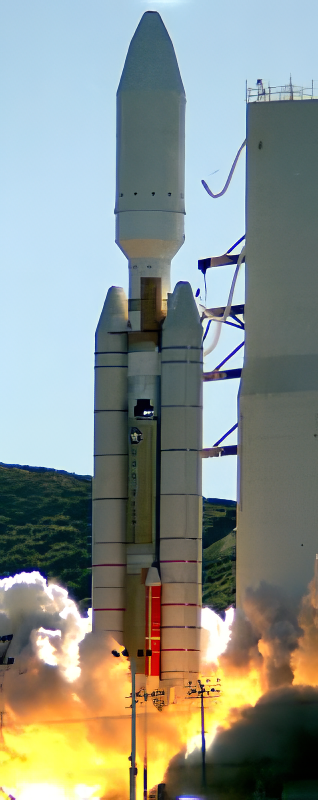
About the Titan 404A
Titan 404A
The Titan 404A is an American expendable heavy-lift launch vehicle operated by the United States Air Force, developed as part of the long-running Titan rocket family originally designed and built by Martin Marietta (later Lockheed Martin). It represents one of the most capable configurations of the Titan IV series, purpose-built to deliver large, classified national security payloads into orbit from Vandenberg Air Force Base in California.
Background and Development
The Titan IV program emerged in the 1980s as the U.S. Air Force sought a domestic heavy-lift capability to support critical reconnaissance and intelligence satellite missions, particularly following the decision to remove classified payloads from the Space Shuttle manifest after the *Challenger* disaster in 1986. The 404A designation refers to a specific Titan IV configuration flying without an upper stage, relying on the vehicle's core performance to place payloads directly into their target orbits. Standing 54 meters tall with a core diameter of 3.05 meters, the Titan 404A is an imposing vehicle augmented by two large solid rocket motor upgrades strapped to its liquid-fueled core stages.
Performance and Configuration
The Titan 404A is capable of delivering approximately 17,700 kilograms to low Earth orbit, placing it firmly in the heavy-lift class and making it well suited for the large, sophisticated reconnaissance satellites it was designed to carry. Without an upper stage, the vehicle depends on the trajectory and energy imparted by its two liquid-propellant core stages, along with its powerful strap-on solid boosters, to achieve the required orbital insertion. This configuration kept complexity and mission timelines streamlined for high-priority national security launches.
Flight History
In our tracking data, the Titan 404A recorded three flights between 1992 and 1996, all of which were successful. This perfect success rate across its operational period reflects both the maturity of the Titan IV airframe and the rigorous quality standards applied to launches carrying irreplaceable intelligence assets.
All three tracked missions carried KH-11 electro-optical reconnaissance satellites — designated KH-11 10, KH-11 11, and KH-11 12 — for the National Reconnaissance Office (NRO) on behalf of the U.S. Air Force. The KH-11, sometimes referred to in open sources by the codename *Kennan* or later *Crystal*, is a large optical imaging satellite broadly comparable in design concept to the Hubble Space Telescope and represents one of the most strategically significant intelligence-gathering platforms ever fielded by the United States. The scale and sensitivity of the KH-11 program demanded a launcher with the Titan 404A's substantial payload capacity, and the vehicle delivered reliably across every mission in this series.
Legacy
Although the Titan 404A flew only a small number of times in the configuration tracked here, its role in sustaining American overhead reconnaissance capabilities during the early 1990s — a period spanning the end of the Cold War and the Gulf War — made it a vehicle of considerable strategic importance. The broader Titan IV family continued operations into the early 2000s before being retired, succeeded by newer heavy-lift systems including the Delta IV Heavy and Atlas V.