Titan 34D
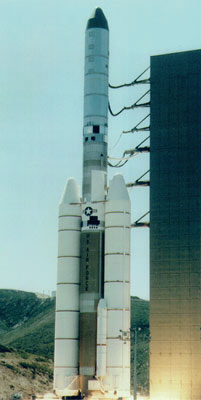
About the Titan 34D
Titan 34D
The Titan 34D was an American expendable launch vehicle operated by the United States Air Force and manufactured by Martin Marietta. A member of the long-running Titan rocket family, it served as the primary heavy-lift workhorse for classified national security payloads during the mid-1980s, bridging a critical era in American military space operations before the transition to newer launch systems.
Design and Capabilities
Standing 50 meters tall with a core diameter of 3.05 meters, the Titan 34D was an enlarged and upgraded derivative of earlier Titan III configurations. It paired a liquid-fueled core stage with two large solid rocket motor strap-on boosters, giving it the muscle needed to loft heavy reconnaissance satellites into demanding orbits. The vehicle was capable of delivering 14,515 kg to low Earth orbit and 5,000 kg to geostationary transfer orbit, making it one of the most capable American launch vehicles of its generation. Launches took place from Vandenberg Air Force Base in California and Cape Canaveral in Florida, depending on the orbital requirements of a given mission.
Operational History
The Titan 34D flew across an active period spanning 1983 to 1988, during which this site's flight record documents 7 tracked missions. Of those, 5 were fully successful, while 2 resulted in failures or partial failures — a sobering reminder of the technical challenges inherent in operating large, complex launch vehicles during this period.
The vehicle's customer manifest was dominated entirely by the United States Air Force, reflecting its purpose-built role as a launcher for sensitive government payloads. Among the most notable missions tracked are flights carrying KH-11 electro-optical reconnaissance satellites and the final examples of the venerable KH-9 film-return reconnaissance satellite — including KH-9 19 and KH-9 20, the latter representing one of the last flights of that storied program. The KH-11 missions — designated here as KH-11 6, 7, 8, and 9 — placed advanced imaging satellites into orbit in support of national intelligence objectives.
Failures and Legacy
The two failures within the Titan 34D's flight record had significant consequences for American space capabilities. One notable loss occurred in 1985 and another in 1986, each destroying high-value reconnaissance payloads. The 1986 failure, coming in the same year as the *Challenger* disaster, contributed to a severe strain on U.S. launch capacity and accelerated discussions about launch vehicle reliability and redundancy within the national security space community.
Despite these setbacks, the Titan 34D successfully performed the majority of its assigned missions and upheld the Titan family's reputation as a reliable heavy-lift platform for the most demanding government payloads. Its legacy informed the development of the Titan IV, which succeeded it as the Air Force's principal expendable heavy-lift vehicle in the late 1980s and 1990s.
The Titan 34D occupies a notable place in Cold War spaceflight history — a largely classified but operationally significant vehicle that kept American reconnaissance satellite programs functioning through one of the most consequential decades of the Space Age.