Titan 34B
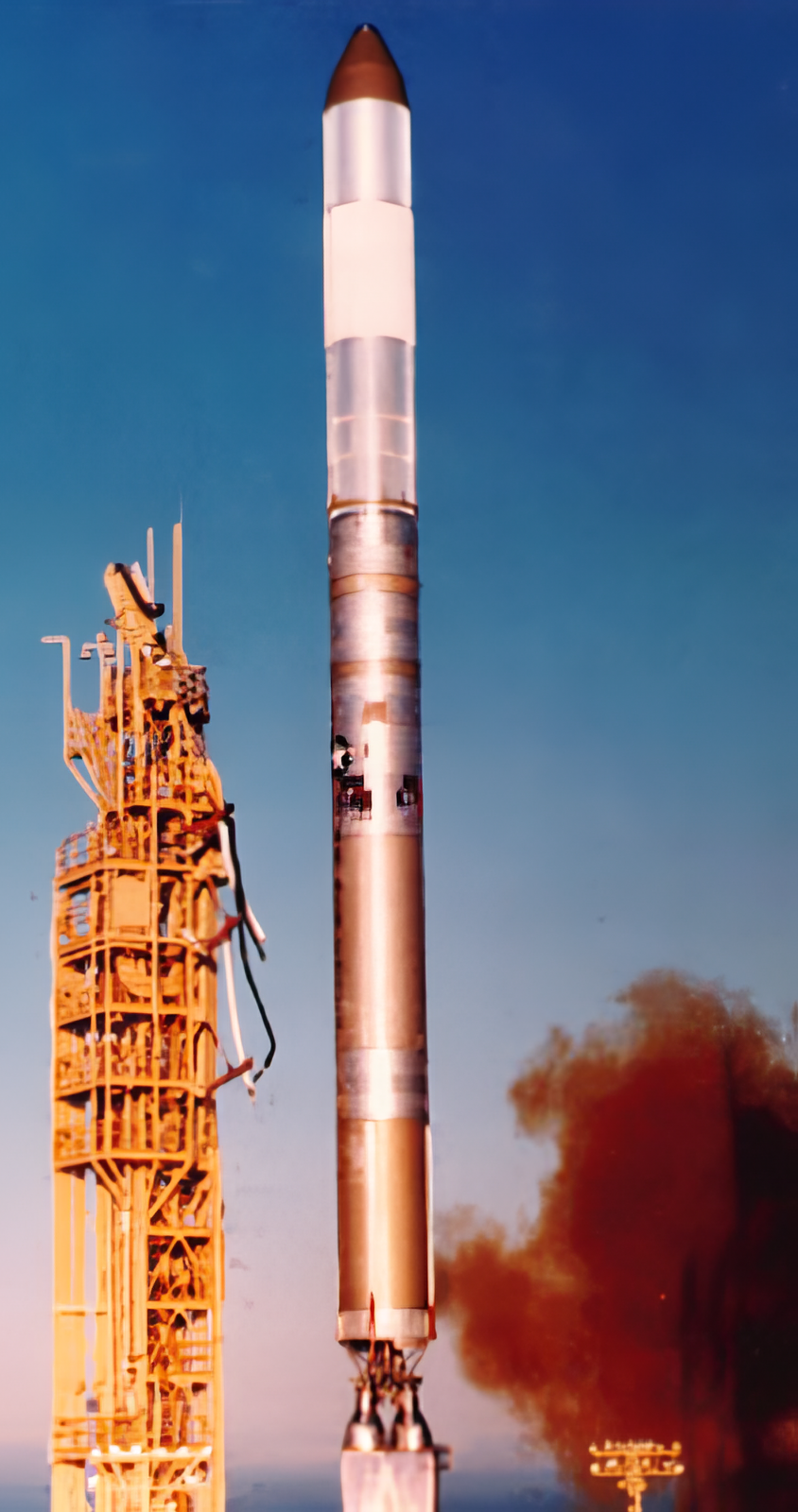
About the Titan 34B
Titan 34B
The Titan 34B was an American expendable launch vehicle operated by the United States Air Force and manufactured by Martin Marietta. A member of the long-running Titan rocket family, the 34B served as a dedicated workhorse for classified military satellite missions throughout the late Cold War era, flying exclusively from Vandenberg Air Force Base in California into orbits suited to national security payloads.
Design and Configuration
Standing 48 meters tall with a core diameter of 3.05 meters, the Titan 34B was derived from the earlier Titan IIIB configuration, pairing a liquid-fueled core stage with an Agena D upper stage. The Agena provided both the final orbital insertion burn and on-orbit maneuvering capability, a combination particularly well suited to reconnaissance and signals intelligence missions that required precise placement. The vehicle could deliver up to 3,500 kilograms to low Earth orbit, giving it the muscle needed for the relatively heavy classified payloads of the era.
Unlike some members of the Titan III family, the 34B did not use large solid rocket boosters strapped to its core. Its stretched core stages provided enhanced propellant capacity compared to earlier Titan IIIB variants, allowing it to handle the heavier payloads that advanced reconnaissance satellites demanded by the mid-1970s.
Operational History
The Titan 34B entered service in 1975 and remained active through 1987, a span of more than a decade during which it compiled an impressive reliability record. Our flight data records 11 launches, all successful, with no failures or partial failures attributed to the vehicle across its operational life — a testament to the maturity of the Titan design and the rigorous standards applied to military space launch programs of the period.
The vehicle's manifest was dominated by two families of classified payloads. The Jumpseat satellites, carried on missions including Jumpseat 6 and Jumpseat 7, are understood to have been signals intelligence craft placed into highly elliptical Molniya-type orbits. The Quasar payloads — represented in recent tracked missions by Quasar 4 through Quasar 7 — served as data-relay satellites supporting the real-time downlink of imagery from other reconnaissance platforms, most notably the KH-11 Kennen. The ability to relay imagery in near-real time was a transformative capability for American intelligence during this period, and the Titan 34B was central to establishing and sustaining that architecture.
Legacy
The Titan 34B occupied a specialized but strategically vital niche within the American space launch portfolio. By flying solely on behalf of the Air Force and its intelligence community partners, it exemplified the era's approach to compartmentalizing sensitive space programs behind dedicated, purpose-configured launch vehicles. Its perfect success rate across eleven missions underscored the reliability that made the broader Titan family a cornerstone of both military and civil space operations for decades. The Titan 34B was eventually retired as newer and more capable launch systems took over the national security launch mission in the late 1980s.
- Feb 12, 1987Titan 34B | Quasar 7Success
- Feb 08, 1985Titan 34B | Quasar 6Success
- Aug 28, 1984Titan 34B | Quasar 5Success
- Jul 31, 1983Titan 34B | Jumpseat 7Success
- Apr 24, 1981Titan 34B | Jumpseat 6Success
- Dec 13, 1980Titan 34B | Quasar 4Success
- Aug 05, 1978Titan 34B | Quasar 3Success
- Feb 25, 1978Titan 34B | Jumpseat 5Success
- Aug 06, 1976Titan 34B | Quasar 2Success
- Jun 02, 1976Titan 34B | Quasar 1Success
- Mar 10, 1975Titan 34B | Jumpseat 4Success