Thorad SLV-2H Agena D
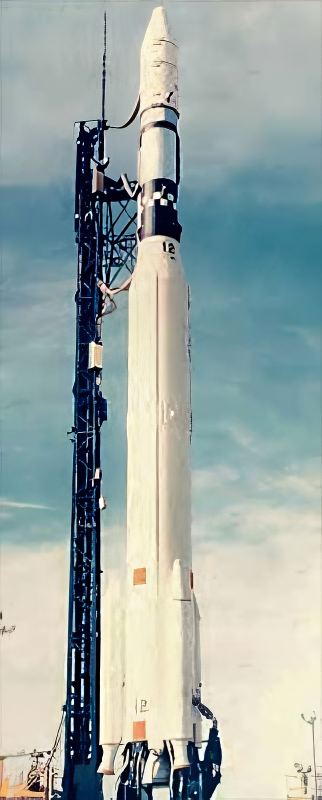
About the Thorad SLV-2H Agena D
Thorad SLV-2H Agena D
The Thorad SLV-2H Agena D is an American expendable orbital launch vehicle developed and operated on behalf of the United States Air Force during the early 1970s. A member of the broader Thor-Agena family, it combined an uprated Thor booster — the "Thorad," or Thrust Augmented Long Tank Thor — with the proven Agena D upper stage to produce a capable two-stage system tailored for reconnaissance satellite missions.
Origins and Design
The vehicle emerged from a long lineage of Thor-derived rockets that served as workhorses for U.S. military space programs throughout the 1960s. The Thorad variant incorporated a lengthened first-stage propellant tank and three strap-on solid rocket boosters to increase lift capability compared to earlier Thor configurations. The Agena D upper stage, already well-established by the time this variant flew, provided reliable on-orbit maneuvering and was well suited to the precise insertion requirements of reconnaissance payloads. Standing approximately 34 meters tall with a diameter of 2.44 meters, the vehicle had a slender, workmanlike profile representative of American medium-lift rockets of its era.
Operational History
The Thorad SLV-2H Agena D was active from 1969 through 1972, a focused operational window during which it flew 13 tracked missions. Of those, 12 were successful, with one resulting in a failure or partial failure — a reliability record consistent with the mature engineering underpinning both the Thor and Agena lineages. Launches were conducted from the Vandenberg Air Force Base on the California coast, the standard site for polar-orbiting reconnaissance missions requiring passes over denied territory.
The vehicle's mission manifest was dominated by satellites flown under the KH-4B program, the final and most capable iteration of the CORONA photographic reconnaissance system. KH-4B spacecraft carried dual-camera panoramic systems and return capsules that delivered exposed film to recovery crews, providing critical intelligence imagery during a pivotal period of the Cold War. Recent missions in the flight record include KH-4B 17, KH-4B 16, KH-4B 15, KH-4B 14, and KH-4B 13, underscoring the vehicle's close identification with this intelligence program. One notable mission, Strawman 4, indicates the vehicle also supported at least one additional classified payload beyond the core CORONA series.
Legacy and Significance
The Thorad SLV-2H Agena D represents the operational peak of the CORONA era, delivering the most refined film-return reconnaissance satellites the program produced. Its brief but productive service life — concentrated into just three years — reflects both the maturity and the coming obsolescence of the Thor-Agena approach, as electro-optical systems and newer launch vehicles would soon supplant film-return technology. Nevertheless, the missions it supported yielded intelligence of lasting strategic value and contributed to the broader history of American national security space operations. The vehicle stands as a capable and dependable instrument of a formative chapter in military spaceflight.
- May 25, 1972Thorad SLV-2H Agena D | KH-4B 17Success
- Apr 19, 1972Thorad SLV-2H Agena D | KH-4B 16Success
- Sep 10, 1971Thorad SLV-2H Agena D | KH-4B 15Success
- Jul 16, 1971Thorad SLV-2H Agena D | Strawman 4Success
- Mar 24, 1971Thorad SLV-2H Agena D | KH-4B 14Success
- Feb 17, 1971Thorad SLV-2H Agena D | KH-4B 13Failure
- Nov 18, 1970Thorad SLV-2H Agena D | KH-4B 12Success
- Jul 23, 1970Thorad SLV-2H Agena D | KH-4B 11Success
- May 20, 1970Thorad SLV-2H Agena D | KH-4B 10Success
- Mar 04, 1970Thorad SLV-2H Agena D | KH-4B 9Success
- Dec 04, 1969Thorad SLV-2H Agena D | KH-4B 8Success
- Jul 24, 1969Thorad SLV-2H Agena D | KH-4B 7Success
- Jun 05, 1969Thorad SLV-2H Agena D | OGO 6Success