Thorad SLV-2G Agena D
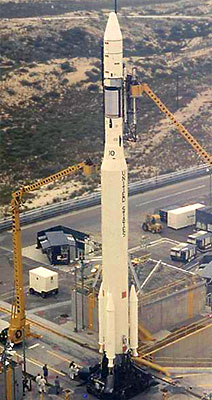
About the Thorad SLV-2G Agena D
Thorad SLV-2G Agena D
The Thorad SLV-2G Agena D is an American expendable orbital launch vehicle developed to serve the classified and scientific satellite programs of the United States Air Force and associated government agencies during the late 1960s and early 1970s. A member of the broader Thor-Agena family, it combined an augmented Thor booster with the proven Agena D upper stage to deliver payloads into polar and low Earth orbits from Vandenberg Air Force Base in California.
Origins and Design
The vehicle emerged from the long lineage of Thor-based rockets that underpinned a substantial portion of American spaceflight activity in the 1960s. The "Thorad" designation — short for Thor Augmented Delta — reflects the addition of three Castor solid-fuel strap-on boosters to the core Thor missile airframe, substantially increasing the vehicle's lift capability over earlier, unaugmented configurations. This augmented first stage was mated to the Agena D, a versatile and restartable upper stage that had already demonstrated its reliability across numerous programs. Standing 32.9 meters tall with a core diameter of 2.44 meters, the vehicle presented a compact but capable profile suited to the reconnaissance and research missions it most commonly flew.
Operational History
Our flight record captures 30 tracked flights conducted between 1966 and 1971, of which 29 were successful and one resulted in a failure or partial failure — a strong reliability record for a vehicle of its era. This five-year operational window placed the Thorad SLV-2G Agena D squarely within a pivotal period of Cold War space activity, during which the United States maintained an intensive cadence of intelligence-gathering and experimental satellite launches.
The United States Air Force was the dominant customer, consistent with the vehicle's primary role supporting defense-related payloads. Recent missions tracked in our database illustrate the breadth of its manifest: the Poppy 8 and Poppy 9 clusters delivered multiple signals intelligence satellites in a single launch each, reflecting the vehicle's capability to deploy small satellite constellations. The Nimbus 4 mission served NASA's Earth observation program, demonstrating that the Thorad SLV-2G Agena D also supported civilian scientific objectives. SERT 2 (Space Electric Rocket Test 2) validated ion propulsion technology in orbit, while ASTEX and Strawman 3 represent the classified manifests that characterized much of the vehicle's service life.
Legacy
The Thorad SLV-2G Agena D occupied an important niche in the American launch vehicle stable, offering more performance than the basic Thor-Agena while remaining simpler and more economical than larger systems. Its strong success rate and flexible Agena D upper stage — capable of restarting its engine on orbit to perform precise maneuvers — made it a reliable choice for both intelligence community and scientific users. By the time its operational period closed in 1971, the vehicle had helped establish foundational infrastructure for American signals intelligence, Earth observation, and experimental space technology programs that would define the following decades.
- Dec 14, 1971Thorad SLV-2G Agena D | Poppy 9A,B,C,DSuccess
- Oct 17, 1971Thorad SLV-2G Agena D | ASTEXSuccess
- Aug 26, 1970Thorad SLV-2G Agena D | Strawman 3Success
- Apr 08, 1970Thorad SLV-2G Agena D | Nimbus 4Success
- Feb 04, 1970Thorad SLV-2G Agena D | SERT 2Success
- Sep 30, 1969Thorad SLV-2G Agena D | Poppy 8A,B,C,DSuccess
- Sep 22, 1969Thorad SLV-2G Agena D | KH-4A 52Success
- Jul 31, 1969Thorad SLV-2G Agena D | Strawman 2Success
- May 02, 1969Thorad SLV-2G Agena D | KH-4A 51Success
- Apr 14, 1969Thorad SLV-2G Agena D | Nimbus 3Success
- Mar 19, 1969Thorad SLV-2G Agena D | KH-4A 50Success
- Feb 05, 1969Thorad SLV-2G Agena D | KH-4B 6Success
- Dec 12, 1968Thorad SLV-2G Agena D | KH-4A 49Success
- Nov 03, 1968Thorad SLV-2G Agena D | KH-4B 5Success
- Oct 05, 1968Thorad SLV-2G Agena D | Strawman 1Success
- Sep 18, 1968Thorad SLV-2G Agena D | KH-4A 48Success
- Aug 07, 1968Thorad SLV-2G Agena D | KH-4B 4Success
- Jun 20, 1968Thorad SLV-2G Agena D | KH-4A 47Success
- May 18, 1968Thorad SLV-2G Agena D | Nimbus BFailure
- May 01, 1968Thorad SLV-2G Agena D | KH-4B 3Success
- Mar 14, 1968Thorad SLV-2G Agena D | KH-4A 46Success
- Jan 24, 1968Thorad SLV-2G Agena D | KH-4A 45Success
- Dec 09, 1967Thorad SLV-2G Agena D | KH-4B 2Success
- Nov 02, 1967Thorad SLV-2G Agena D | KH-4A 44Success
- Sep 15, 1967Thorad SLV-2G Agena D | KH-4B 1Success
- Aug 07, 1967Thorad SLV-2G Agena D | KH-4A 43Success
- Jun 16, 1967Thorad SLV-2G Agena D | KH-4A 42Success
- May 09, 1967Thorad SLV-2G Agena D | KH-4A 41Success
- Nov 08, 1966Thorad SLV-2G Agena D | KH-4A 37Success
- Aug 09, 1966Thorad SLV-2G Agena D | KH-4A 35Success