Thor SLV-2A Agena D
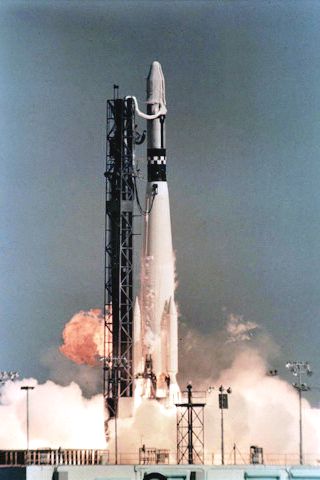
About the Thor SLV-2A Agena D
Thor SLV-2A Agena D
The Thor SLV-2A Agena D is an American expendable orbital launch vehicle developed during the early 1960s, combining a Thor ballistic missile first stage with the versatile Agena D upper stage. Operated primarily by the United States Air Force, it served as a workhorse of the U.S. government's space launch program throughout the mid-1960s, supporting a wide range of reconnaissance, scientific, and experimental satellite missions.
Development and Configuration
The vehicle belongs to the broader family of Thor-Agena combinations that formed the backbone of American launch activity during the early Space Age. The SLV-2A designation refers to a standardized, improved variant of the Thor booster, while the Agena D upper stage represented the most capable and widely produced iteration of the Agena series. Standing 31 meters tall with a diameter of 2.44 meters, the rocket offered a compact but capable profile well suited to the polar and sun-synchronous orbits favored by reconnaissance satellites. Launches were conducted primarily from Vandenberg Air Force Base in California, which provided the necessary southward launch corridors for low-Earth polar orbits.
The Agena D upper stage was notable for its restartable engine, giving mission planners considerable flexibility in achieving precise orbital insertions. This capability made the stage attractive for a variety of payload types, from classified intelligence satellites to open scientific spacecraft.
Operational History
According to tracked flight records, the Thor SLV-2A Agena D flew 61 missions between 1963 and 1968, achieving 57 successful outcomes alongside 4 failures or partial failures — a strong reliability record for its era. The vehicle's peak operational period coincided with an intense phase of American space reconnaissance activity, and the United States Air Force was by far its dominant customer.
Among the most significant payloads carried were satellites in the KH-4A series, part of the Corona reconnaissance program that provided critical photographic intelligence during the Cold War. Missions such as KH-4A 38, KH-4A 39, and KH-4A 40 exemplify the vehicle's central role in national security space operations. The rocket also supported multi-payload launches, including the Multigroup missions that placed several satellites into orbit on a single flight, demonstrating an early form of rideshare capability.
Beyond reconnaissance, the Thor SLV-2A Agena D carried scientific payloads into orbit. The OGO 4 mission, part of NASA's Orbiting Geophysical Observatory program, illustrated the vehicle's ability to serve civilian scientific objectives alongside its dominant military role. Similarly, Setter program payloads reflect the vehicle's use in experimental and technology-demonstration contexts.
Legacy
The Thor SLV-2A Agena D occupies an important place in spaceflight history as a highly reliable and adaptable launch system during a formative decade for American space power. Its combination of a proven ballistic missile core with a flexible, restartable upper stage made it suitable for a diverse mission portfolio. By the close of its operational life in 1968, it had helped establish the operational patterns — polar launch sites, small reconnaissance satellites, multi-payload manifests — that would define U.S. national security space launches for decades to come.
- Jan 17, 1968Thor SLV-2A Agena D | Multigroup 3 & Setter 1B-2Success
- Jul 28, 1967Thor SLV-2A Agena D | OGO 4Success
- Jul 25, 1967Thor SLV-2A Agena D | Multigroup 2 & Setter 1BSuccess
- Mar 30, 1967Thor SLV-2A Agena D | KH-4A 40Success
- Feb 22, 1967Thor SLV-2A Agena D | KH-4A 39Success
- Jan 14, 1967Thor SLV-2A Agena D | KH-4A 38Success
- Dec 29, 1966Thor SLV-2A Agena D | Multigroup 1 & Setter 1ASuccess
- Sep 20, 1966Thor SLV-2A Agena D | KH-4A 36Success
- Jun 24, 1966Thor SLV-2A Agena D | PageosSuccess
- Jun 21, 1966Thor SLV-2A Agena D | KH-4A 34Success
- May 24, 1966Thor SLV-2A Agena D | KH-4A 33Success
- May 03, 1966Thor SLV-2A Agena D | KH-4A 32Failure
- Apr 07, 1966Thor SLV-2A Agena D | KH-4A 31Success
- Mar 09, 1966Thor SLV-2A Agena D | KH-4A 30Success
- Feb 09, 1966Thor SLV-2A Agena D | P-770 Group 3-D 2Success
- Feb 02, 1966Thor SLV-2A Agena D | KH-4A 29Success
- Dec 24, 1965Thor SLV-2A Agena D | KH-4A 28Success
- Dec 09, 1965Thor SLV-2A Agena D | KH-4A 27Success
- Oct 28, 1965Thor SLV-2A Agena D | KH-4A 26Success
- Oct 14, 1965Thor SLV-2A Agena D | OGO 2Success
- Oct 05, 1965Thor SLV-2A Agena D | KH-4A 25Success
- Sep 22, 1965Thor SLV-2A Agena D | KH-4A 24Success
- Aug 17, 1965Thor SLV-2A Agena D | KH-4A 23Success
- Jul 19, 1965Thor SLV-2A Agena D | KH-4A 22Success
- Jul 17, 1965Thor SLV-2A Agena D | P-770 Group 3-A 1Success
- Jun 09, 1965Thor SLV-2A Agena D | KH-4A 21Success
- May 18, 1965Thor SLV-2A Agena D | KH-4A 20Success
- Apr 29, 1965Thor SLV-2A Agena D | KH-4A 19Success
- Mar 25, 1965Thor SLV-2A Agena D | KH-4A 18Success
- Feb 25, 1965Thor SLV-2A Agena D | KH-4A 17Success
- Jan 15, 1965Thor SLV-2A Agena D | KH-4A 16Success
- Dec 21, 1964Thor SLV-2A Agena D | Quill 1Success
- Dec 19, 1964Thor SLV-2A Agena D | KH-4A 15Success
- Nov 18, 1964Thor SLV-2A Agena D | KH-4A 14Success
- Nov 04, 1964Thor SLV-2A Agena D | P-698BK Group 3-D 1Success
- Nov 02, 1964Thor SLV-2A Agena D | KH-4A 13Success
- Oct 17, 1964Thor SLV-2A Agena D | KH-4A 12Success
- Oct 05, 1964Thor SLV-2A Agena D | KH-4A 11Success
- Sep 14, 1964Thor SLV-2A Agena D | KH-4A 10Success
- Aug 21, 1964Thor SLV-2A Agena D | KH-5 12Success
- Aug 05, 1964Thor SLV-2A Agena D | KH-4A 9Success
- Jul 10, 1964Thor SLV-2A Agena D | KH-4A 8Success
- Jul 02, 1964Thor SLV-2A Agena D | P-698BK Group 2-D 2Success
- Jun 19, 1964Thor SLV-2A Agena D | KH-4A 7Success
- Jun 13, 1964Thor SLV-2A Agena D | KH-5 11Success
- Jun 04, 1964Thor SLV-2A Agena D | KH-4A 6Success
- Apr 27, 1964Thor SLV-2A Agena D | KH-4A 5Success
- Mar 24, 1964Thor SLV-2A Agena D | KH-4A 4Failure
- Feb 28, 1964Thor SLV-2A Agena D | P-698BK Group 1-ASuccess
- Feb 15, 1964Thor SLV-2A Agena D | KH-4A 3Success
- Jan 11, 1964Thor SLV-2A Agena D | Poppy 5A, 5B & 5CSuccess
- Dec 21, 1963Thor SLV-2A Agena D | KH-4 26Success
- Oct 29, 1963Thor SLV-2A Agena D | KH-5 10Success
- Sep 23, 1963Thor SLV-2A Agena D | KH-4A 2Success
- Aug 25, 1963Thor SLV-2A Agena D | KH-4A 1Success
- Jul 31, 1963Thor SLV-2A Agena D | KH-6 3Success
- Jun 27, 1963Thor SLV-2A Agena D | KH-4 22Success
- Jun 12, 1963Thor SLV-2A Agena D | KH-4 21Success
- May 18, 1963Thor SLV-2A Agena D | KH-6 2Success
- Mar 18, 1963Thor SLV-2A Agena D | KH-6 1Failure
- Feb 28, 1963Thor SLV-2A Agena D | KH-4 19Failure