Thor SLV-2A Agena B
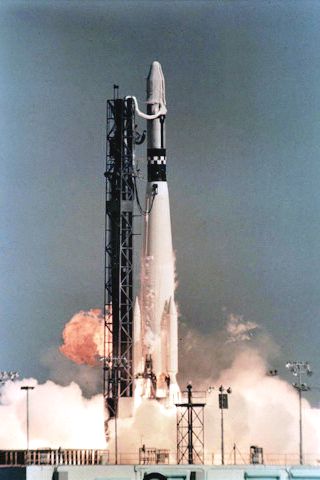
About the Thor SLV-2A Agena B
Thor SLV-2A Agena B
The Thor SLV-2A Agena B is an American expendable orbital launch vehicle developed during the early 1960s as part of the broader family of Thor-Agena rockets operated primarily by the United States Air Force. Combining a Thor ballistic missile derivative as its first stage with the Agena B upper stage, it served as a capable workhorse for government satellite programs during a particularly active period in the Space Race.
Origins and Design
The Thor-Agena family emerged from the U.S. military's urgent need to place reconnaissance, scientific, and experimental satellites into orbit with reliability and consistency. The SLV-2A designation identifies a specific, evolved configuration of the Thor first stage, while the Agena B upper stage — developed by Lockheed — brought a significant operational advantage over earlier Agena variants: a restartable engine that allowed mission planners greater flexibility in achieving precise orbital insertions. Standing 31 meters tall with a diameter of 2.44 meters, the vehicle had a slender, purposeful profile characteristic of the Thor-derived rocket family. Launches were conducted from Vandenberg Air Force Base in California, which provided the high-inclination trajectories favored by reconnaissance and Earth-observation missions.
Operational History
In the flight record associated with this website, the Thor SLV-2A Agena B is credited with 2 tracked flights, both successful, spanning an active period from 1963 to 1966. This clean success record reflects both the maturity of the Thor-Agena design by this stage of its development and the disciplined launch operations of the USAF programs it supported.
The most publicly recognized mission in this vehicle's record is the launch of Nimbus 2, a NASA meteorological satellite that advanced the science of global weather observation from orbit. Nimbus 2 demonstrated the growing ambition of American civil and scientific space programs during the mid-1960s and benefited directly from the Agena B's ability to deliver spacecraft to precise sun-synchronous-type orbits suited to Earth imaging.
The second tracked mission, P-698BK Group 1-D 2, represents the more secretive side of the vehicle's portfolio. Consistent with the USAF's heavy use of Thor-Agena vehicles for classified payloads, this mission's details remain limited in the open record, but it exemplifies the dual-use nature of the platform — serving both transparent scientific goals and sensitive national security objectives within the same vehicle generation.
Legacy and Context
The Thor SLV-2A Agena B sits within one of the most prolific and historically significant rocket families in the early history of spaceflight. Thor-derived vehicles, in their many configurations, carried hundreds of payloads across decades of American space activity. The Agena B stage in particular represented a meaningful step forward in upper-stage technology, helping to establish the restartable liquid-propellant upper stage as a standard tool of orbital mechanics.
Though the Thor SLV-2A Agena B itself flew in relatively small numbers in this site's records, its missions touched on some of the defining priorities of 1960s space activity: Earth observation, meteorology, and national security. It stands as a representative example of how the United States systematically converted ballistic missile technology into a versatile orbital launch capability during the formative years of the Space Age.