Thor SLV-2 Agena D
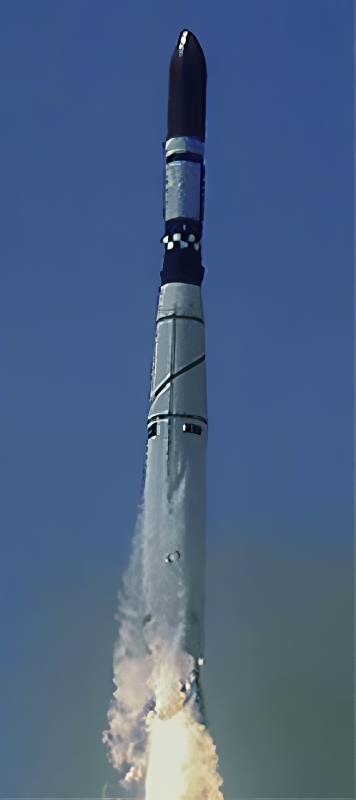
About the Thor SLV-2 Agena D
Thor SLV-2 Agena D
The Thor SLV-2 Agena D is an American expendable orbital launch vehicle combining a modified Thor ballistic missile first stage with the versatile Agena D upper stage. Operated primarily by the United States Air Force, the vehicle was developed to support a range of military reconnaissance and surveillance satellite programs during the Cold War era. It represents one of the most operationally significant configurations in the broader Thor-Agena family, which formed a cornerstone of early American space launch capability.
Design and Configuration
Standing 27.2 meters tall with a diameter of 2.44 meters, the Thor SLV-2 Agena D follows the general architecture established by earlier Thor-Agena variants. The SLV-2 designation refers to a standardized Thor booster optimized for space launch duties, while the Agena D upper stage was the most capable and widely used iteration of the Agena series. The Agena D was particularly valued for its restartable engine, an advanced feature for its era that allowed precise orbital insertion and the ability to adjust trajectories on a single mission — a critical capability for intelligence-gathering satellites.
Operational History
The Thor SLV-2 Agena D was active from 1963 to 1967, a period of intense American investment in reconnaissance satellite infrastructure. Based on the flight record tracked for this vehicle, eight flights were conducted in total, of which six were successful and two resulted in failure or partial failure — a respectable record reflective of the inherent difficulties of early spaceflight operations.
The vehicle's customer base was dominated entirely by the United States Air Force, underscoring its dedicated military role. Missions flown on this configuration were closely tied to classified national security programs. Notable payloads included multiple flights for the Poppy series — passive radar calibration and signals intelligence satellites — with the vehicle delivering clustered payloads such as Poppy 6A, B, C, D and Poppy 7A, B, C, D, demonstrating a capability to deploy multiple satellites in a single launch. Other significant missions carried DSAP-1 (Defense Satellite Applications Program) payloads and a KH-4 Corona reconnaissance satellite, the latter being part of America's pioneering photographic intelligence satellite effort. The MRPV mission further reflects the diverse but consistently classified nature of the vehicle's manifest.
Legacy and Context
The Thor SLV-2 Agena D occupied an important niche within the broader Thor-Agena family at a time when the United States was rapidly developing its national reconnaissance infrastructure. Launch operations for Thor-based vehicles of this era were conducted from Vandenberg Air Force Base in California, which provided the high-inclination polar orbits essential for reconnaissance coverage of Soviet territory.
While relatively modest in total flight count compared to some contemporaries, the missions flown by the Thor SLV-2 Agena D directly supported programs of considerable strategic importance. The vehicle's operational period aligns with a transformative chapter in space history, bridging early experimental reconnaissance efforts and the more mature satellite architectures that would follow in the late 1960s and beyond.
- May 31, 1967Thor SLV-2 Agena D | Poppy 7A,B,C,DSuccess
- Sep 02, 1965Thor SLV-2 Agena D | MRPVFailure
- Mar 09, 1965Thor SLV-2 Agena D | Poppy 6A,B,C,DSuccess
- Jun 18, 1964Thor SLV-2 Agena D | DSAP-1 F8 & F9Success
- Jan 19, 1964Thor SLV-2 Agena D | DSAP-1 F6 & F7Success
- Nov 27, 1963Thor SLV-2 Agena D | KH-4 25Success
- Nov 09, 1963Thor SLV-2 Agena D | KH-4 24 & RM 5Failure
- Aug 29, 1963Thor SLV-2 Agena D | KH-5 9Success