Thor DM-21 Agena-B
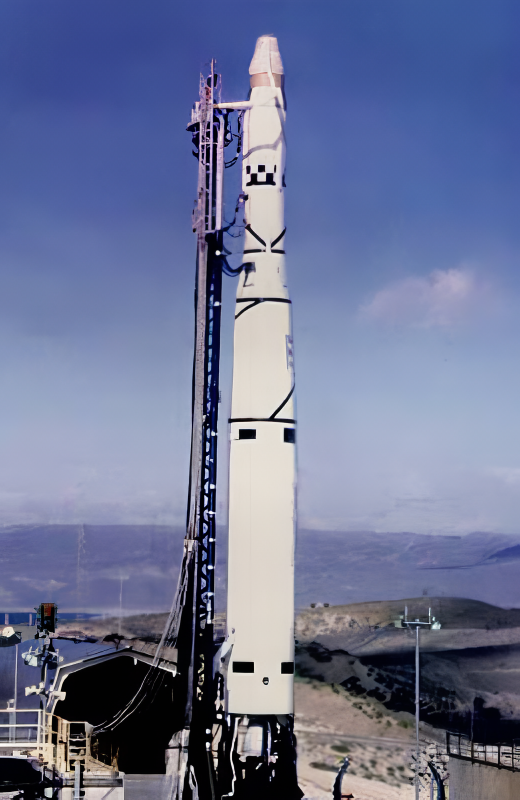
About the Thor DM-21 Agena-B
Thor DM-21 Agena-B
The Thor DM-21 Agena-B was an American orbital launch vehicle combining a Douglas-built Thor ballistic missile first stage with a Lockheed-built Agena-B upper stage. Operated primarily by the United States Air Force, it served as a workhorse of early American space reconnaissance and scientific satellite programs during the opening years of the Space Race.
Development and Design
The vehicle emerged from the broader family of Thor-based launch systems that the United States developed rapidly in the late 1950s and early 1960s. The DM-21 designation refers to a specific Thor variant optimized for space launch duties, while the Agena-B upper stage represented a significant improvement over its predecessor, offering a restartable engine and greater propellant capacity. This combination gave mission planners meaningful flexibility in placing payloads into a range of orbits, including the polar and near-polar paths favored by reconnaissance satellites. Launches were conducted primarily from Vandenberg Air Force Base in California, whose high-latitude location made it ideally suited for polar orbit missions.
Operational History
According to tracked flight data, the Thor DM-21 Agena-B flew 40 missions between 1960 and 1963, recording 32 successes and 8 failures or partial failures. This reliability profile was broadly representative of the era, when launch vehicle technology was still maturing rapidly and mission loss rates across the industry remained considerably higher than later standards.
The vehicle's customer base was dominated almost entirely by the United States Air Force, reflecting its central role in classified national security spaceflight. The majority of its missions supported the CORONA reconnaissance program, flying payloads under the KH-4 and KH-5 designations. These satellites were designed to photograph denied territory from orbit and return film via re-entry capsule, providing American intelligence agencies with unprecedented strategic imagery during the Cold War.
Notable Missions
Among the final missions in the tracked record, several stand out for their historical significance. Flights carrying KH-4 payloads — including KH-4 12, KH-4 14, and KH-4 15 — represented continued refinement of the CORONA system's imaging capability. The KH-5 series, exemplified by the KH-5 7 mission, supported geodetic mapping objectives that complemented the photographic reconnaissance effort.
The Alouette 1 mission is particularly noteworthy as a rare example of the vehicle being used for a scientific, non-reconnaissance purpose. Launched in 1962, Alouette 1 was a Canadian-built ionospheric research satellite, making it the first satellite designed and built by a country other than the United States or Soviet Union. Its successful delivery to orbit demonstrated the Thor DM-21 Agena-B's versatility beyond its primary intelligence-gathering role.
The P-698BK Group 1-D 1 mission, associated with early signals intelligence development programs, rounded out the vehicle's contributions to the classified space effort of the period.
Legacy
The Thor DM-21 Agena-B occupied a brief but consequential window in launch vehicle history. Its four active years coincided with a formative period in American space reconnaissance, and the missions it supported laid critical groundwork for the satellite intelligence infrastructure that would define Cold War-era national security strategy for decades.
- Jan 16, 1963Thor DM-21 Agena-B | P-698BK Group 1-D 1Success
- Nov 24, 1962Thor DM-21 Agena-B | KH-4 15Success
- Nov 05, 1962Thor DM-21 Agena-B | KH-4 14Success
- Oct 09, 1962Thor DM-21 Agena-B | KH-5 7Success
- Sep 29, 1962Thor DM-21 Agena-B | Alouette 1Success
- Sep 17, 1962Thor DM-21 Agena-B | KH-4 12Success
- Sep 01, 1962Thor DM-21 Agena-B | KH-5 6Success
- Jul 28, 1962Thor DM-21 Agena-B | KH-4 9Success
- Jul 21, 1962Thor DM-21 Agena-B | KH-4 8Success
- Jun 23, 1962Thor DM-21 Agena-B | KH-4 6Success
- Jun 18, 1962Thor DM-21 Agena-B | P-102 Group 2-D 1Success
- Jun 02, 1962Thor DM-21 Agena-B | KH-4 5Success
- May 30, 1962Thor DM-21 Agena-B | KH-4 4Success
- May 15, 1962Thor DM-21 Agena-B | KH-5 5Success
- Apr 29, 1962Thor DM-21 Agena-B | KH-4 3Success
- Apr 18, 1962Thor DM-21 Agena-B | KH-4 2Success
- Feb 27, 1962Thor DM-21 Agena-B | KH-4 1Success
- Feb 21, 1962Thor DM-21 Agena-B | P-102 Group 0-DSuccess
- Jan 13, 1962Thor DM-21 Agena-B | Discoverer 37Failure
- Dec 12, 1961Thor DM-21 Agena-B | Discoverer 36 & OSCAR 1Success
- Nov 15, 1961Thor DM-21 Agena-B | Discoverer 35Success
- Nov 05, 1961Thor DM-21 Agena-B | Discoverer 34Partial Failure
- Oct 23, 1961Thor DM-21 Agena-B | Discoverer 33Failure
- Oct 13, 1961Thor DM-21 Agena-B | Discoverer 32Success
- Sep 17, 1961Thor DM-21 Agena-B | Discoverer 31Success
- Sep 12, 1961Thor DM-21 Agena-B | Discoverer 30Success
- Aug 30, 1961Thor DM-21 Agena-B | Discoverer 29Success
- Aug 04, 1961Thor DM-21 Agena-B | Discoverer 28Failure
- Jul 21, 1961Thor DM-21 Agena-B | KH-5 4Failure
- Jul 07, 1961Thor DM-21 Agena-B | Discoverer 26Success
- Jun 16, 1961Thor DM-21 Agena-B | Discoverer 25Success
- Jun 08, 1961Thor DM-21 Agena-B | KH-5 3Failure
- Apr 08, 1961Thor DM-21 Agena-B | KH-5 2Success
- Mar 30, 1961Thor DM-21 Agena-B | Discoverer 22Failure
- Feb 18, 1961Thor DM-21 Agena-B | Discoverer 21 (MIDAS RM-2)Success
- Feb 17, 1961Thor DM-21 Agena-B | KH-5 1Success
- Dec 20, 1960Thor DM-21 Agena-B | Discoverer 19Success
- Dec 07, 1960Thor DM-21 Agena-B | Discoverer 18Success
- Nov 12, 1960Thor DM-21 Agena-B | Discoverer 17Success
- Oct 26, 1960Thor DM-21 Agena-B | Discoverer 16Failure