Thor Delta M
About the Thor Delta M
Thor Delta M
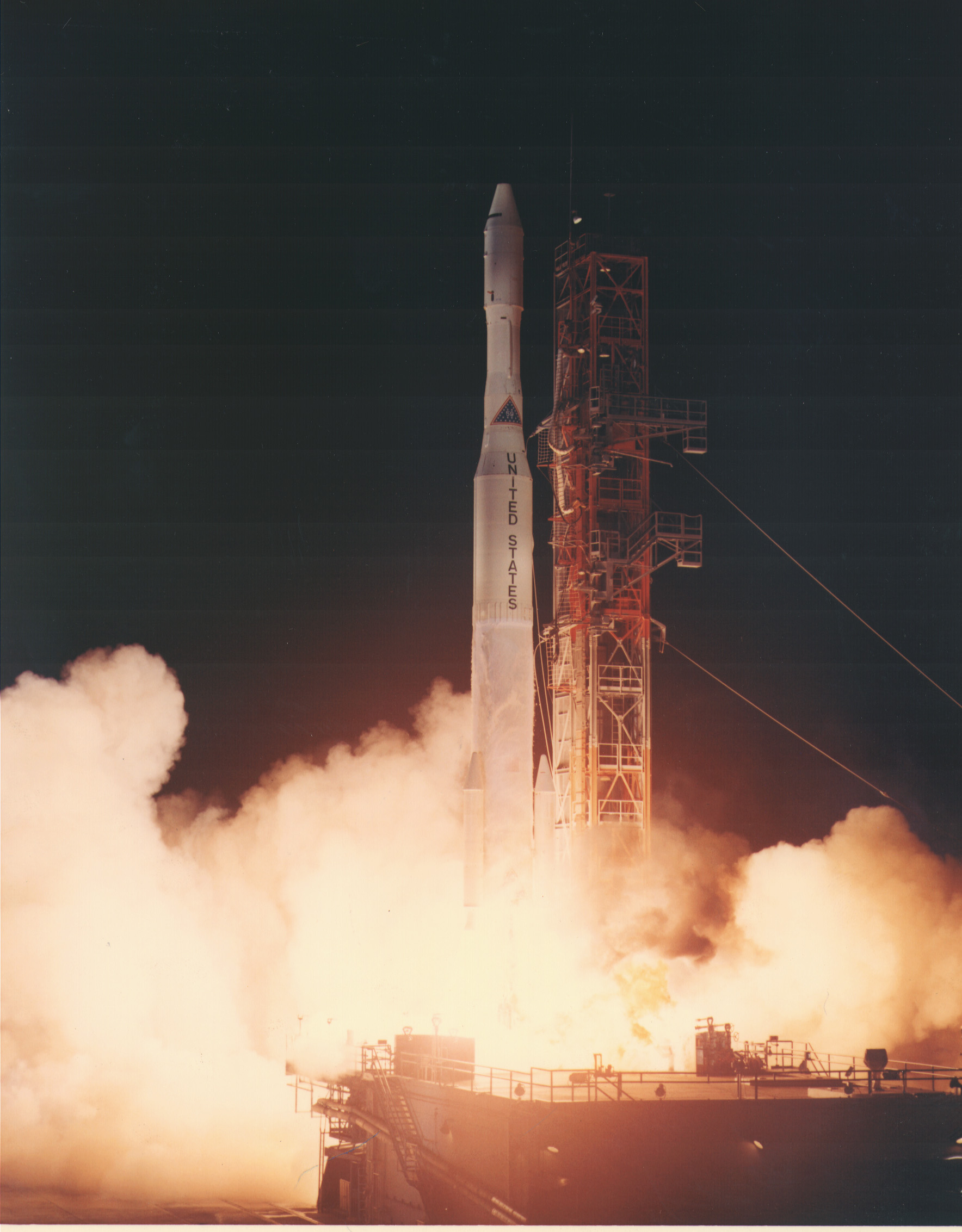
The Thor Delta M is an American orbital launch vehicle developed and operated by McDonnell Douglas as part of the long-running Delta family of rockets. Derived from the Thor intermediate-range ballistic missile and evolved through successive generations of the Delta program, the Thor Delta M served as a reliable workhorse for the United States during the late 1960s and early 1970s, primarily delivering communications and military satellites into orbit on behalf of government customers.
Design and Specifications
Standing 34 meters tall with a core diameter of 2.44 meters, the Thor Delta M represented an incremental refinement within the Delta lineage. It was capable of delivering up to 355 kilograms of payload to low Earth orbit or geostationary transfer orbit, reflecting the relatively modest but mission-appropriate performance demands of its era. The vehicle incorporated a liquid-fueled first stage based on the Thor booster, a restartable upper stage, and could be configured with strap-on solid rocket boosters to augment liftoff thrust — a characteristic feature of Delta-family vehicles during this period.
Operational History
According to tracked flight records, the Thor Delta M conducted 12 flights between 1968 and 1971, achieving 10 successes alongside 2 failures or partial failures. This record reflects a solid, if not perfect, reliability profile consistent with the engineering standards and operational realities of early commercial and government launch services.
The United States Air Force was the vehicle's top customer, and the mission manifest illustrates the strategic importance of the rocket during a pivotal era in satellite communications. Notable missions carried under this configuration include the INTELSAT III series — specifically the F-6, F-7, and F-8 flights — which were part of an international effort to expand global telecommunications infrastructure. The Thor Delta M also lofted the NATO IIA and NATO IIB satellites, early milestones in dedicated military communications for the NATO alliance, as well as Skynet IB, a British military communications satellite, underscoring the vehicle's role in supporting allied and coalition space programs.
Role and Legacy
The Thor Delta M occupied an important position in the broader history of expendable launch vehicles. Operating at the intersection of the early commercial satellite boom and Cold War-era military space requirements, it helped demonstrate that standardized, production-line rocket families could serve a diverse range of payloads and customers. The missions it carried — spanning international telecommunications consortia, allied military networks, and U.S. government programs — highlight the growing strategic and commercial value of orbital communications infrastructure during this period.
The Delta family of which the Thor Delta M was a part would continue to evolve considerably beyond this variant, ultimately producing some of the most enduring launch vehicle lineages in American spaceflight history. The Thor Delta M's four-year operational window, though brief, represents a meaningful chapter in that continuity — bridging the experimental spirit of early rocketry with the increasingly routine cadence of satellite deployment that would define the following decades.
- Feb 03, 1971Thor Delta M | NATO IIBSuccess
- Aug 19, 1970Thor Delta M | Skynet IBSuccess
- Jul 23, 1970Thor Delta M | INTELSAT III F-8Success
- Apr 23, 1970Thor Delta M | INTELSAT III F-7Success
- Mar 20, 1970Thor Delta M | NATO IIASuccess
- Jan 15, 1970Thor Delta M | INTELSAT III F-6Success
- Nov 22, 1969Thor Delta M | Skynet IASuccess
- Jul 26, 1969Thor Delta M | INTELSAT III F-5Failure
- May 22, 1969Thor Delta M | INTELSAT III F-4Success
- Feb 06, 1969Thor Delta M | INTELSAT III F-3Success
- Dec 19, 1968Thor Delta M | INTELSAT III F-2Success
- Sep 19, 1968Thor Delta M | INTELSAT III F-1Failure