Thor Delta E1
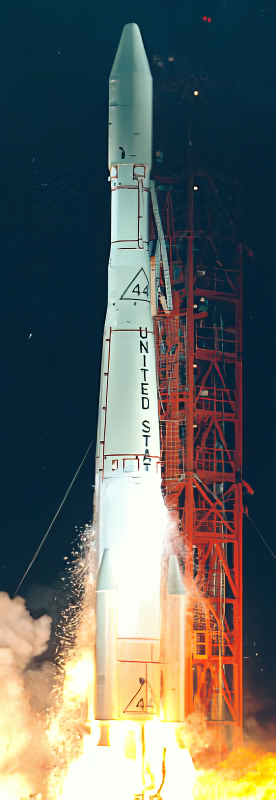
About the Thor Delta E1
Thor Delta E1
The Thor Delta E1 is an American orbital launch vehicle developed and operated by NASA and the Douglas Aircraft Company as part of the long-running Delta family of rockets. Derived from the US Air Force's Thor intermediate-range ballistic missile, the Delta series evolved through numerous incremental variants during the 1960s and 1970s, with the E1 representing one of the more capable configurations of its era. The United States Air Force was the vehicle's top customer, and launches were conducted primarily from Vandenberg Air Force Base and Cape Canaveral.
Design and Capabilities
The Thor Delta E1 stands 28 meters tall with a core diameter of 2.44 meters, giving it the slender, distinctive profile characteristic of early Delta variants. It is capable of delivering 540 kg to low Earth orbit (LEO) and 150 kg to geostationary transfer orbit (GTO), making it a competent mid-range launcher suited for the scientific and government satellites of its period. Like other Delta E-series vehicles, it made use of an upgraded first-stage engine and an improved second stage compared to earlier Delta configurations, alongside a cluster of solid-fuel strap-on boosters to augment liftoff thrust.
Operational History
The Thor Delta E1 was active from 1966 through 1971, a period that coincided with an especially productive era of scientific satellite deployment. Our flight record attributes 17 tracked flights to the vehicle, of which 16 were fully successful and 1 resulted in a failure or partial failure — a strong reliability record reflective of the Delta family's reputation for dependability during this formative period of American spaceflight.
The vehicle's manifest reads as a cross-section of Cold War-era space science. Pioneer 9, launched aboard a Thor Delta E1, was a NASA heliocentric probe designed to study the solar wind and interplanetary magnetic fields. HEOS 1 (Highly Eccentric Orbit Satellite) was a joint European space science mission. The Isis 1 and Isis 2 satellites were Canadian-American ionospheric research spacecraft, part of a collaborative program between NASA and Canada's Defence Research Telecommunications Establishment. ESSA 9 was among the final satellites of the Environmental Science Services Administration's operational meteorological constellation, contributing to early weather observation from orbit. IMP G (Interplanetary Monitoring Platform) continued NASA's long-running series of magnetospheric and solar physics investigations.
Legacy
The Thor Delta E1 occupies a meaningful place in the broader history of the Delta rocket family, which itself became one of the most prolific and trusted launch vehicle lineages in spaceflight history. The E1 variant bridged the gap between the early, relatively modest Delta configurations of the early 1960s and the more powerful Thrust Augmented and Improved Delta variants that would follow. Its successful support of international scientific missions demonstrated that American expendable launch vehicles could serve as reliable platforms for multinational cooperation in space exploration, a role the Delta family would continue to fulfill for decades.
- Apr 01, 1971Thor Delta E1 | Isis 2Success
- Jun 21, 1969Thor Delta E1 | IMP GFailure
- Feb 26, 1969Thor Delta E1 | ESSA 9Success
- Jan 30, 1969Thor Delta E1 | Isis 1Success
- Dec 05, 1968Thor Delta E1 | HEOS 1Success
- Nov 08, 1968Thor Delta E1 | Pioneer 9Success
- Jan 11, 1968Thor Delta E1 | GEOS BSuccess
- Dec 13, 1967Thor Delta E1 | Pioneer 8Success
- Nov 10, 1967Thor Delta E1 | ESSA 6Success
- Sep 28, 1967Thor Delta E1 | INTELSAT II F-4Success
- Jul 19, 1967Thor Delta E1 | Explorer 35Success
- May 24, 1967Thor Delta E1 | IMP FSuccess
- Mar 23, 1967Thor Delta E1 | INTELSAT II F-3Success
- Jan 11, 1967Thor Delta E1 | INTELSAT II F-2Success
- Oct 26, 1966Thor Delta E1 | INTELSAT II F-1Success
- Aug 17, 1966Thor Delta E1 | Pioneer 7Success
- Jul 01, 1966Thor Delta E1 | Explorer 33Success