Thor Delta E
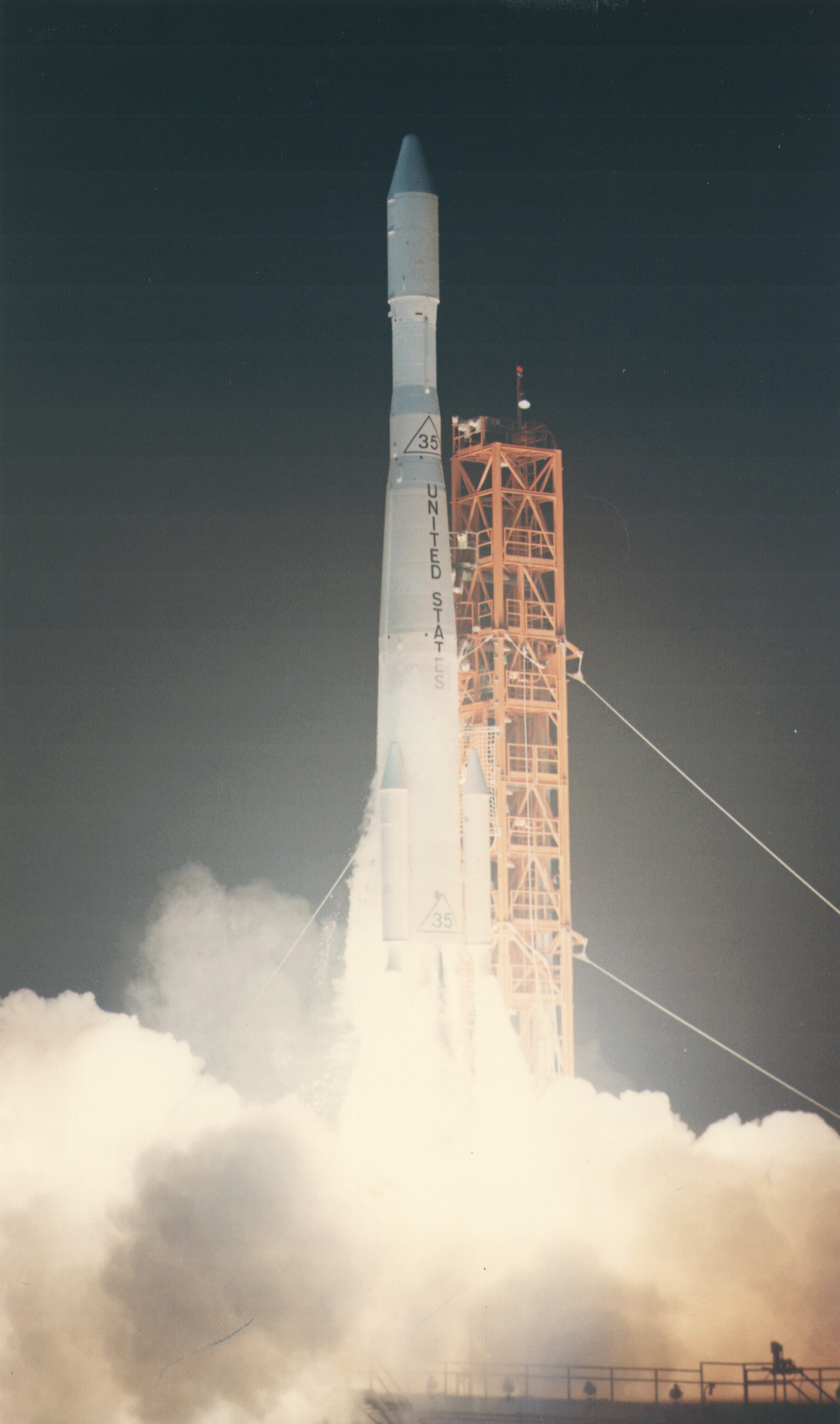
About the Thor Delta E
Thor Delta E
The Thor Delta E is an American expendable orbital launch vehicle developed and operated by Douglas Aircraft Company on behalf of the United States government. A member of the long-running Delta family descended from the Thor intermediate-range ballistic missile, the Thor Delta E represents one of the incremental upgrades that steadily expanded the Delta's capability through the 1960s. It served the United States' growing civil and military space programs during its operational period from 1965 to 1967.
Development and Design
The Delta family evolved through a series of designated variants, each reflecting improvements in propulsion, staging, or upper-stage configuration. The Thor Delta E built upon its predecessors by incorporating an upgraded main engine and an improved upper stage, allowing it to lift meaningfully heavier payloads than earlier Delta models. Standing 31 meters tall with a core diameter of 2.44 meters, the vehicle retained the recognizable slender profile common to Thor-derived rockets. It was capable of delivering 540 kg to low Earth orbit and approximately 150 kg to geostationary transfer orbit, making it well suited to the small-to-medium scientific and applications satellites of its era.
Launches were conducted from Cape Canaveral in Florida, the primary American launch site for Delta-family vehicles throughout this period.
Flight History
The Thor Delta E compiled a perfect record of six successful flights across its operational lifespan, with no failures or partial failures recorded. This reliability was characteristic of the maturing Delta program, which had by the mid-1960s established itself as one of NASA's most dependable workhorses.
The vehicle's manifest reflected the ambitious scope of American space science at the time. Among its most significant missions was GEOS A (also known as Explorer 29), a geodetic satellite that contributed important data for mapping Earth's gravitational field. The Pioneer 6 mission, launched in 1965, placed a solar-monitoring spacecraft into a heliocentric orbit, beginning what would become a long-lived series of interplanetary probes studying the solar wind and interplanetary magnetic field.
The Thor Delta E also launched four satellites in the ESSA (Environmental Science Services Administration) series — ESSA 2, 3, 4, and 5 — which formed a critical part of the United States' early operational meteorological satellite infrastructure. These spacecraft provided cloud-cover imagery that supported weather forecasting on a routine, operational basis, marking a significant step beyond purely experimental meteorology missions.
Legacy
The United States Air Force was the primary customer served by the Thor Delta E, reflecting the close relationship between military requirements and America's early civil space launch infrastructure. The vehicle's brief but unblemished career contributed to the sustained development of the Delta lineage, which would continue to evolve through dozens of subsequent variants over the following decades. The Thor Delta E's consistent performance during a pivotal period of satellite development helped cement the Delta program's reputation as a reliable and adaptable launch system at the heart of American space operations.