Thor Delta
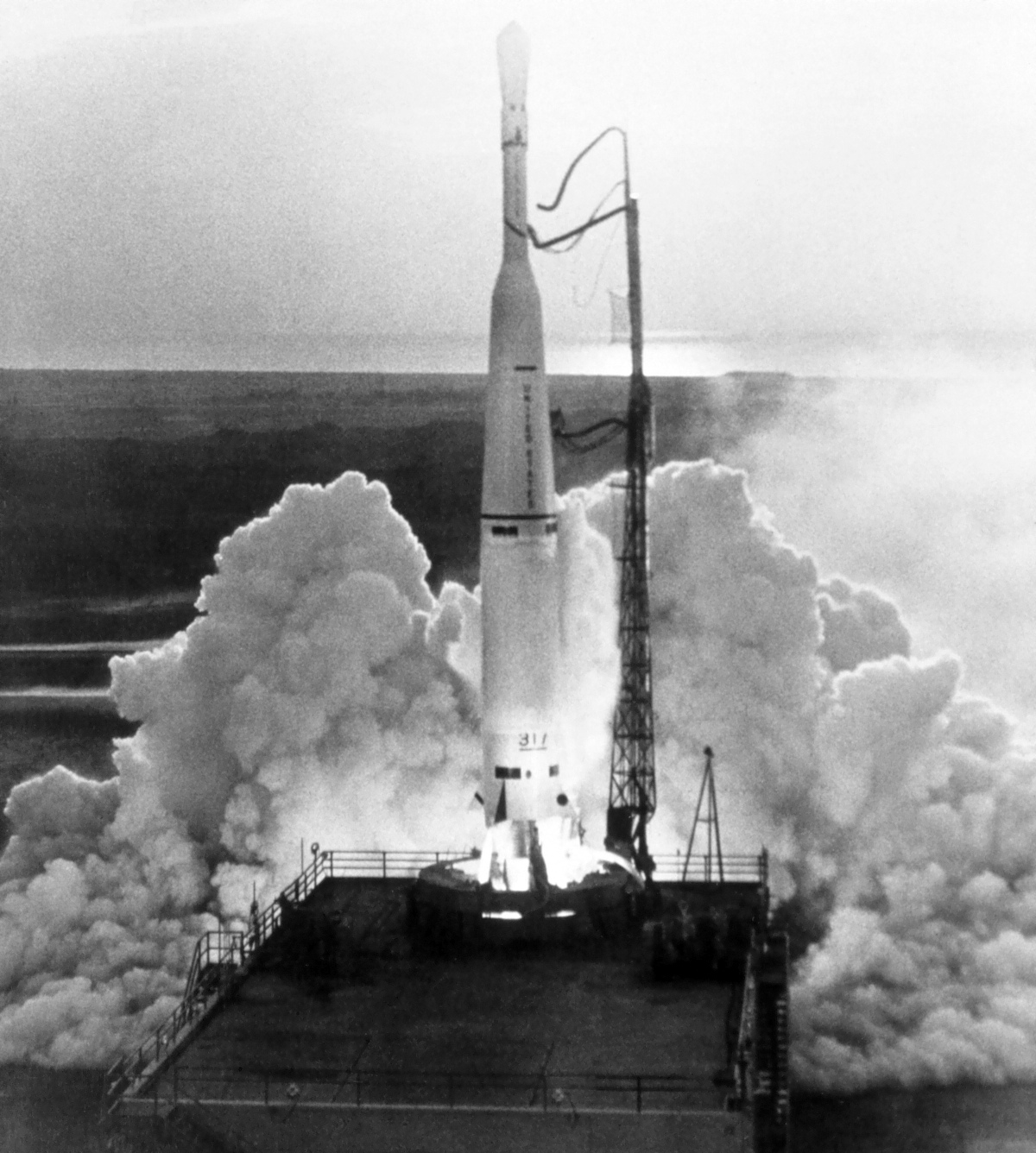
About the Thor Delta
Thor Delta
The Thor Delta was an American orbital launch vehicle developed by Douglas Aircraft Company and operated primarily by the United States Air Force during the early 1960s. A direct ancestor of the long-running Delta rocket family, it represented one of the foundational steps in American expendable launch vehicle history, bridging the gap between the military ballistic missile program and the emerging needs of the civilian space age.
Origins and Design
The Thor Delta was derived from the PGM-17 Thor intermediate-range ballistic missile, which had been developed for the Air Force in the late 1950s. By adding an upper stage to the proven Thor booster, engineers created a versatile small-lift vehicle capable of placing scientific and communications payloads into Earth orbit. Standing 31 meters tall with a diameter of 2.44 meters, the vehicle was compact by later standards but well-suited to the modest payload requirements of its era. Its lift capacity to low Earth orbit reached 226 kilograms, sufficient for the small experimental satellites that defined early spaceflight ambitions.
Launches were conducted from Cape Canaveral in Florida, which served as the primary American launch site for orbital missions during this period.
Operational History
According to tracked flight records, the Thor Delta flew 9 missions between 1960 and 1962, achieving 8 successes alongside 1 failure or partial failure — a strong reliability record for the nascent state of launch technology at the time. This brief but productive operational window coincided with a pivotal moment in the Space Race, and the vehicle's manifest reflected the urgency and ambition of the era.
Among its most historically significant payloads, the Thor Delta launched Telstar 1 in July 1962, the world's first active communications satellite, which relayed the first transatlantic television signals. The vehicle also orbited multiple spacecraft in NASA's TIROS Earth-observation series — including TIROS 4, TIROS 5, and TIROS 6 — which were instrumental in advancing meteorological satellite technology. The OSO 1 mission carried the first Orbiting Solar Observatory into space, opening a new chapter in solar science, while Ariel 1 marked a landmark in international cooperation as the first joint American-British satellite.
Legacy
Although the Thor Delta operated for only a brief window of roughly two years, its contributions to spaceflight far outweighed its short service life. The missions it supported helped establish the practical utility of satellites for communications, weather observation, and scientific research — applications that would define the satellite industry for decades to come.
The vehicle's architecture proved highly adaptable, and its lineage evolved continuously through a succession of improved Delta variants that remained in active service well into the twenty-first century. The original Thor Delta is therefore regarded not merely as a functional workhorse of the early Space Age, but as the founding design of one of the most enduring rocket families in history. Its modest nine flights helped set the trajectory for generations of American orbital launch capability.
- Sep 18, 1962Thor Delta | Tiros 6Success
- Jul 10, 1962Thor Delta | Telstar 1Success
- Jun 19, 1962Thor Delta | Tiros 5Success
- Apr 26, 1962Thor Delta | Ariel 1Success
- Mar 07, 1962Thor Delta | OSO 1Success
- Feb 08, 1962Thor Delta | Tiros 4Success
- Nov 23, 1960Thor Delta | Tiros 2Success
- Aug 12, 1960Thor Delta | Echo 1Success
- May 13, 1960Thor Delta | EchoFailure