Thor Burner 2A
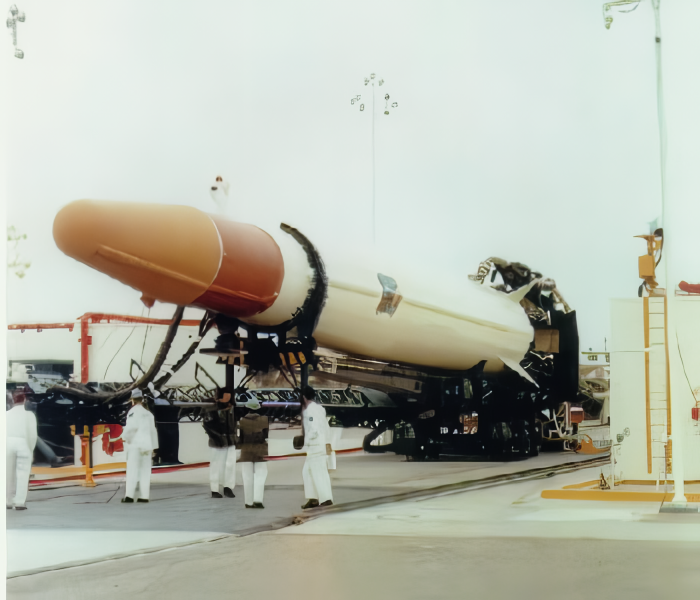
About the Thor Burner 2A
Thor Burner 2A
The Thor Burner 2A is an American orbital launch vehicle developed to place small military payloads into polar and sun-synchronous orbits. Operated primarily by the United States Air Force, it represents a mature evolution of the long-running Thor rocket family and served as a reliable workhorse for classified and operational defense satellites during the early-to-mid 1970s.
Origins and Design
The Thor Burner 2A belongs to a lineage stretching back to the Thor intermediate-range ballistic missile of the 1950s, which was progressively adapted into a prolific family of space launch vehicles. The "Burner 2A" designation refers to its upper stage configuration — an upgraded variant of the Burner II solid-fueled kick stage, paired with a Thor first stage derived from the Thrust Augmented Thor or similar booster variants of that era. Standing 23 meters tall with a diameter of 2.44 meters, the vehicle is a compact, single-stack system well suited to dedicated lightweight payloads. No liquid-fueled second stage sits between the first stage and the solid upper stage, keeping the stack simple and the integration process streamlined for operational military launch cadences.
Operational History
According to tracked flight records, the Thor Burner 2A flew 8 missions between 1971 and 1976, achieving a perfect success rate across all tracked launches. This unblemished record reflects both the maturity of the underlying Thor booster and the straightforward reliability of the Burner 2A upper stage.
The vehicle's manifest was dominated by Defense Meteorological Satellite Program (DMSP) payloads — specifically the 5B and 5C series spacecraft. DMSP satellites provided the Air Force with critical weather imagery and environmental data in support of military operations, flying in low polar orbits that the Thor Burner 2A's trajectory profile was well suited to reach. Notable missions include DMSP-5C F3, DMSP-5C F2, and DMSP-5C F1, as well as the earlier DMSP-5B F5, DMSP-5B F4, and DMSP-5B F3 flights. The presence of DSAP-5B F3 in the manifest also points to involvement with reconnaissance-adjacent programs, consistent with the Air Force's broader use of this vehicle class for national security space missions.
Launches were conducted from Vandenberg Air Force Base in California, the standard site for polar-orbit missions requiring a southward trajectory over the Pacific Ocean without overflying populated areas.
Legacy
The Thor Burner 2A occupied an important niche in the early American military space program, bridging the gap between the experimental satellite era and the sustained operational satellite constellations that would define defense space operations from the late Cold War onward. Its consistent performance supporting DMSP — a program that continues in evolved form to this day — cemented the Thor family's reputation as a dependable foundation for national security launches. By the mid-1970s, evolving payload requirements and the development of more capable vehicles gradually superseded the Burner 2A configuration, but its contributions to operational military meteorology and reconnaissance support remain a noteworthy chapter in American space launch history.
- Feb 19, 1976Thor Burner 2A | DMSP-5C F3Success
- May 24, 1975Thor Burner 2A | DMSP-5C F2Success
- Aug 09, 1974Thor Burner 2A | DMSP-5C F1Success
- Mar 16, 1974Thor Burner 2A | DMSP-5B F5Success
- Aug 17, 1973Thor Burner 2A | DMSP-5B F4Success
- Nov 09, 1972Thor Burner 2A | DSAP-5B F3Success
- Mar 24, 1972Thor Burner 2A | DMSP-5B F2Success
- Oct 14, 1971Thor Burner 2A | DSAP-5B F1Success