Thor Agena D
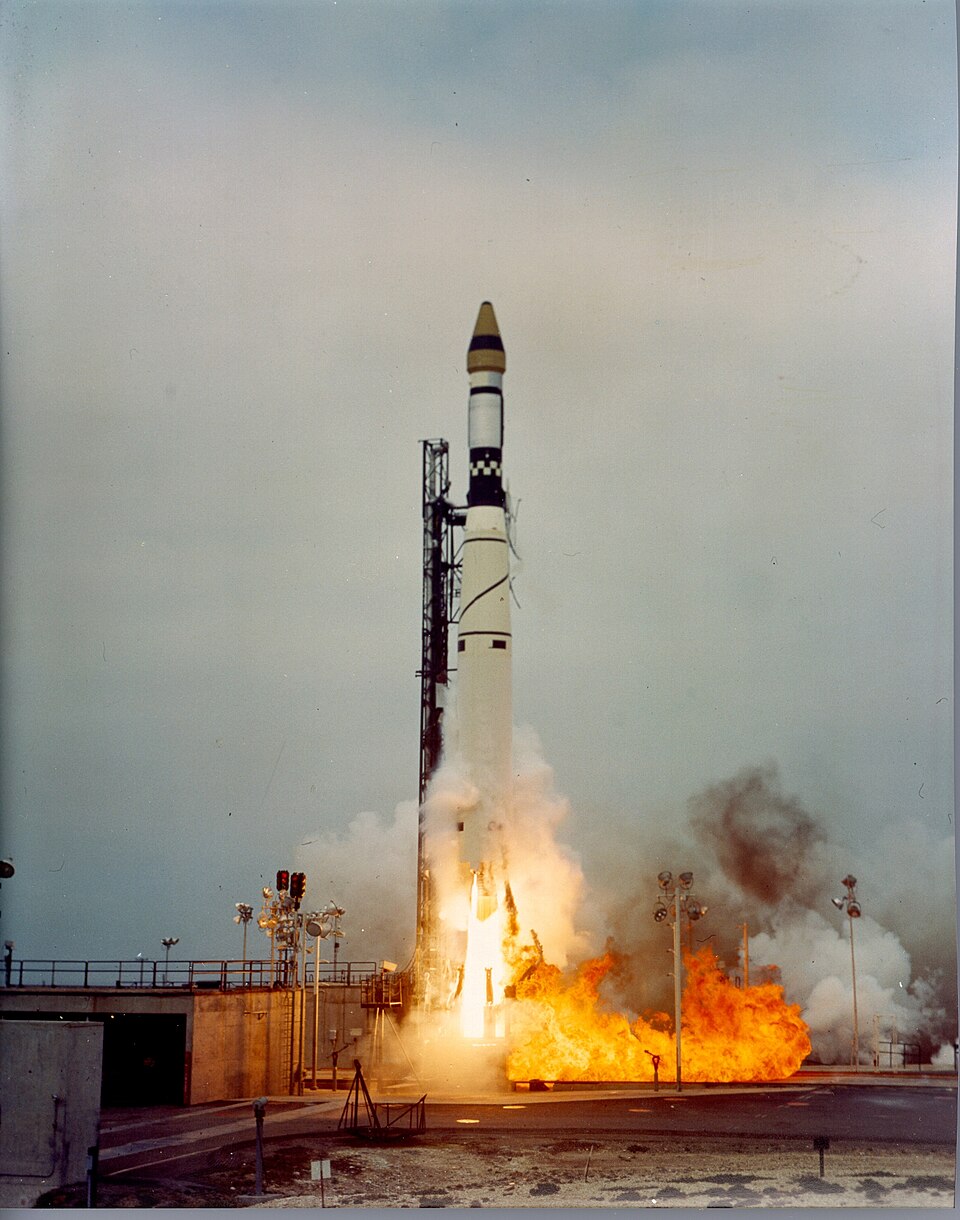
About the Thor Agena D
Thor Agena D
The Thor Agena D was an American expendable two-stage orbital launch vehicle developed for the United States Air Force during the early 1960s. Combining the proven Thor ballistic missile as a first stage with the highly capable Agena D upper stage, it represented a refinement of an already well-established launch vehicle lineage and served as a workhorse for classified reconnaissance and signals intelligence missions during the height of the Cold War.
Design and Configuration
Standing 31 meters tall with a diameter of 2.44 meters, the Thor Agena D was a compact but capable vehicle for its era. The Agena D upper stage was a standardized, restartable platform that offered greater flexibility than its predecessors, featuring improved avionics and a common interface designed to accommodate a wide variety of payloads. This standardization made the Agena D particularly attractive for military satellite programs that required reliable, repeatable performance. The Thor booster, manufactured by Douglas Aircraft, had already accumulated considerable flight heritage, lending the combination a degree of operational maturity from the outset.
Operational History
According to tracked flight records, the Thor Agena D flew 13 missions between 1962 and 1963, achieving 11 successes alongside 2 failures or partial failures. This represented a strong but not flawless record during a period when orbital launch reliability was still being established across the industry. Launches were conducted from Vandenberg Air Force Base in California, the primary site for polar and sun-synchronous military satellite missions requiring coverage of the Soviet Union.
The vehicle's manifest was dominated by intelligence-gathering payloads operated under the auspices of the National Reconnaissance Office. KH-4 Corona reconnaissance satellites appeared frequently among its missions, including flights designated KH-4 17, KH-4 18, KH-4 20, and KH-4 23. The KH-5 Argon mapping satellite also flew on the vehicle, with KH-5 8 among the recorded missions. In addition, the Thor Agena D carried Poppy 4A and 4B, signals intelligence satellites developed for naval electronic intelligence collection, illustrating the vehicle's versatility across different classified mission types.
Role and Significance
The Thor Agena D occupied an important place in early American space operations, bridging the gap between the experimental dawn of satellite reconnaissance and its maturation into a routine, institutionalized capability. The KH-4 Corona program in particular was fundamental to United States strategic intelligence during the Cold War, and the Thor Agena D was one of the vehicles that sustained it during a critical operational period.
The vehicle's relatively brief active window of just two years reflects the rapid pace of development in early spaceflight, as newer and more capable configurations were continuously introduced to meet evolving mission requirements. Nevertheless, the Thor Agena D's contributions to satellite reconnaissance, signals intelligence, and geodetic mapping during 1962 and 1963 made it a meaningful participant in one of the most consequential chapters of Cold War aerospace history.
- Jul 19, 1963Thor Agena D | KH-4 23Success
- Jun 15, 1963Thor Agena D | Poppy 4A & 4BFailure
- Apr 26, 1963Thor Agena D | KH-5 8Failure
- Apr 01, 1963Thor Agena D | KH-4 20Success
- Jan 07, 1963Thor Agena D | KH-4 18Success
- Dec 14, 1962Thor Agena D | KH-4 17Success
- Dec 13, 1962Thor Agena D | Poppy 3A & 3BSuccess
- Dec 04, 1962Thor Agena D | KH-4 16Success
- Oct 26, 1962Thor Agena D | Star-RadSuccess
- Sep 29, 1962Thor Agena D | KH-4 13 & RM 4Success
- Aug 29, 1962Thor Agena D | KH-4 11 & RM 3Success
- Aug 02, 1962Thor Agena D | KH-4 10Success
- Jun 28, 1962Thor Agena D | KH-4 7Success