Sputnik 8K74PS
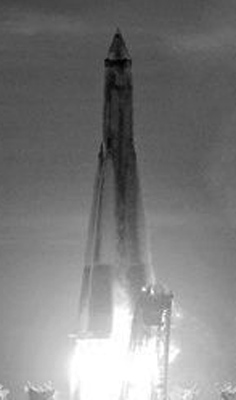
About the Sputnik 8K74PS
Sputnik 8K74PS
The Sputnik 8K74PS is a Soviet orbital launch vehicle operated by the Soviet Space Program, representing one of the most historically significant rockets ever flown. A member of the broader R-7 Semyorka family — the world's first intercontinental ballistic missile, adapted for spaceflight — the 8K74PS variant was a minimally modified version of the R-7 designed specifically and urgently to place the first artificial satellites into Earth orbit.
Origins and Design
The 8K74PS designation reflects a stripped-down derivative of the baseline R-7 missile. To save weight and accelerate the timeline, engineers removed the heavy nose cone instrumentation and made other simplifications, allowing the rocket to carry a small payload to low Earth orbit. The vehicle retained the R-7's characteristic configuration of a central core stage surrounded by four strap-on boosters, all igniting at liftoff — an arrangement that would define Soviet and later Russian launch vehicles for decades to come. Launches were conducted from Baikonur Cosmodrome in what is now Kazakhstan.
Flight Record
Our tracking data records two flights of the Sputnik 8K74PS, both conducted in 1957, and both resulting in success. This represents a perfect launch record for the variant, with no failures or partial failures recorded.
The first mission, Sputnik 1, launched on October 4, 1957, and carried the world's first artificial satellite into orbit — a polished metal sphere emitting a radio signal that could be tracked by observers around the globe. The achievement stunned the world and marked the opening of the Space Age, demonstrating for the first time that a human-made object could be placed in orbit around Earth.
The second mission, Sputnik 2, followed on November 3, 1957, and carried the passenger Laika, a Soviet dog who became the first living creature from Earth to reach orbit. Though Laika did not survive the mission, Sputnik 2 proved that a living being could be launched into space, laying essential groundwork for future crewed spaceflight.
Historical Significance
Despite flying only twice, the Sputnik 8K74PS occupies an unrivaled place in the history of astronautics. Its two missions together constitute the opening chapter of the Space Age, delivering both the first satellite and the first animal traveler to orbit within the span of a single month. The political and scientific shockwaves generated by these launches — particularly Sputnik 1 — accelerated the development of space programs worldwide and directly contributed to the formation of NASA in 1958.
The Soviet Space Program relied on the broader R-7 family far beyond this early variant, and the lineage descends in an unbroken line to the Soyuz rockets still flying today. The 8K74PS itself, however, was a purpose-built instrument of a singular historical moment, retired after its two landmark missions had permanently changed humanity's relationship with the cosmos.