Sputnik 8A91
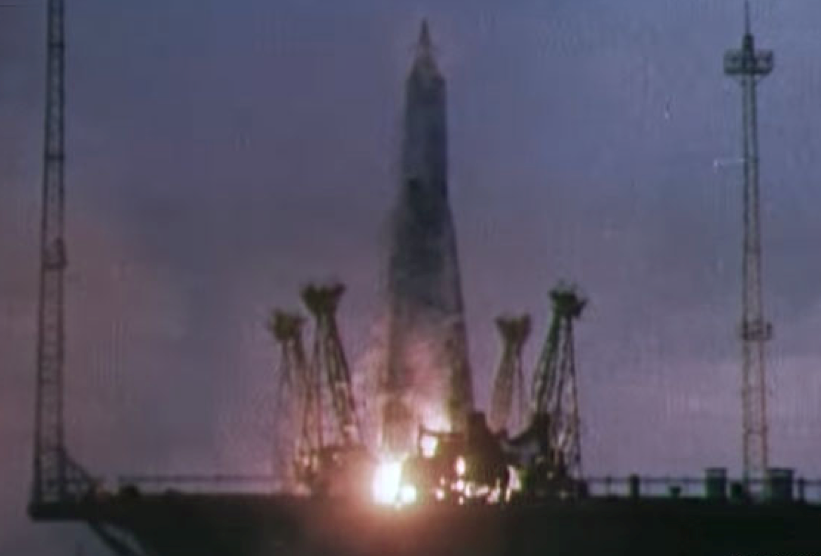
About the Sputnik 8A91
Sputnik 8A91
The Sputnik 8A91 was a Soviet orbital launch vehicle operated by the Soviet Space Program during the earliest years of the Space Age. A direct derivative of the R-7 intercontinental ballistic missile designed under the direction of Sergei Korolev, the 8A91 represented one of the first purpose-adapted configurations of the R-7 airframe intended to place scientific payloads into Earth orbit.
Background and Development
The R-7 family gave the Soviet Union its foundational launch capability, and the 8A91 variant was developed as a relatively minimal modification of the base missile design. Rather than introducing entirely new stages or propulsion systems, Soviet engineers refined the existing configuration to support orbital insertion missions. The vehicle launched from what is now known as the Baikonur Cosmodrome in present-day Kazakhstan, the same facility that had supported the first Sputnik launches and would go on to serve as the backbone of Soviet — and later Russian — human spaceflight operations.
Operational History
The 8A91 flew a brief but historically significant operational career, conducting two launches in 1958, the year immediately following humanity's first satellite. Our flight record attributes one successful mission and one failure or partial failure to the vehicle across this period. Its sole customer was the Soviet Space Program, reflecting its role as a government instrument of scientific exploration and geopolitical demonstration rather than a commercial enterprise.
The two missions tracked in our data are designated Sputnik 8A91 | D-1 1 and Sputnik 8A91 | D1- 2, corresponding to early Soviet efforts to continue expanding on the landmark achievements of the original Sputnik program. The mixed outcome of its two flights — one success and one failure — was not unusual for the period, when launch vehicle technology was advancing rapidly and the engineering challenges of reliable orbital insertion were still being mastered by all spacefaring nations.
Place in History
The 8A91 occupies a noteworthy position in the broader lineage of the R-7 rocket family. That family ultimately gave rise to vehicles such as the Vostok and Soyuz launch systems, which between them carried every Soviet and Russian cosmonaut to orbit for decades. In this sense, the 8A91 represents an early and transitional step in the evolution of a rocket line that proved to be among the most enduring in spaceflight history.
Its operational life was confined entirely to 1958, making it one of the shortest-lived variants in the R-7 lineage. However, the lessons and hardware heritage it shared with successor vehicles ensured that its brief service contributed meaningfully to the cumulative knowledge that sustained Soviet launch operations through the following decades.
Summary
With two flights across a single year, the Sputnik 8A91 was a short-lived but historically grounded participant in the opening chapter of the orbital age. Its record of one success and one failure, in service exclusively to the Soviet Space Program, reflects the experimental nature of early orbital rocketry and the rapid pace at which Soviet engineers were iterating on the foundational R-7 design.