Soyuz-U-PVB
About the Soyuz-U-PVB
Soyuz-U-PVB
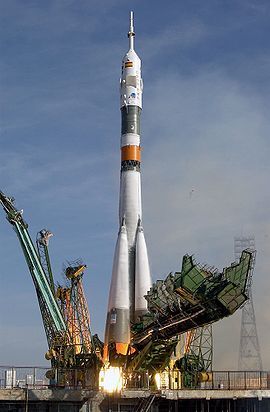
The Soyuz-U-PVB is a Soviet and Russian expendable orbital launch vehicle, a specialized variant of the widely used Soyuz-U booster developed and operated under the Soviet and later Russian space programs. Manufactured by the Progress State Research and Production Space Center (TsSKB-Progress) in Samara, Russia, it was employed primarily to serve the reconnaissance and scientific satellite requirements of state defense and civil space customers.
Development and Design
The Soyuz-U-PVB is derived from the Soyuz-U, itself a member of the long-running R-7 rocket family that traces its lineage to the world's first intercontinental ballistic missile. The designation "PVB" reflects a modified upper-stage configuration — specifically the integration of a Fregat-style or refined upper stage intended to improve injection accuracy and expand the range of accessible orbits compared to the baseline Soyuz-U. Standing 51 meters tall with a core diameter of 3 meters, the vehicle shares the classic Soyuz silhouette: four liquid-fueled strap-on boosters surrounding a central sustainer core, topped by an upper stage and payload fairing. Its capability to deliver up to 6,900 kg to low Earth orbit made it well suited for medium-mass government payloads.
Operational History
The Soyuz-U-PVB entered service in 1984 and flew its final tracked mission in 2009, representing an active career of roughly 25 years. Across that span, the vehicle accumulated 74 flights in available records, of which 72 were fully successful and 2 resulted in failure or partial failure — a reliability rate consistent with the broader Soyuz family's reputation for dependability.
Its customer base was almost exclusively governmental and defense-oriented. The Soviet Space Program, Soviet Strategic Rocket Forces, Russian Space Forces, and the Russian Federal Space Agency (ROSCOSMOS) all relied on the vehicle throughout its service life, reflecting the continuity of Russian state launch requirements across the dissolution of the Soviet Union.
Payloads and Missions
The Soyuz-U-PVB was used predominantly to deploy optical reconnaissance and intelligence-gathering satellites. Among the most frequently launched payloads were members of the Yantar series — including the Yantar-4K2M, a film-return reconnaissance satellite — and the Orlets-1 high-resolution reconnaissance system. The vehicle also supported scientific missions, most notably the Foton-M series of microgravity research capsules, which carried biological and materials science experiments for both Russian and international research communities.
Later missions included the deployment of the Lotos-S 1 satellite, an early example of Russia's next-generation signals intelligence constellation, indicating that the Soyuz-U-PVB remained relevant into the late 2000s for emerging defense space programs.
Legacy
The Soyuz-U-PVB occupies a specific niche within the broader Soyuz heritage as a defense-focused, upper-stage-enhanced variant optimized for precision orbital insertion. While largely overshadowed in public awareness by the crewed Soyuz variants, its 25-year service record and consistent utilization by Russian military and civil authorities underscore its importance as a quiet but reliable backbone of Soviet and Russian national security spaceflight operations.
- Nov 20, 2009Soyuz-U-PVB | Lotos-S 1Success
- Apr 29, 2009Soyuz-U-PVB | Yantar-4K2M 5Success
- Nov 14, 2008Soyuz-U-PVB | Yantar-4K2M 4Success
- Sep 14, 2007Soyuz-U-PVB | Foton-M No. 3Success
- Jun 07, 2007Soyuz-U-PVB | Yantar-4K2M 3Success
- Sep 14, 2006Soyuz-U-PVB | Orlets-1 8Success
- Jun 15, 2006Soyuz-U-PVB | Resurs-DKSuccess
- May 03, 2006Soyuz-U-PVB | Yantar-4K2M 2Success
- Sep 02, 2005Soyuz-U-PVB | Yantar-1KFT 21Success
- May 31, 2005Soyuz-U-PVB | Foton-M No. 2Success
- Sep 24, 2004Soyuz-U-PVB | Yantar-4K2M 1Success
- Aug 12, 2003Soyuz-U-PVB | Orlets-1 7Success
- Oct 15, 2002Soyuz-U-PVB | Foton-M No. 1Failure
- Feb 25, 2002Soyuz-U-PVB | Yantar-4K2 81Success
- May 29, 2001Soyuz-U-PVB | Yantar-4K2 80Success
- Sep 29, 2000Soyuz-U-PVB | Yantar-1KFT 20Success
- Aug 09, 2000Soyuz-U-PVB | Cluster Rumba & TangoSuccess
- Jul 16, 2000Soyuz-U-PVB | Cluster Salsa & SambaSuccess
- May 03, 2000Soyuz-U-PVB | Yantar-4KS1M 9Success
- Mar 20, 2000Soyuz-U-PVB | DumsatSuccess
- Feb 08, 2000Soyuz-U-PVB | IRDT 1Success
- Nov 22, 1999Soyuz-U-PVB | Globalstar 29,34,39,61Success
- Oct 18, 1999Soyuz-U-PVB | Globalstar 31,56,57,59Success
- Sep 28, 1999Soyuz-U-PVB | Resurs F-1MSuccess
- Sep 22, 1999Soyuz-U-PVB | Globalstar 33,50,55,58Success
- Sep 09, 1999Soyuz-U-PVB | Foton 12Success
- Aug 18, 1999Soyuz-U-PVB | Yantar-4K2 79Success
- Apr 15, 1999Soyuz-U-PVB | Globalstar 19,42,44,45Success
- Mar 15, 1999Soyuz-U-PVB | Globalstar 22,37,41,46Success
- Feb 09, 1999Soyuz-U-PVB | Globalstar 23,36,38,40Success
- Jun 25, 1998Soyuz-U-PVB | Yantar-4KS1M 8Success
- Jun 24, 1998Soyuz-U-PVB | Yantar-4K2 78Success
- Feb 17, 1998Soyuz-U-PVB | Yantar-1KFT 19Success
- Dec 15, 1997Soyuz-U-PVB | Yantar-4K2 77Success
- Jun 20, 1996Soyuz-U-PVB | Yantar-4K2 76Failure
- Mar 14, 1996Soyuz-U-PVB | Yantar-4K2 75Success
- Jun 28, 1995Soyuz-U-PVB | Yantar-4K2 74Success
- Mar 22, 1995Soyuz-U-PVB | Yantar-4K2 73Success
- Jul 20, 1994Soyuz-U-PVB | Yantar-4K2 72Success
- Jun 14, 1994Soyuz-U-PVB | Foton 9Success
- Jun 07, 1994Soyuz-U-PVB | Zenit-8 102Success
- Mar 17, 1994Soyuz-U-PVB | Yantar-4K2 71Success
- Aug 24, 1993Soyuz-U-PVB | Resurs-F 19Success
- Jul 22, 1993Soyuz-U-PVB | Zenit-8 101Success
- Jul 14, 1993Soyuz-U-PVB | Yantar-4K2 70Success
- Jun 25, 1993Soyuz-U-PVB | Resurs-F 18Success
- Dec 29, 1992Soyuz-U-PVB | Bion 10Success
- Nov 15, 1992Soyuz-U-PVB | Resurs-500Success
- Jul 30, 1992Soyuz-U-PVB | Zenit-8 100Success
- Jun 23, 1992Soyuz-U-PVB | Resurs-F 15Success
- Apr 01, 1992Soyuz-U-PVB | Yantar-4K2 63Success
- Oct 04, 1991Soyuz-U-PVB | Foton 7Success
- Aug 21, 1991Soyuz-U-PVB | Resurs-F2 7Success
- Jul 09, 1991Soyuz-U-PVB | Zenit-8 99Success
- Jun 28, 1991Soyuz-U-PVB | Resurs-F 11Success
- May 21, 1991Soyuz-U-PVB | Resurs-F2 6Success
- Mar 06, 1991Soyuz-U-PVB | Zenit-8 98Success
- Jan 17, 1991Soyuz-U-PVB | Zenit-8 97Success
- Dec 26, 1990Soyuz-U-PVB | Zenit-8 96Success
- Sep 07, 1990Soyuz-U-PVB | Resurs-F 9Success
- Aug 16, 1990Soyuz-U-PVB | Resurs-F 8Success
- Aug 03, 1990Soyuz-U-PVB | Yantar-4K2 54Success
- Jul 17, 1990Soyuz-U-PVB | Resurs-F2 5Success
- Sep 06, 1989Soyuz-U-PVB | Resurs-F 5Success
- Jul 05, 1989Soyuz-U-PVB | Zenit-8 83Success
- May 25, 1989Soyuz-U-PVB | Resurs-F 1Success
- May 05, 1989Soyuz-U-PVB | Zenit-8 80Success
- Apr 06, 1989Soyuz-U-PVB | Zenit-8 79Success
- Mar 16, 1989Soyuz-U-PVB | Zenit-8 78Success
- Dec 08, 1988Soyuz-U-PVB | Zenit-8 74Success
- Sep 22, 1988Soyuz-U-PVB | Zenit-8 69Success
- Jun 07, 1985Soyuz-U-PVB | Resurs-F1 17F41 54LSuccess
- Nov 29, 1984Soyuz-U-PVB | Zenit-8 9Success
- Mar 21, 1984Soyuz-U-PVB | Zenit-6U 93Success