Soyuz 2.1b Fregat
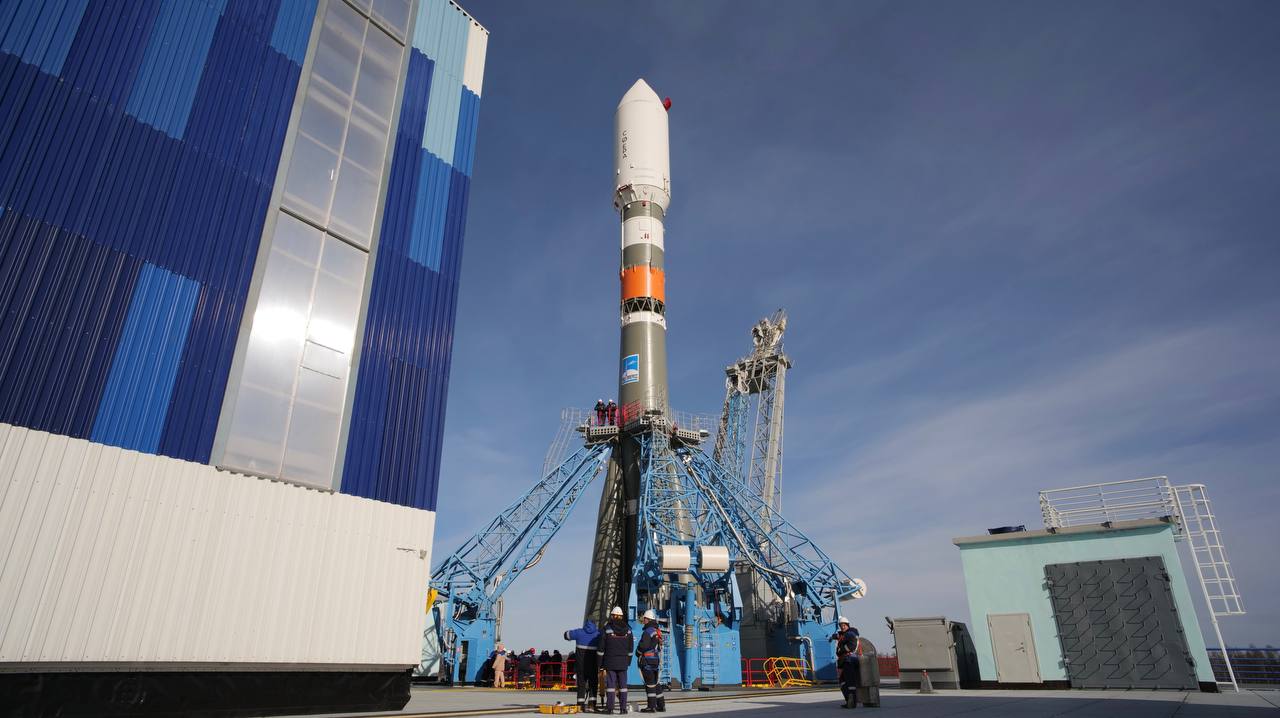
About the Soyuz 2.1b Fregat
Soyuz 2.1b Fregat
The Soyuz 2.1b Fregat is a Russian orbital launch vehicle operated primarily by Roscosmos and the Russian Space Forces, combining the modernised Soyuz 2.1b booster with the restartable Fregat upper stage to deliver payloads to medium and high orbits. It represents one of the most capable configurations within the long-running Soyuz family, a lineage stretching back to the earliest years of the Space Age.
Vehicle Overview
Standing 46.3 metres tall with a core diameter of 2.95 metres, the Soyuz 2.1b Fregat follows the classic Soyuz architecture: a central core stage flanked by four liquid-propellant boosters, topped by a third stage and the Fregat upper stage. The 2.1b designation reflects the incorporation of a modernised third-stage engine — the RD-0124 — which provides improved performance and efficiency compared to earlier Soyuz variants. The Fregat stage is a near-autonomous spacecraft in its own right, capable of multiple restarts in orbit, making this configuration well suited to precise orbital insertion for navigation and military satellites.
The vehicle is rated to carry up to 8,200 kg to low Earth orbit and up to 3,250 kg to geostationary transfer orbit, giving it genuine versatility across a range of mission profiles.
Operational History
Our flight record covers 26 tracked flights between 2006 and 2026, of which 23 were successful, with 2 resulting in failure or partial failure. This places the vehicle's documented success rate among the higher tiers for operational orbital rockets, though not without notable setbacks.
Launch operations have taken place from Baikonur Cosmodrome in Kazakhstan and Plesetsk Cosmodrome in Russia, the latter being the preferred site for missions supporting Russian military and national security space programmes.
Primary Customers and Missions
The top customers in our data are the Russian Space Forces, Roscosmos, and the Russian Aerospace Defence Forces, reflecting the vehicle's dominant role in supporting Russia's strategic space infrastructure. Recent missions have been heavily focused on two flagship programmes.
The Glonass-K1 series — Russia's next-generation GLONASS navigation satellites — has been a consistent payload, with recent flights delivering Glonass-K1 No. 16, 17, 18, and 19, the latter pair flying together as Kosmos 2595 and Kosmos 2596 on a dual-manifest mission. These satellites form a critical part of Russia's sovereign global navigation satellite system, the counterpart to the American GPS constellation.
Alongside navigation, the EKS (Tundra) programme has relied on this vehicle for its highly elliptical early-warning satellite constellation. Recent launches delivered EKS 5 (Tundra 5, Kosmos 2552) and EKS 6 (Tundra 6, Kosmos 2563), both placed into Molniya-type orbits — a task uniquely suited to the Fregat stage's multi-burn capability.
Role and Significance
The Soyuz 2.1b Fregat occupies a central place in Russia's operational launch architecture, serving as the workhorse for high-priority government and military space missions. Its combination of a proven booster lineage with an agile upper stage gives it flexibility that few comparable vehicles can match, and its continued active status through 2026 underscores its enduring importance to Russian space operations.
- Aug 24, 2026Soyuz 2.1b/Fregat | Glonass-K1 No. 23 (Kosmos 2619)Success
- Sep 13, 2025Soyuz 2.1b/Fregat | Glonass-K1 No. 18 (Kosmos 2595) & Kosmos 2596Success
- Nov 02, 2022Soyuz 2.1b/Fregat | EKS 6 (Tundra 6) (Kosmos 2563)Success
- Oct 10, 2022Soyuz 2.1b/Fregat | Glonass-K1 No. 17 (Kosmos 2559)Success
- Jul 07, 2022Soyuz 2.1b/Fregat | Glonass-K1 No. 16 (Kosmos 2557)Success
- Nov 25, 2021Soyuz 2.1b/Fregat | EKS 5 (Tundra 5) (Kosmos 2552)Success
- Oct 25, 2020Soyuz 2.1b/Fregat | Glonass-K1 No. 15 (Kosmos 2547)Success
- May 22, 2020Soyuz 2.1b/Fregat | EKS 4 (Tundra 4) (Kosmos 2546)Success
- Sep 26, 2019Soyuz 2.1b/Fregat | EKS 3 (Tundra 3) (Kosmos 2541)Success
- Jul 05, 2019Soyuz 2.1b/Fregat | Meteor-M No.2-2 & rideshare payloadsSuccess
- Nov 28, 2017Soyuz 2.1b/Fregat | Meteor-M No.2-1 & rideshare payloadsFailure
- May 25, 2017Soyuz-2.1b/Fregat | EKS-2 (Tundra 2) (Kosmos 2518)Success
- May 29, 2016Soyuz-2.1b/Fregat | Glonass-M No. 53 (Kosmos 2516)Success
- Feb 07, 2016Soyuz-2.1b/Fregat | Glonass-M (Kosmos 2514)Success
- Nov 17, 2015Soyuz-2.1b/Fregat | EKS (Tundra) (Kosmos 2510)Success
- Nov 30, 2014Soyuz-2.1b/Fregat | Glonass-K1 (Kosmos 2501)Success
- Jul 08, 2014Soyuz-2.1b/Fregat | Meteor-M No.2, MKA-PN2, DX-1, UKube-1, TechDemoSat-1, SkySat-2, AISSat-2Success
- Jun 14, 2014Soyuz-2.1b/Fregat | Glonass-M (Kosmos 2500)Success
- Mar 23, 2014Soyuz-2.1b/Fregat | Glonass-M (Kosmos 2494)Success
- Apr 26, 2013Soyuz-2.1b/Fregat | Glonass-M (Kosmos 2485)Success
- Dec 23, 2011Soyuz-2.1b/Fregat | Meridian 5Failure
- Nov 28, 2011Soyuz 2.1b/Fregat | Glonass-M (Kosmos 2478)Success
- Oct 02, 2011Soyuz-2.1b/Fregat | Glonass-M (Kosmos 2474)Success
- Feb 26, 2011Soyuz-2.1b/Fregat | Glonass-K1 (Kosmos 2471)Success
- Sep 17, 2009Soyuz 2.1b/Fregat | Meteor-M 1Success
- Dec 27, 2006Soyuz 2.1b/Fregat | COROTSuccess