Scout X-4
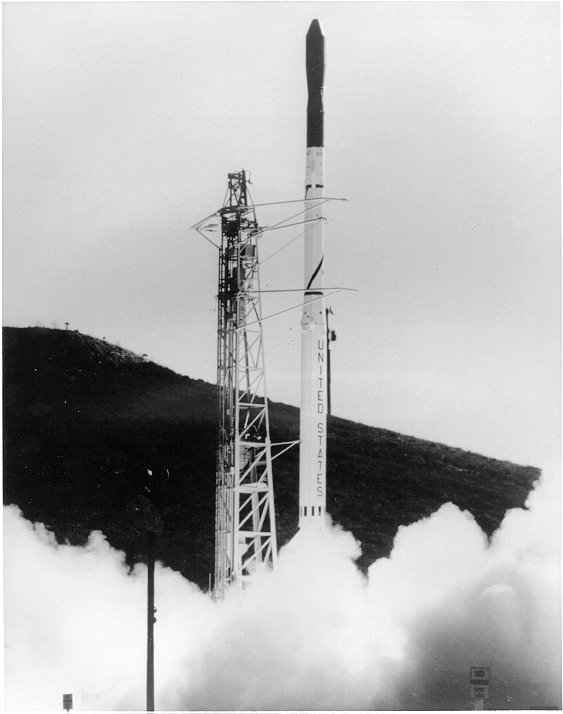
About the Scout X-4
Scout X-4
The Scout X-4 was an American small-satellite launch vehicle developed and operated by NASA, serving as one of the primary configurations in the long-running Scout rocket family manufactured by Chance Vought (later LTV Aerospace). A four-stage, all-solid-propellant rocket, it represented a mature and refined iteration of the Scout design, optimized for reliably delivering lightweight scientific payloads into low Earth orbit. Standing 25 meters tall with a diameter of 1.01 meters, the vehicle was compact and relatively economical by the standards of the era, filling an essential niche for small research satellites that did not require the heavy-lift capability of larger boosters.
Development and Role
The Scout family emerged in the late 1950s as the United States sought an affordable, responsive launcher for modest scientific and military payloads. The X-4 variant refined the earlier Scout configurations and was active during a particularly productive period of early space science, flying missions between 1963 and 1965. Its all-solid-propellant design simplified operations and reduced turnaround times compared to liquid-fueled alternatives, making it attractive to a wide range of institutional customers. Launch operations took place primarily from Wallops Flight Facility in Virginia, with some missions conducted from Vandenberg Air Force Base in California and, notably, international facilities in support of cooperative programs.
Flight Record
Across its operational period, the Scout X-4 compiled a strong record of 12 tracked flights, of which 11 were successful and one resulted in a failure or partial failure. This reliability made it a trusted workhorse for scientific satellite deployment, capable of lifting approximately 103 kilograms to low Earth orbit — modest by later standards, but well suited to the compact instrument packages of 1960s space science.
The vehicle's customer base reflected the breadth of scientific interest in orbital research during this era. NASA was the dominant operator, using the Scout X-4 to support its Explorer and Beacon Explorer programs. The United States Air Force contributed military and dual-use science missions such as the Solrad 8 solar radiation monitoring satellite. International cooperation was a hallmark of the X-4's career: the National Center of Space Research (France's CNES predecessor body) and the National Research Council of Canada both flew payloads aboard the vehicle, underscoring its role in early multilateral space science.
Notable Missions
Among the most significant flights in the X-4 record were San Marco 1, which made Italy one of the first nations to launch a satellite and was itself conducted from a sea-based platform off the Kenyan coast, and FR-1, a Franco-American ionospheric research satellite. The paired Explorer 24 and Explorer 25 mission demonstrated the vehicle's ability to deploy multiple small payloads simultaneously. Explorer 23 contributed to the study of the near-Earth micrometeoroid environment, while Beacon Explorer C advanced ionospheric and geodetic research. These missions collectively spanned atmospheric science, solar physics, and international space cooperation.
Legacy
The Scout X-4 occupies a respected place in spaceflight history as a reliable, internationally utilized small-lift launcher of the early Space Age. Its combination of solid-propellant simplicity, reasonable payload capacity, and strong mission success rate established the credibility of the broader Scout family, which would continue flying in evolved forms well into the 1990s.
- Dec 06, 1965Scout X-4 | FR-1Success
- Nov 19, 1965Scout X-4 | Solrad 8Success
- Apr 29, 1965Scout X-4 | Beacon Explorer CSuccess
- Dec 15, 1964Scout X-4 | San Marco 1Success
- Nov 21, 1964Scout X-4 | Explorer 24 & 25Success
- Nov 06, 1964Scout X-4 | Explorer 23Success
- Oct 10, 1964Scout X-4 | Beacon Explorer BSuccess
- Aug 25, 1964Scout X-4 | Explorer 20Success
- Jun 25, 1964Scout X-4 | ESRSFailure
- Jun 04, 1964Scout X-4 | Transit VCSuccess
- Dec 19, 1963Scout X-4 | Explorer 19Success
- Jun 28, 1963Scout X-4 | GRSSuccess