Scout X-1
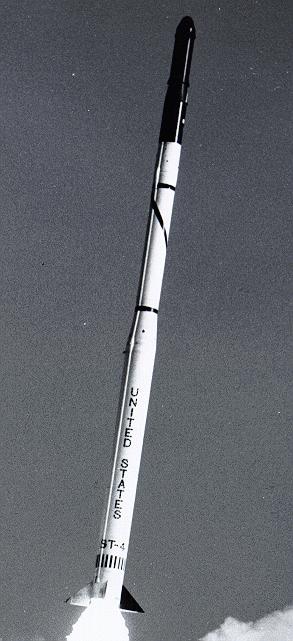
About the Scout X-1
Scout X-1
The Scout X-1 was an American small-satellite orbital launch vehicle developed by Chance Vought Corporation for NASA, representing the earliest operational configuration of the Scout rocket family. Standing 25 meters tall with a diameter of 1.01 meters, it was one of the most slender and compact orbital launch vehicles of its era, designed to provide the United States with an economical, solid-fueled means of placing small scientific payloads into low Earth orbit.
Design and Capability
Scout was notable for being the first all-solid-propellant launch vehicle to achieve orbit, a distinction that set it apart from the large liquid-fueled rockets dominating the early Space Age. The X-1 variant, as the inaugural production configuration, established the baseline four-stage solid-motor architecture that would define the Scout family for decades. Its payload capacity to low Earth orbit stood at 59 kilograms, placing it firmly in the small-satellite category but sufficient for the compact scientific instruments of the period. Launches were conducted from NASA Wallops Flight Facility in Virginia, making it one of the few orbital vehicles associated with that range during the early 1960s.
Operational History
The Scout X-1 was active from 1960 to 1961, a brief but historically significant window during which it accumulated six tracked flights — three successful and three resulting in failure or partial success. This reliability record reflects the inherent difficulties of qualifying an entirely new propulsion approach during the pioneering years of spaceflight, and early solid-motor performance and stage-separation technology presented genuine engineering challenges.
NASA was the primary customer for the vehicle throughout its service life, using it to support a range of scientific and experimental missions. Among the payloads flown were Explorer 9 and Explorer 13, members of NASA's storied Explorer program dedicated to in-situ measurements of the upper atmosphere and space environment. Explorer 9 was a large inflatable sphere designed to measure atmospheric density at high altitude. Other missions in the flight record include NASA S-56, S-55, ST-2, and P-21, representing a mix of atmospheric, meteoroid, and technology demonstration objectives typical of early NASA science programs.
Legacy
Although the X-1 variant itself had a short operational life, it laid essential groundwork for the larger and more capable Scout configurations — including the Scout X-2, X-3, and eventually the long-lived Scout D and Scout G variants — that would continue flying into the 1990s. The vehicle demonstrated that solid propellants could be reliably applied to orbital missions, influencing small-launch-vehicle design philosophy well beyond the Scout program itself.
The Scout X-1 occupies a meaningful place in spaceflight history as the trailblazing form of a rocket that served American science for over three decades, delivering modest but scientifically valuable payloads at a time when every successful orbit was a hard-won achievement.