Scout D-1
About the Scout D-1
Scout D-1
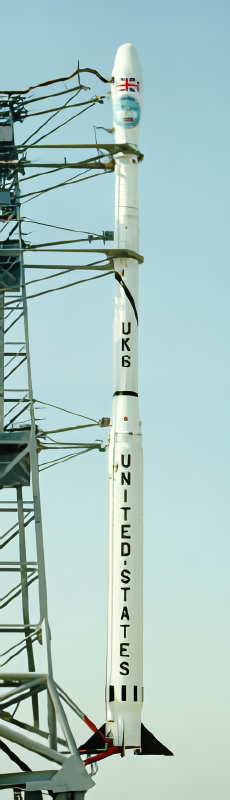
The Scout D-1 was an American solid-fueled orbital launch vehicle developed and operated by Vought Corporation (later LTV Aerospace) on behalf of NASA. A member of the long-running Scout family, the D-1 represented a mature, refined iteration of a line that dates back to the early 1960s, when Scout became one of the first all-solid-propellant rockets to achieve orbital flight. Lightweight, relatively low-cost, and highly reliable, Scout vehicles occupied a distinct niche in the American launch catalog, dedicated to small scientific and military payloads.
Design and Capability
The Scout D-1 stood 25 meters tall with a diameter of 1.14 meters, making it a slender, compact vehicle by the standards of any era. It was a four-stage rocket, with each stage powered by a solid-propellant motor, a configuration that simplified operations and reduced the infrastructure required at launch. Its capacity to deliver up to 183 kilograms to low Earth orbit placed it firmly in the small-satellite class, well suited to the scientific instruments and experimental spacecraft that constituted its primary manifest.
Operational History
Based on tracked flight data, the Scout D-1 flew 16 missions between 1972 and 1983, achieving a perfect success record across all tracked launches — a notable achievement for any launch vehicle. Primary launch operations were conducted from Wallops Flight Facility in Virginia and Vandenberg Air Force Base in California, with additional launches taking place from the San Marco Platform off the coast of Kenya, an Italian-operated equatorial launch site that offered advantageous orbital insertion geometry for certain payloads.
The vehicle served a diverse range of customers. NASA was the dominant user, flying a broad spectrum of scientific missions aboard the D-1. The United States Air Force employed it for navigation and military research satellites. International customers included the Science and Engineering Research Council of the United Kingdom, the Italian Space Agency, and the European Space Research Organisation, reflecting the Scout's reputation as a dependable ride for allied scientific programs.
Notable Missions
Among the D-1's most significant flights were several that left a lasting mark on Earth science and atmospheric research. The SAGE (Stratospheric Aerosol and Gas Experiment) mission advanced understanding of the stratosphere and ozone layer. HCMM (Heat Capacity Mapping Mission) contributed to early remote-sensing science. Ariel 6, launched for the United Kingdom, continued a productive series of British scientific satellites. HILAT served U.S. Air Force research into high-latitude ionospheric phenomena, while TIP 3 and Transat O-11 supported military navigation development programs.
Legacy
The Scout D-1 exemplifies the role that small, reliable launch vehicles play in enabling scientific discovery. Its decade-plus of operation bridged an important era in satellite technology, carrying instruments that contributed to atmospheric science, geodesy, and space physics. The Scout family as a whole demonstrated that solid-propellant rockets could be both versatile and consistently dependable, a lesson that continues to inform the design of small-launch vehicles to the present day.
- Jun 27, 1983Scout D-1 | HILATSuccess
- Jun 02, 1979Scout D-1 | Ariel 6Success
- Feb 18, 1979Scout D-1 | SAGESuccess
- Apr 26, 1978Scout D-1 | HCMMSuccess
- Oct 28, 1977Scout D-1 | Transat O-11Success
- Sep 01, 1976Scout D-1 | TIP 3Success
- Jun 18, 1976Scout D-1 | GP-ASuccess
- Oct 12, 1975Scout D-1 | TIP 2Success
- Aug 30, 1974Scout D-1 | ANSSuccess
- Jul 16, 1974Scout D-1 | Aeros 2Success
- Mar 09, 1974Scout D-1 | MirandaSuccess
- Feb 18, 1974Scout D-1 | San Marco 4Success
- Dec 16, 1972Scout D-1 | Aeros 1Success
- Nov 22, 1972Scout D-1 | ESRO 4Success
- Nov 15, 1972Scout D-1 | SAS 2Success
- Aug 13, 1972Scout D-1 | Explorer 46Success