Scout B
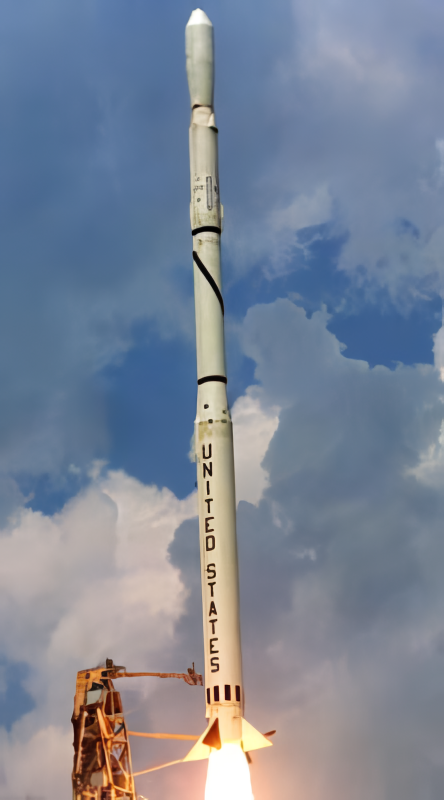
About the Scout B
Scout B
The Scout B was an American small-payload orbital launch vehicle developed and operated by NASA's Langley Research Center, manufactured by Vought (later LTV Aerospace). It was one of several progressive variants of the Scout (Solid Controlled Orbital Utility Test) rocket family, which served as the United States' primary light-lift solid-fuel launcher throughout much of the 1960s and 1970s. Standing 25 meters tall with a diameter of 1.01 meters, Scout B was a slender, all-solid four-stage vehicle capable of delivering up to 143 kilograms to low Earth orbit.
Development and Role
The Scout family was conceived to provide an economical, reliable means of placing small scientific satellites into orbit without the complexity and cost of larger liquid-fueled rockets. The B variant represented an incremental improvement over the original Scout design, incorporating uprated motors to increase payload capacity. Its compact size and solid-propellant stages made it well-suited to operations from multiple launch facilities, including NASA's Wallops Flight Facility in Virginia and the San Marco platform off the coast of Kenya — the latter enabling equatorial launches.
Flight History
Based on tracked flight data, the Scout B flew 23 missions between 1965 and 1971, achieving a strong reliability record of 21 successes against 2 failures or partial failures. This success rate reflected both the maturity of the Scout design by the time the B variant entered service and the rigorous quality controls maintained across the program.
The vehicle's customer manifest was notably international, a distinction that set the Scout program apart from many of its contemporaries. While NASA and the United States Air Force were the primary domestic customers, the European Space Research Organisation (ESRO), the German Aerospace Center (DLR), and the Italian Space Agency (ASI) all flew payloads aboard Scout B — underscoring its importance as an early vehicle for international scientific cooperation in space.
Notable Missions
Among the most significant missions carried by Scout B was Uhuru (also known as Explorer 42), launched from the San Marco platform in 1970. Uhuru became the world's first satellite dedicated entirely to X-ray astronomy, opening an entirely new observational window on the universe. The San Marco 3 mission similarly made use of the equatorial launch site to study atmospheric density near the equator.
Other notable flights included Solrad 10, part of the Naval Research Laboratory's program to monitor solar X-ray emissions, OFO (Orbiting Frog Otolith), a NASA biological research satellite, and SSS 1 (Spacecraft Charging at High Altitudes), which investigated spacecraft-plasma interactions. The BIC (Bremsstrahlung Investigation in the Corona) mission reflected the vehicle's sustained role in solar physics research.
Legacy
The Scout B occupies a respected place in spaceflight history as a dependable workhorse of the early space age. Its blend of simplicity, reliability, and affordability made it an accessible platform for a wide range of scientific disciplines — from atmospheric science to X-ray astronomy — and helped foster the participation of international partners in space research during a formative period in the field.
- Nov 15, 1971Scout B | SSS 1Success
- Sep 20, 1971Scout B | BICSuccess
- Jul 08, 1971Scout B | Solrad 10Success
- Apr 24, 1971Scout B | San Marco 3Success
- Dec 12, 1970Scout B | UhuruSuccess
- Nov 09, 1970Scout B | OFOSuccess
- Nov 08, 1969Scout B | AzurSuccess
- Oct 01, 1969Scout B | ESRO 1B (Boreas)Success
- Oct 03, 1968Scout B | ESRO 1A (Aurorae)Success
- Aug 22, 1968Scout B | RAM C-2Success
- Aug 08, 1968Scout B | Explorer 39Success
- May 17, 1968Scout B | ESRO 2BSuccess
- Mar 05, 1968Scout B | Explorer 37Success
- Dec 05, 1967Scout B | OV3-6Success
- Oct 19, 1967Scout B | RAM C-1Success
- May 30, 1967Scout B | ESRO 2AFailure
- Apr 26, 1967Scout B | San Marco 2Success
- Jan 31, 1967Scout B | OV3-5Failure
- Oct 28, 1966Scout B | OV3-2Success
- Aug 04, 1966Scout B | OV3-3Success
- Jun 10, 1966Scout B | OV3-4Success
- Apr 22, 1966Scout B | OV3-1Success
- Aug 10, 1965Scout B | SEVSuccess