Saturn IB
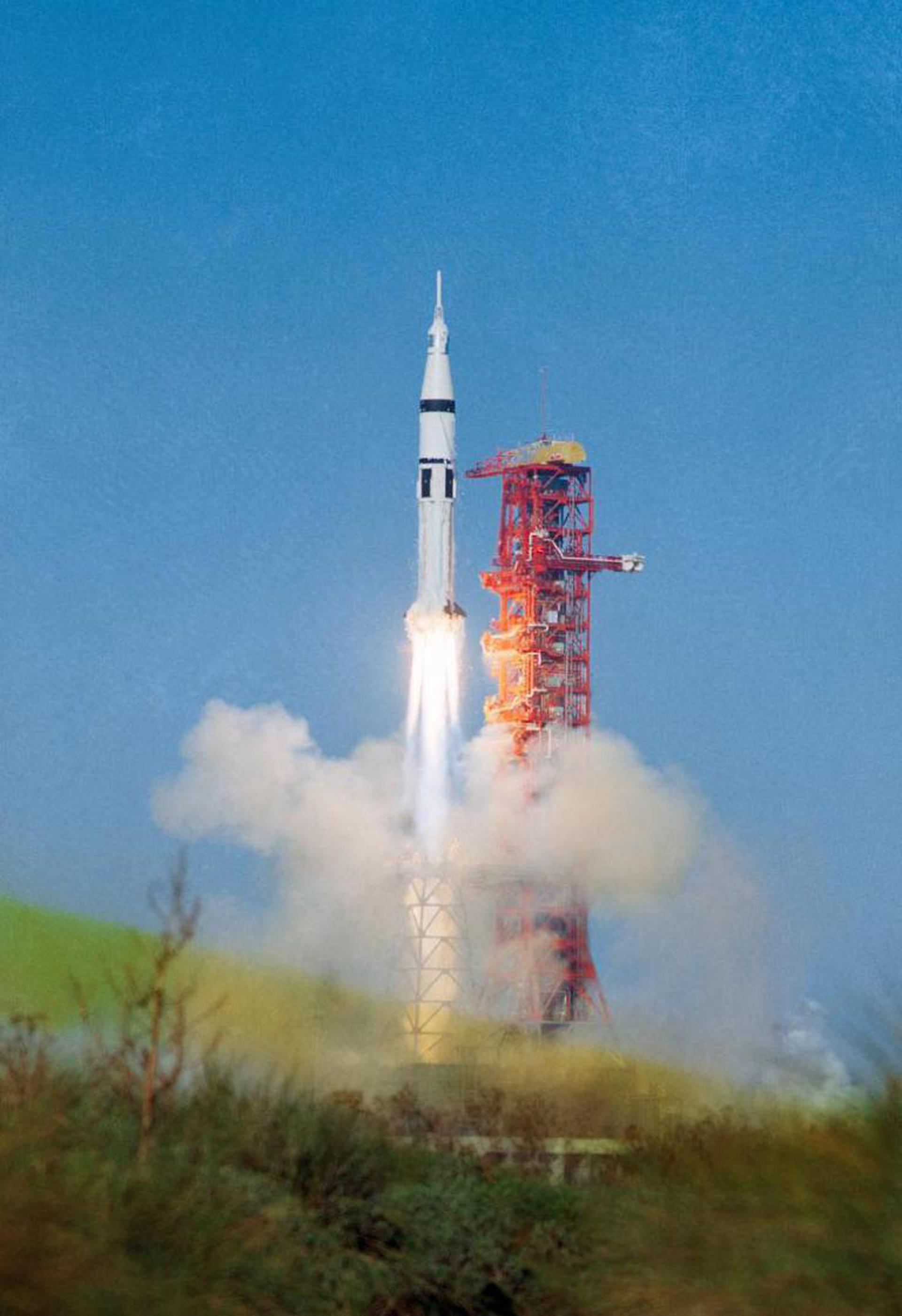
About the Saturn IB
Saturn IB
The Saturn IB was an American orbital launch vehicle developed and operated by the National Aeronautics and Space Administration (NASA), serving as a mid-range member of the Saturn rocket family. Manufactured under the direction of NASA's Marshall Space Flight Center, it was designed to carry crewed and uncrewed Apollo spacecraft into Earth orbit without requiring the full power of the larger Saturn V. Standing 43.2 metres tall with a diameter of 6.61 metres, the Saturn IB could deliver up to 21,000 kilograms to low Earth orbit, making it well suited for missions that did not require a lunar trajectory.
The vehicle retained the first stage originally developed for the Saturn I program, clustering eight engines to generate its considerable liftoff thrust, while its upper stage — the S-IVB — was the same unit flown atop the Saturn V, burning liquid hydrogen and liquid oxygen. This commonality with the larger rocket simplified manufacturing and crew training, and the S-IVB's restartable engine gave mission planners meaningful flexibility in orbit insertion.
Operational History
Our flight record covers 10 Saturn IB launches between 1966 and 1975, reflecting a strong but selective operational tempo. Of those flights, 9 were fully successful, with one resulting in a failure or partial failure — a remarkably high reliability rate for a rocket of its era and complexity.
The Saturn IB opened its career with developmental missions, most notably Apollo 5 in 1968, which carried the lunar module on its first uncrewed flight test in Earth orbit. That mission was pivotal in validating the spacecraft hardware that would later carry astronauts to the Moon. The following year, Apollo 7 — also launched on a Saturn IB — became the first crewed Apollo mission, restoring NASA's confidence in the program following the tragic Apollo 1 fire. Apollo 7 demonstrated the command and service module's performance across nearly eleven days in orbit.
After a multi-year pause while the Saturn V carried crews to the Moon, the Saturn IB returned to service in support of Skylab, NASA's first space station. It launched the Skylab 2, Skylab 3, and Skylab 4 crews in 1973 and 1974, delivering astronauts for stays of increasing duration as NASA expanded its understanding of long-duration spaceflight. The Skylab 4 crew ultimately spent over 84 days aboard the station, a record at the time.
The Saturn IB's final flight came in 1975 with the Apollo-Soyuz Test Project, a landmark mission in which an American Apollo spacecraft docked with a Soviet Soyuz in orbit. The mission was as much a diplomatic achievement as a technical one, symbolizing a thaw in Cold War tensions during the era of détente. It also marked the end of the Apollo era and the last flight of any Saturn-family rocket.
Legacy
Across its decade of service, the Saturn IB proved itself a dependable and historically significant vehicle. Every major mission it supported — from the first crewed Apollo flight to the final handshake in orbit — carried outsized importance for American spaceflight. Its role bridging early Apollo development and the post-lunar Skylab program cemented its place as one of the most consequential rockets of the 1960s and 1970s.
- Jul 15, 1975Saturn IB | Apollo-Soyuz Test ProjectSuccess
- Nov 16, 1973Saturn IB | Skylab 4Success
- Jul 28, 1973Saturn IB | Skylab 3Success
- May 25, 1973Saturn IB | Skylab 2Success
- Oct 11, 1968Saturn IB | Apollo 7Success
- Jan 22, 1968Saturn IB | Apollo 5Success
- Jan 27, 1967Saturn IB | Apollo 1 (Failure before launch)Failure
- Aug 25, 1966Saturn IB | Apollo AS-202Success
- Jul 05, 1966Saturn IB | Apollo AS-203Success
- Feb 26, 1966Saturn IB | Apollo AS-201Success