Saturn I
About the Saturn I
Saturn I
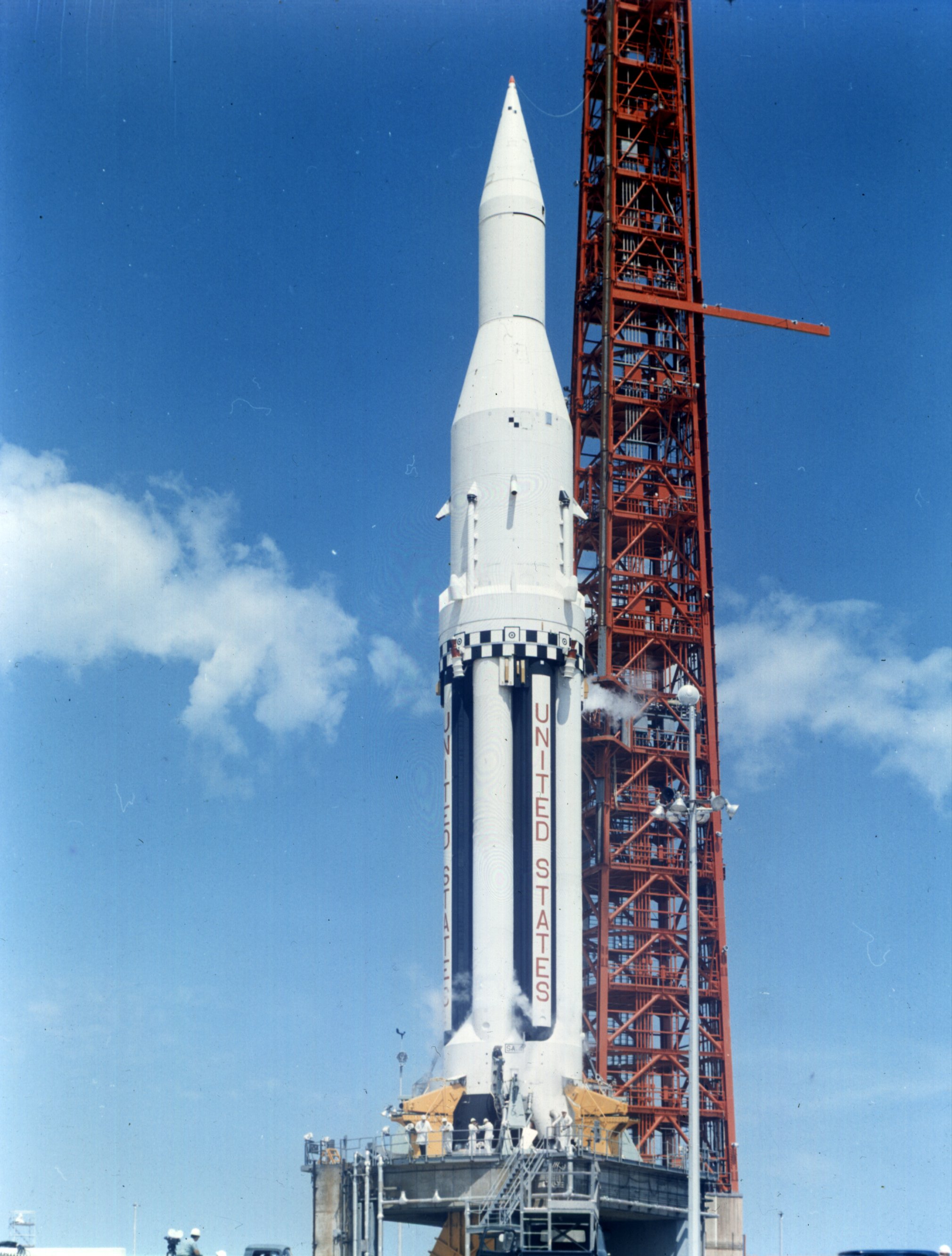
The Saturn I was an American orbital launch vehicle developed and operated by the National Aeronautics and Space Administration (NASA), serving as the United States' first large booster and a foundational element of the nation's human spaceflight program during the early 1960s. Manufactured under the direction of NASA's Marshall Space Flight Center, with Chrysler as the primary contractor for the first stage, the Saturn I represented a significant leap in American launch capability and laid the technical groundwork for the more powerful vehicles that would follow.
Design and Capability
Standing 55 meters tall with a diameter of 6.6 meters, the Saturn I was a substantial vehicle for its era. It was capable of delivering 9,100 kilograms to low Earth orbit, a figure that far exceeded contemporary American boosters. The first stage, designated S-I, was famously constructed by clustering eight Redstone-derived engines around a central Jupiter propellant tank — an arrangement that earned it the nickname "cluster's last stand" among engineers skeptical of the approach. The second stage, the S-IV, used liquid hydrogen and liquid oxygen, making it an early operational demonstration of cryogenic upper-stage propulsion.
Operational History
Our flight record covers 10 launches conducted between 1961 and 1965, all of which were successful — a remarkable achievement for a vehicle of such ambition and novelty. The Saturn I flew exclusively on behalf of NASA, reflecting its role as a purpose-built national asset rather than a commercial launcher.
Early missions in the program, including Saturn-SA 5, Saturn-SA 6, and Saturn-SA 7, were used to test the vehicle's systems and demonstrate its payload capacity, often carrying boilerplate Apollo spacecraft hardware. These flights proved the structural and propulsive integrity of the Saturn concept and built operator confidence ahead of crewed missions.
The final three tracked missions — Pegasus 1, Pegasus 2, and Pegasus 3 — represented the Saturn I's most scientifically significant contribution. The Pegasus satellites were large, wing-like spacecraft designed to measure the flux of micrometeoroids in near-Earth space, gathering data critical to understanding the hazards that astronauts and spacecraft would face on missions to the Moon. Each Pegasus payload was carried alongside an Apollo boilerplate capsule, allowing NASA to simultaneously test spacecraft hardware and conduct scientific observations.
Legacy
The Saturn I's perfect launch record across ten flights made it one of the most reliable new launch vehicles of its generation. It demonstrated that large clustered-engine first stages were a viable engineering approach and validated the use of liquid hydrogen in upper stages — both lessons that directly informed the design of the Saturn IB and the iconic Saturn V. While the Saturn I itself was retired after 1965 as more capable successors entered service, its operational success provided NASA with the confidence and technical heritage necessary to pursue the Apollo lunar landing program. It remains a landmark vehicle in the history of spaceflight, representing the moment American heavy-lift capability transitioned from aspiration to proven reality.
- Jul 30, 1965Saturn I | Pegasus 3Success
- May 25, 1965Saturn I | Pegasus 2Success
- Feb 16, 1965Saturn I | Pegasus 1Success
- Sep 18, 1964Saturn I | Saturn-SA 7Success
- May 28, 1964Saturn I | Saturn-SA 6Success
- Jan 29, 1964Saturn I | Saturn SA-5Success
- Mar 28, 1963Saturn I | Saturn SA-4Success
- Nov 16, 1962Saturn I | Saturn SA-3Success
- Apr 25, 1962Saturn I | Saturn SA-2Success
- Oct 27, 1961Saturn I | Saturn SA-1Success