Rokot/Briz-KM
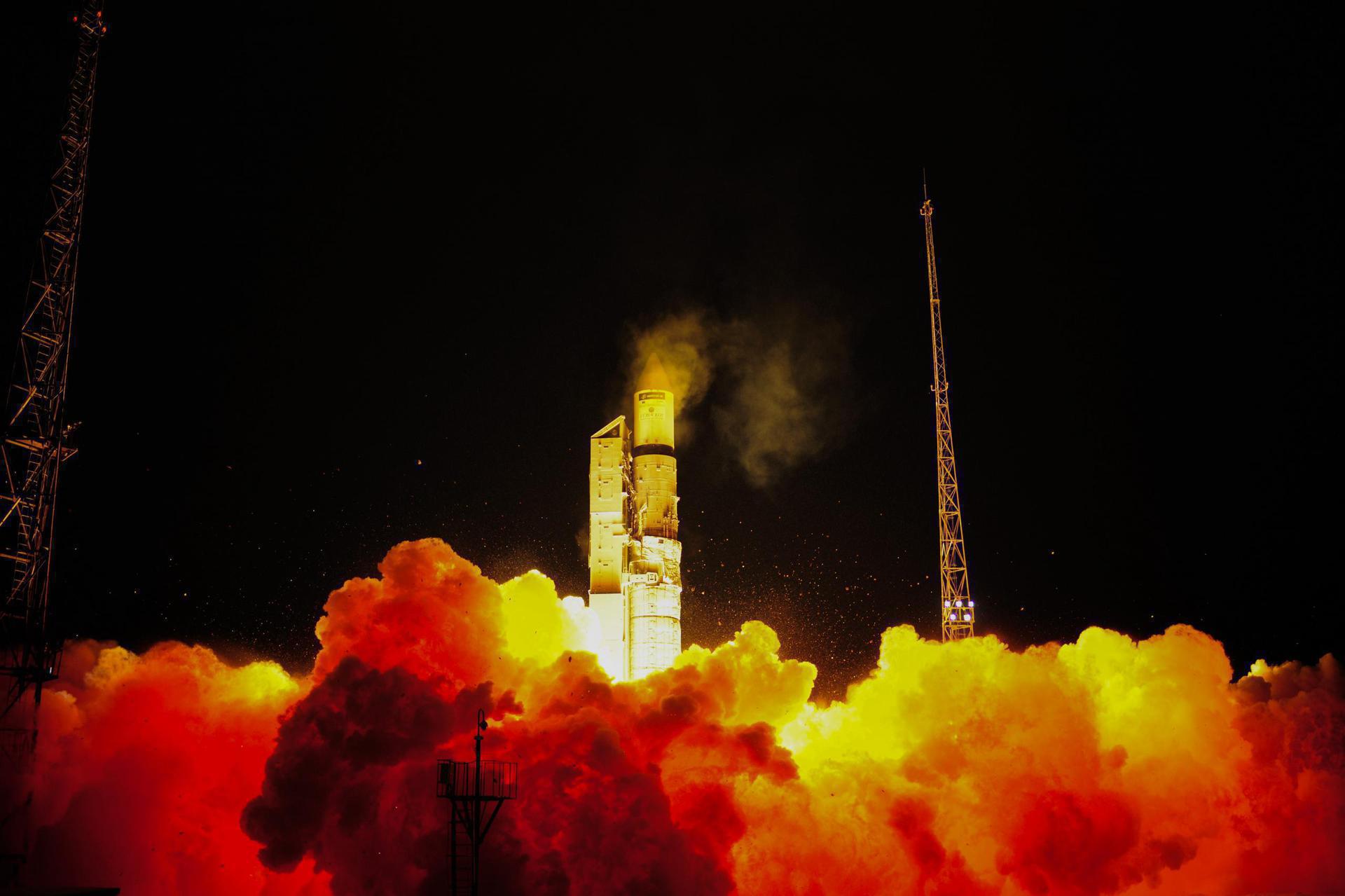
About the Rokot/Briz-KM
Rokot/Briz-KM
The Rokot/Briz-KM is a Russian orbital launch vehicle derived from the Soviet-era RS-18 (SS-19 *Stiletto*) intercontinental ballistic missile, adapted for commercial and government satellite launches. It is operated by Eurockot Launch Services, a joint venture between Khrunichev State Research and Production Space Center and Airbus Defence and Space, and has also served the Russian Space Forces and Russian Aerospace Defence Forces as a dedicated smallsat launcher.
Origins and Configuration
Rokot is a three-stage rocket. The first two stages are taken directly from the retired RS-18 ICBM, while the Briz-KM upper stage — a restartable, storable-propellant stage developed by Khrunichev — provides the precision orbital insertion capability that makes the vehicle suitable for commercial and scientific missions. Standing 29 metres tall with a diameter of 2.5 metres, Rokot is a compact vehicle by orbital launch standards, reflecting its ballistic missile heritage. It is capable of delivering 1,850 kg to low Earth orbit.
The vehicle launches from Plesetsk Cosmodrome in northwestern Russia, the primary site for Russian military space operations and one of the most active launch facilities in the world.
Flight Record
Our data records 31 tracked flights between 2000 and 2019, of which 28 were successful and 3 resulted in failure or partial failure. This represents a strong but not unblemished record, consistent with a mature small-lift vehicle operating across nearly two decades of service.
The rocket's customer base reflects a dual identity: Eurockot Launch Services brought it to the commercial market, while the Russian Space Forces and Russian Aerospace Defence Forces sustained a steady cadence of government payloads throughout its operational life.
Notable Missions
Among the most prominent recent missions in our record is the deployment of the Gonets-M communications satellites alongside the experimental Blits-M geodetic reflector, illustrating the vehicle's ability to carry multiple smallsats on a single flight. The Geo-IK-2 geodetic spacecraft series (including Kosmos 2517 and Kosmos 2540) represents high-priority Russian government science missions, as does the Rodnik (Strela-3M) military communications constellation, with triplets such as Kosmos 2530, 2531, and 2532 delivered in a single launch.
On the commercial side, Rokot/Briz-KM played a significant role in the European Copernicus Earth observation programme, launching Sentinel-5P in 2017 and Sentinel-3B in 2018 for the European Space Agency. These high-profile ESA missions underscored the vehicle's precision and reliability for sensitive scientific payloads requiring exact sun-synchronous orbits.
Legacy
Rokot/Briz-KM occupies a distinctive place in post-Soviet spaceflight history as one of the most successful examples of ICBM-to-launch-vehicle conversion, a concept that made surplus ballistic missile stockpiles commercially viable. Its retirement after 2019 coincided with shifting geopolitical circumstances and Russia's broader push toward next-generation small-lift vehicles. The rocket's nearly two decades of service, spanning Russian military constellations and internationally recognised Earth observation programmes, cement its record as a reliable workhorse of the small-satellite launch era.
- Dec 26, 2019Rokot/Briz-KM | Gonets-M24, Gonets-M25, Gonets-M26 & Blits-MSuccess
- Aug 30, 2019Rokot / Briz-KM | Geo-IK-2 N13L (Kosmos 2540)Success
- Nov 30, 2018Rokot / Briz-KM | 3 x Rodnik (Kosmos 2530, 2531, 2532)Success
- Apr 25, 2018Rokot / Briz-KM | Sentinel-3BSuccess
- Oct 13, 2017Rokot / Briz-KM | Sentinel-5PSuccess
- Jun 04, 2016Rokot/Briz-KM | Geo-IK-2 No.12L (Kosmos 2517)Success
- Feb 16, 2016Rokot / Briz-KM | Sentinel-3ASuccess
- Sep 23, 2015Rokot / Briz-KM | 3 x Strela-3M (Kosmos 2507, Kosmos 2508, Kosmos 2509)Success
- Mar 31, 2015Rokot / Briz-KM | Gonets M-21, Gonets M-22, Gonets M-23, Kosmos 2504Success
- Jul 03, 2014Rokot / Briz-KM | Gonets-M18, Gonets-M19, Gonets-M20Success
- May 23, 2014Rokot / Briz-KM | 3x Strela-3M (Kosmos 2496, Kosmos 2497, Kosmos 2498) & Kosmos 2499Success
- Dec 25, 2013Rokot / Briz-KM | 3 x Strela-3M (Kosmos-2488, Kosmos-2489, Kosmos-2490) & Kosmos-2491Success
- Nov 22, 2013Rokot / Briz-KM | Swarm A, B, CSuccess
- Sep 11, 2013Rokot / Briz-KM | Gonets M-14, Gonets M-16, Gonets M-17Success
- Jan 15, 2013Rokot / Briz-KM | 3 x Strela-3M (Kosmos-2482, Kosmos-2483, Kosmos-2484)Failure
- Jul 28, 2012Rokot / Briz-KM | Gonets M-13, Gonets M-15, Strela-3M (Kosmos-2481) & Yubileyniy 2 (MiR)Success
- Feb 01, 2011Rokot/Briz-KM | Geo-IK-2 No.11L (Kosmos 2470)Failure
- Sep 08, 2010Rokot / Briz-KM | Gonets-M12 & 2 x Strela-3 (Kosmos 2467, Kosmos 2468)Success
- Jun 02, 2010Rokot / Briz-KM | SERVIS-2Success
- Nov 02, 2009Rokot / Briz-KM | SMOSSuccess
- Jul 06, 2009Rokot / Briz-KM | Strela-3 140 & 141Success
- Mar 17, 2009Rokot / Briz-KM | GOCESuccess
- May 23, 2008Rokot / Briz-KM | Strela-3 137 to 139Success
- Jul 28, 2006Rokot / Briz-KM | Arirang-2Success
- Oct 08, 2005Rokot / Briz-KM | CRYOSATFailure
- Aug 26, 2005Rokot / Briz-KM | Monitor-E No. 1Success
- Oct 30, 2003Rokot / Briz-KM | SERVIS-1Success
- Jun 30, 2003Rokot / Briz-KM | MimosaSuccess
- Jun 20, 2002Rokot / Briz-KM | Iridium 97 & 98Success
- Mar 17, 2002Rokot / Briz-KM | GRACESuccess
- May 16, 2000Rokot / Briz-KM | SimSat 1 & 2Success