R-36O 8K69M
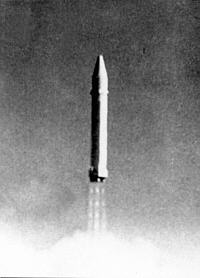
About the R-36O 8K69M
R-36O 8K69M
The R-36O 8K69M is a Soviet orbital launch vehicle derived from the R-36 intercontinental ballistic missile family, operated exclusively by the Soviet Space Program. Developed by the Yuzhnoye Design Bureau in Ukraine (then part of the USSR), it represents one of the most strategically significant and technically unconventional rockets of the Cold War era.
Background and Design
The R-36O — where "O" stands for *orbitalnoye*, meaning "orbital" — was specifically developed to carry the Fractional Orbital Bombardment System (FOBS), a weapons delivery concept intended to place a nuclear warhead into a low Earth orbit before de-orbiting it onto a target. Unlike a conventional ballistic missile trajectory, this approach allowed a warhead to approach its target from any direction and with reduced radar warning time. The system was designed to circumvent early-warning defense networks, particularly those oriented toward polar approaches from the north.
Standing 35 meters tall with a diameter of 3 meters, the 8K69M variant is a slender, purpose-built vehicle well-suited to the demands of fractional orbital insertion. Its configuration reflects the engineering priorities of the Soviet strategic rocket forces during the late 1960s and early 1970s.
Operational History
In our tracked flight record, the R-36O 8K69M conducted 2 flights between 1970 and 1971, both recorded as successful. Its sole customer was the Soviet Space Program, reflecting the vehicle's purely state-directed, military-strategic mission. The two most recently catalogued missions — OGCh 24 and OGCh 23 — carried payloads designated *OGCh*, the Russian abbreviation for *Orbitalnaуa Golovnaya Chast*, or "orbital warhead section." These designations underscore the vehicle's role as a testbed and operational platform for FOBS-related hardware.
Launches were conducted from Baikonur Cosmodrome in Kazakhstan, the primary Soviet launch facility and the hub of most large-scale Soviet space and strategic rocket activity throughout this period.
Historical Significance
The R-36O program occupied a unique and controversial position in Cold War arms competition. The FOBS concept it enabled prompted serious concern among Western defense planners and ultimately contributed to the negotiations that shaped the SALT I arms control agreements of 1972. While not a conventional satellite launcher, the 8K69M variant demonstrated the Soviet Union's capacity to blur the line between ballistic missile technology and orbital spaceflight in strategically purposeful ways.
The broader R-36 family — which also produced heavy satellite launch vehicles and later evolved into the powerful R-36M (known in the West as the SS-18 "Satan") — stands as one of the most consequential missile lineages in history. The 8K69M variant, however, remains notable specifically for its role in operationalizing the fractional orbital delivery concept, a capability that had no direct Western equivalent during its active service years.
With only a brief operational window spanning 1970 to 1971 in our records, the R-36O 8K69M represents a narrow but historically meaningful chapter in both launch vehicle history and Cold War strategic competition.