R-36O 8K69
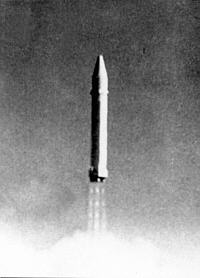
About the R-36O 8K69
R-36O 8K69
The R-36O 8K69 is a Soviet orbital launch vehicle derived from the R-36 intercontinental ballistic missile, operated exclusively by the Soviet Space Program. Developed by the Yuzhnoye Design Bureau in Ukraine, the vehicle was specifically configured to support the Fractional Orbital Bombardment System (FOBS), a Cold War-era strategic concept designed to place a nuclear warhead into a low orbital trajectory and de-orbit it onto a target before completing a full revolution of Earth — thereby evading early-warning radar systems positioned to detect conventional ICBM trajectories.
Standing 32.6 meters tall with a diameter of 3 meters, the 8K69 is a two-stage rocket sharing its core lineage with the broader R-36 family. Launches were conducted from Baikonur Cosmodrome in what is now Kazakhstan, the primary Soviet launch facility throughout the Space Race era.
Operational History
According to tracked flight records, the R-36O 8K69 flew 21 missions between 1965 and 1970, of which 19 were successful and 2 resulted in failure or partial failure. This represents a reliability rate consistent with the operational demands of a highly specialized military program conducted largely in secrecy. The vehicle's activity window places it squarely within the most intense period of superpower strategic competition, when both the United States and Soviet Union were aggressively developing novel delivery systems to circumvent each other's defenses.
The payload carried by the 8K69 was designated OGCh — a Russian abbreviation referring to the orbital warhead section, the maneuvering re-entry vehicle at the heart of the FOBS concept. Recent missions logged in flight records include OGCh 17 through OGCh 22, reflecting the sequential test and operational cadence of the program during its final years of activity.
Strategic Context
The FOBS program represented a significant departure from conventional ballistic missile doctrine. Because the warhead traveled only a fractional orbit rather than a standard suborbital arc, it approached targets from unexpected directions and at lower altitudes, dramatically compressing detection and response times. The system was sufficiently alarming to Western defense planners that it was later addressed in arms control negotiations, and FOBS-type systems were ultimately restricted under the SALT II framework agreed upon in 1979 — nearly a decade after the 8K69 had concluded its flight campaign.
Legacy
The R-36O 8K69 occupies a distinctive place in launch vehicle history as one of the very few orbital vehicles developed primarily as a weapons delivery system rather than a scientific or commercial platform. Its missions do not carry the satellite designations typical of reconnaissance or communications payloads; instead, the OGCh series reflects the blurred boundary between spaceflight capability and nuclear strategy that defined much of early Soviet space activity. The program demonstrated that orbital mechanics themselves could be weaponized, a concept that shaped strategic thinking on both sides of the Iron Curtain for years after the 8K69's final flight.
- Jul 28, 1970R-36O 8K69 | R-36O 8K69 | OGCh 22Success
- Sep 15, 1969R-36O 8K69 | OGCh 21Success
- Oct 02, 1968R-36O 8K69 | OGCh 20Success
- May 27, 1968R-36O 8K69 | OGCh 19Success
- May 20, 1968R-36O 8K69 | OGCh 18Success
- Apr 25, 1968R-36O 8K69 | OGCh 17Success
- Oct 28, 1967R-36O 8K69 | OGCh 16Success
- Oct 18, 1967R-36O 8K69 | OGCh 15Success
- Sep 22, 1967R-36O 8K69 | OGCh 14Success
- Sep 19, 1967R-36O 8K69 | OGCh 13Success
- Aug 08, 1967R-36O 8K69 | OGCh 12Success
- Jul 31, 1967R-36O 8K69 | OGCh 11Success
- Jul 17, 1967R-36O 8K69 | OGCh 10Success
- May 17, 1967R-36O 8K69 | OGCh 9Success
- Mar 22, 1967R-36O 8K69 | OGCh 8Failure
- Jan 25, 1967R-36O 8K69 | OGCh 7Success
- Nov 02, 1966R-36O 8K69 | OGCh 6Failure
- Sep 17, 1966R-36O 8K69 | OGCh 5Success
- May 19, 1966R-36O 8K69 | OGCh 4Success
- Feb 05, 1966R-36O 8K69 | OGCh 2Success
- Dec 16, 1965R-36O 8K69 | OGCh 1Success