Qaem 100
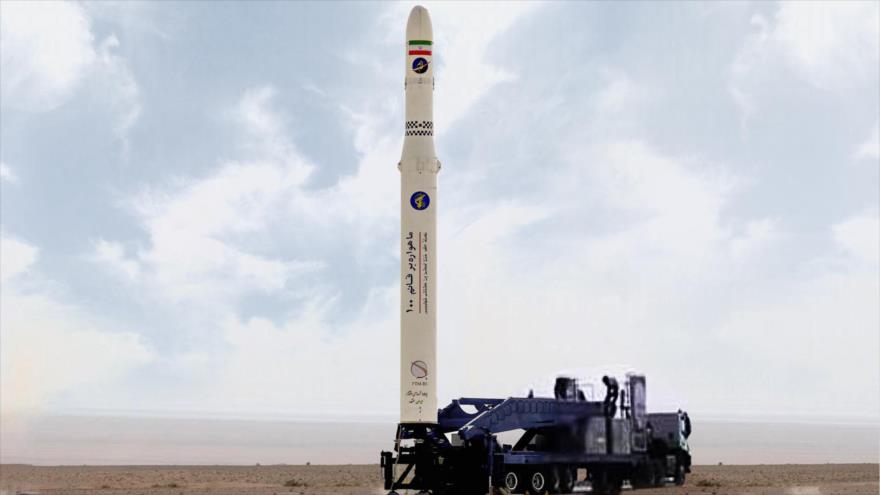
About the Qaem 100
Qaem 100
The Qaem 100 is an Iranian small-satellite launch vehicle operated by the Islamic Revolutionary Guard Corps (IRGC) Aerospace Force. It represents Iran's second indigenously developed orbital rocket family and is notable for being the first Iranian launch vehicle operated directly by the IRGC rather than the civilian Iran Space Agency or the Ministry of Defense. Its emergence marked a significant milestone in Iran's military space program.
Background and Development
The Qaem 100 is a solid-fueled rocket, a design choice that distinguishes it from earlier Iranian orbital vehicles such as the Safir and Qased, which relied on liquid propellants. Solid-fuel motors require less preparation time before launch and are generally easier to store and transport, characteristics considered advantageous for a military operator. The vehicle is capable of delivering approximately 80 kg to low Earth orbit (LEO), placing it firmly in the small-lift category. It launches from sites within Iran and is developed under the broader framework of IRGC efforts to establish an independent, militarily relevant space capability.
Flight History
Based on tracked flight data, the Qaem 100 has conducted three orbital launch attempts between 2023 and 2024, recording two successes and one failure or partial failure. This gives the vehicle a success rate consistent with an early-operational rocket still maturing its reliability profile.
The first tracked mission, Qaem 100 | Soraya, successfully placed the Soraya satellite into orbit in early 2023, representing the IRGC's first confirmed orbital success and drawing significant international attention. The Qaem 100 | Chamran-1 mission followed, and the most recent tracked attempt, Qaem 100 | Nahid-1, rounds out the known manifest. The single failure or partial failure in this record highlights the challenges typical of any launch vehicle in its early operational phase, where hardware and procedures are still being refined through flight experience.
Role and Significance
The Qaem 100's primary customer is the IRGC Aerospace Force, which uses the platform to pursue military and strategic space objectives, including surveillance and intelligence-gathering satellite deployments. The program has attracted scrutiny from Western governments and nonproliferation analysts, who note that the technologies underpinning solid-fueled orbital rockets share engineering heritage with ballistic missile development. Iran has maintained that its space activities are civilian and scientific in character, though the IRGC's direct operational role distinguishes the Qaem 100 program from that framing.
Outlook
With three flights logged and the program still in an early stage, the Qaem 100 is an active and evolving system. Its relatively modest payload capacity to LEO limits it to small satellites, but for the IRGC's stated missions — deploying compact reconnaissance or communications spacecraft — this capability is operationally meaningful. Whether the program will see an upgraded or higher-capacity follow-on vehicle remains to be seen, but the Qaem 100 has already established Iran's IRGC as a functioning spaceflight operator, a status with implications that extend well beyond technical achievement alone.